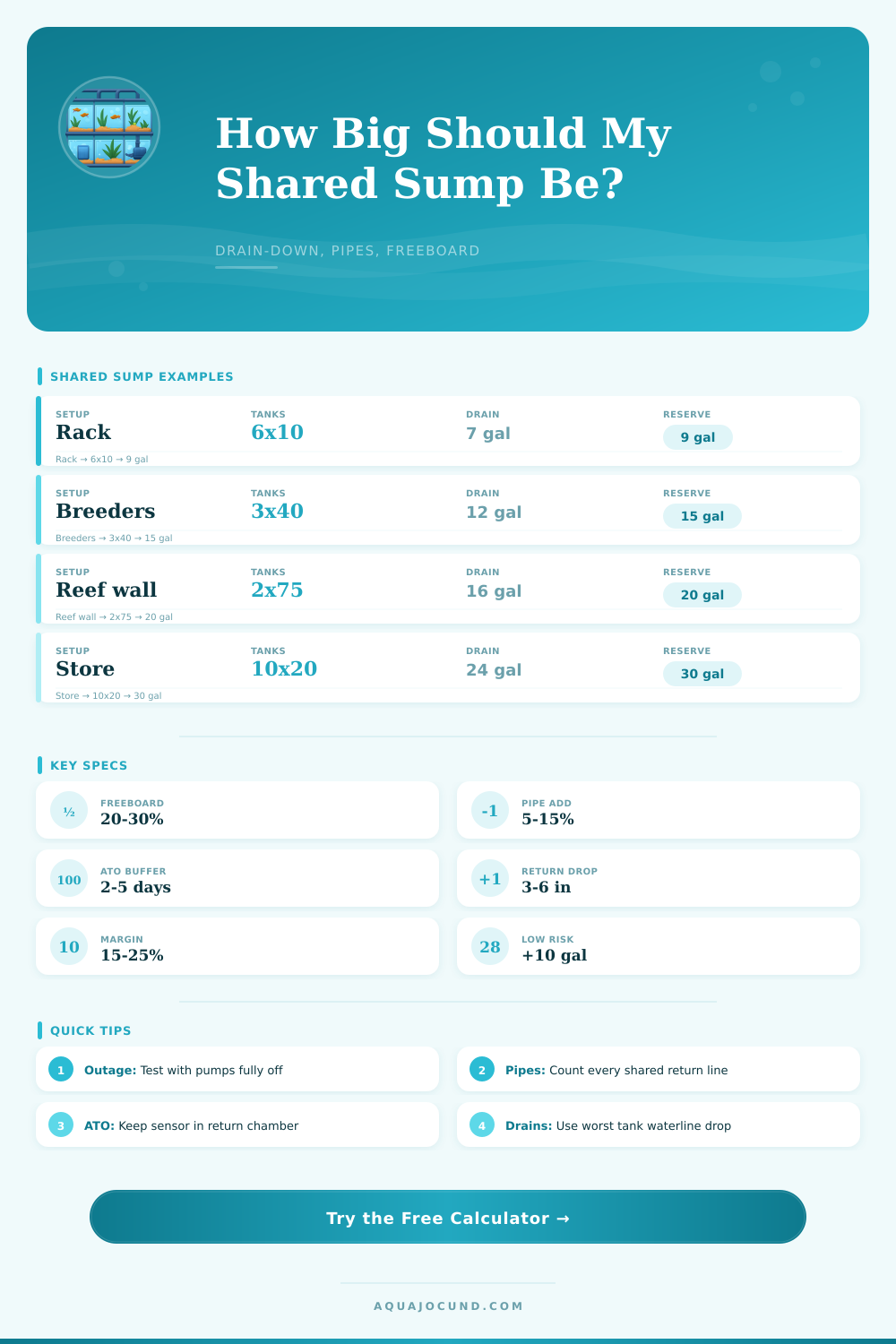
I know that your sump appears large from the exterior so you think “that should be plenty of capacity.” But what if there’s a power outage? Then all those tanks will empty their contents into the same sump simultaneously, before you realize it, the sump could overflow. That’s an error common to multi-tank systems. People underestimates the rate of flow and how little margin exists.
To size a communal sump, you must calculate the real hydraulic reserve required for a worst case scenario. After you input your tank size, the page do the math for you. But what use is a number on the screen if you don’t understand what it means? How much water will be displaced out of your display tanks if the flow are stopped? That’s the point of the calculation. And it’s not just “how many gallons are in all my aquariums?” Total volume isn’t the issue here. The issue is how much volume drops below the waterline while the system is running, moving to wherever the siphonage ends.
How to Size Your Sump Correctly
A half inch difference across multiple large tank is a few gallons of volume that suddenly dissapears out of the system. Add that amount to the volume of water that sits already contained in your overflow boxes and pipes. This is water you can’t see but that needs to be accounted for when the system shut down. Hobbyists often overlook pipe volume because they believe a piece of tubing will hold very little water. A foot-long section of 1″ drain line could be enough to increase your sump considerabley when it’s dumped suddenly. Even shorter lengths of pipe adds noticeable capacity (see table below). Include it as part of your emergency reserve. Remember, each inch of inside diameter multiplies rapidly when connecting four or more tanks.
It’s like constructing a boat but refusing to recognize any leaks even though the water fills the hull. The depth of the pump is how low it sits. Does it have a few inches to go down before turning off? That is another factor to consider different than evaporation buffers. How much usable volume does the sump provide before it shuts down your return pumps during a power outage? You don’t want the return chamber dropping so far that it shuts your return pumps down, that kills all hope of keeping things stable at that point. So again, how much usable volume should the sump has to prevent this?
Another important consideration in telling a good system from an amateur build is free board. Ideally, you should of have at least 20-30% of your total sump volume dedicated to being empty air space over your emergency line. That’s your last defense against all hell breaking loose at once. Lose that and you lose your livestock.
When you put together long drain lines, shallow tanks, and high evaporation rates, the math isn’t kind. Structurally, space for error is not just desirable but necessary. You can use one big sump, or split up capacity into multiple smaller ones. That’s a decision based off how much risk you want to be sharing. A centralized return is easier to plumb, but puts all of your eggs in one basket. Dividing returns spreads out that risk so if one fails it doesn’t take down everything. Each approach also involves a tradeoff between initial cost and how hard it is to maintain.
No matter what aesthetic you prefer the volume requirement won’t change. The shared sump is a kind of insurance policy against chaos. It’s there quietly under your floor when you really need it. And by running your numbers through this tool you stop guessing at capacity. You engineer for resilence. You make sure there’s always someplace safe for water to go when the lights go out. The peace of mind is worth every inch of planned space.