🌱 Moss Coverage Calculator
Estimate aquarium moss mats, starter cups, hardscape coverage, tie points, growth weeks, and trimming intervals for rocks, wood, branches, and custom layouts.
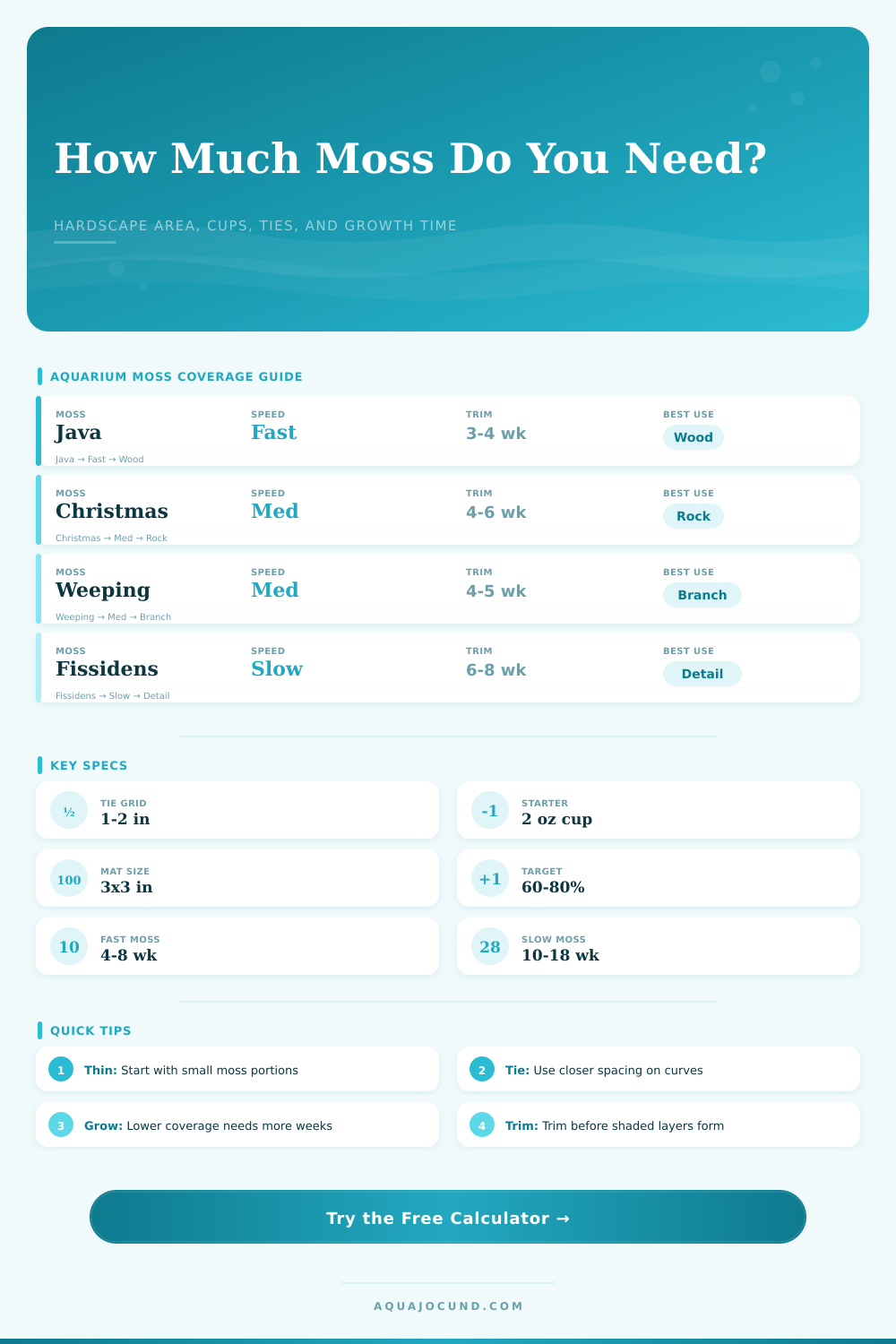
| Moss Type | Relative Growth | Coverage Multiplier | Typical Trim Interval | Best Hardscape Use |
|---|---|---|---|---|
| Java moss | Fast | 1.25 | 3 to 4 weeks | Wood, rocks, beginner moss walls |
| Christmas moss | Medium | 1.00 | 4 to 6 weeks | Flat rock, ledges, branch fans |
| Weeping moss | Medium | 0.95 | 4 to 5 weeks | Driftwood arms and overhangs |
| Flame moss | Medium-slow | 0.85 | 5 to 7 weeks | Upright accents and rock columns |
| Taiwan moss | Medium | 1.05 | 4 to 6 weeks | Fine fronds on visible hardscape |
| Fissidens | Slow | 0.55 | 6 to 8 weeks | Detail stones, roots, foreground accents |
| Riccardia | Slow | 0.50 | 6 to 9 weeks | Cushion growth on small stones |
| Layout Example | Typical Tank | Measured Surface | Starter Cups | Tie Spacing |
|---|---|---|---|---|
| Nano rock cap | 5 gal / 19 L | 20 to 35 sq in / 129 to 226 sq cm | 1 cup | 1.25 to 1.5 in |
| Shrimp driftwood | 10 gal / 38 L | 35 to 60 sq in / 226 to 387 sq cm | 2 cups | 1 to 1.5 in |
| 20 long ledge | 20 gal / 76 L | 55 to 90 sq in / 355 to 581 sq cm | 2 to 3 cups | 1.5 to 2 in |
| 40 breeder rock group | 40 gal / 151 L | 90 to 150 sq in / 581 to 968 sq cm | 4 to 6 cups | 1.5 to 2 in |
| 75 gal branch display | 75 gal / 284 L | 150 to 260 sq in / 968 to 1677 sq cm | 6 to 10 cups | 1 to 1.75 in |
| Attachment Method | Spacing Adjustment | Best Surface | Calculator Effect |
|---|---|---|---|
| Cotton or aquascaping thread | Normal spacing | Rocks, roots, branch forks | Uses entered tie grid directly |
| Fishing line grid | Normal spacing | Wood and rough stone | Uses entered tie grid directly |
| Gel glue dots | About 20% fewer points | Small patches and detail stones | Reduces tie count estimate |
| Sandwiched mesh panel | About 35% fewer points | Moss walls and flat panels | Reduces tie count estimate |
| Starting Coverage | Target Coverage | Fast Moss | Medium Moss | Slow Moss |
|---|---|---|---|---|
| 35% | 70% | 5 to 7 weeks | 7 to 10 weeks | 14 to 18 weeks |
| 45% | 80% | 5 to 8 weeks | 8 to 12 weeks | 16 to 22 weeks |
| 60% | 85% | 4 to 6 weeks | 6 to 9 weeks | 12 to 18 weeks |
| 75% | 90% | 3 to 5 weeks | 5 to 7 weeks | 9 to 14 weeks |
When you buy moss, it’s with the thought that you’ll be filling up an entire landscape. But more times than not, it end up being sparse and thin. That’s because volume isn’t everything… It also require time, density, and surface area.
You don’t need to convert or guess at any coefficients. You simply input the dimensions of your hardscape and let the calculator do all the math for you. From there, it turn your tank limitations into actual material requirements. You will no longer waste money by buying too many starter cups or running out early.
How to Choose the Right Amount of Moss
So what’s the deal? How do you decide what shape to anchor?
Well, if I’m looking at a piece of driftwood that’s cylindrical or irregular in shape, I need to wrap around it and all its branches. A flat rock, however, is just a rectangle, easy to fill out. And these shapes dictates your material needs, which the tool helps you calculate. Because it needs to know the diameter (and visible height) of the wood, the tool asks. Then it can calculates surface area based off these measurements. If you don’t account for the curved nature of the piece, though, you’ll find yourself missing spots along the sides of the wood. You measured the length of it but forgot about circumference, leaving those sides empty.
Then you choose which species of moss you’re growing. Every species of moss will grow at a different rate, which affect how fast it multiplies. Because java moss spreads rapidly, filling spaces quickly, it receive a larger growth rate. Java moss is ideal for getting that lush appearance in a short period of time. Christmas moss forms layered fronds, creating vertical structure that makes it appear much denser initially, though it doesn’t spread out horizontally as rapidy. It’s possible that you may require more starter cups with Christmas moss to get the same initial visual density different than java moss. Your timeline is determined by growth speed, which can be viewed using this reference table:
Another variable affecting your material number is how you are attaching it. If you’re tying with fishing line, then you can get super exact with positioning, but you need more time and each piece has to have its own tie point(s). Gel glue dots goes down quickly, but don’t leave much margin for error. Depending on how complicated your hardscape is, and which attachment method you choose, there’s an allowance for waste built into the calculator. Obviously you’ll have some scrap pieces, particularly if you’re wrapping branches or using rougher surfaces where it’s impossible to tessellate with perfect tiles. Ten to thirty percent additional material seems reasonable… Not pessimistic.
The last ingredient is time. The tool estimates how many weeks it takes to fill in, depending on your starting coverage compared to your final coverage. If you had few patches to begin, you would of wait longer to see the moss knit itself together. If you had lots of density at the beginning, you see fast results, but you paid more at first. Under good light, a fast species like Java moss could knit from patchy to full within six to eight weeks. Rubellus could knit from patchy to full within six to eight weeks. A slow species such as Fissidents may take close to five months.
Knowing that helps keep you from panicking and trying to cut things back. Let the moss set itself down before you begin cutting it back. Don’t snip away the only thing you have growing. Let it grow, let it shade, then trim. That’s the moss-care rhythm.