🧪 Micro Fertilizer Mixing Calculator
Mix aquarium trace stock from CSM+B, optional chelated iron, bottle volume, target Fe per dose, trace strength, preservative choice, and dosing frequency.
| Source | Typical Fe | Best Use | Calculator Role |
|---|---|---|---|
| CSM+B style trace mix | 7% | General planted tank micros | Main trace grams and Fe base |
| Tenso-style trace mix | 6.5% | Alternate complete trace stock | Similar mix with a slightly different Fe label |
| DTPA chelated Fe | 11% | Iron boost for neutral to higher pH | Extra Fe grams without full trace increase |
| EDTA chelated Fe | 13% | Soft to neutral water Fe boost | Higher Fe percent per gram |
| EDDHA chelated Fe | 6% | Harder water and high pH cases | Lower Fe percent, strong color tint possible |
| Iron gluconate | 12.46% | Short-lived available Fe top-up | Optional chelated Fe field |
| Tank | Volume | Fe Needed For 0.10 ppm | Dry CSM+B Equivalent | Typical Stock Dose |
|---|---|---|---|---|
| Nano cube | 5 gal / 19 L | 1.9 mg Fe | 27 mg at 7% Fe | 1 to 3 mL |
| Low tech | 10 gal / 38 L | 3.8 mg Fe | 54 mg at 7% Fe | 2 to 5 mL |
| 20 long | 20 gal / 76 L | 7.6 mg Fe | 108 mg at 7% Fe | 5 to 10 mL |
| 40 breeder | 40 gal / 151 L | 15.1 mg Fe | 216 mg at 7% Fe | 10 to 20 mL |
| 75 gallon | 75 gal / 284 L | 28.4 mg Fe | 406 mg at 7% Fe | 15 to 30 mL |
| Bottle Recipe | Stock Strength | Fe Per mL | Best Fit |
|---|---|---|---|
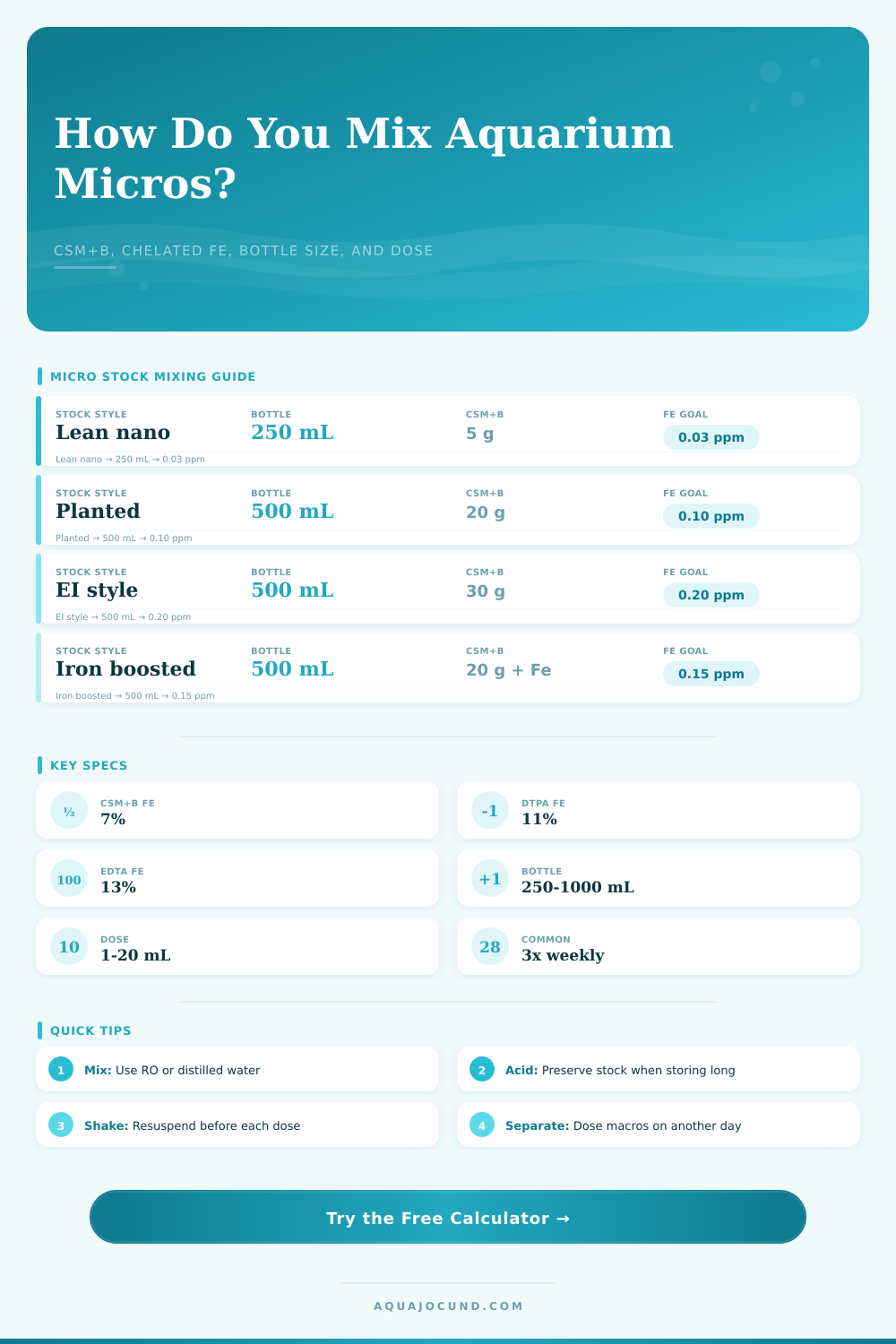
| 5 g CSM+B in 250 mL | 20 mg trace mix per mL | 1.4 mg Fe per mL | Lean nano stock |
| 10 g CSM+B in 500 mL | 20 mg trace mix per mL | 1.4 mg Fe per mL | Low tech weekly dosing |
| 20 g CSM+B in 500 mL | 40 mg trace mix per mL | 2.8 mg Fe per mL | General planted stock |
| 30 g CSM+B in 500 mL | 60 mg trace mix per mL | 4.2 mg Fe per mL | EI style dosing |
| 20 g CSM+B + 5 g DTPA in 500 mL | 50 mg total powder per mL | 3.9 mg Fe per mL | Iron boosted micros |
| Option | Storage Fit | Mixing Note | Calculator Warning |
|---|---|---|---|
| No preservative | Short stock age | Use RO or distilled water and keep cool | Best for small batches used quickly |
| Acidified stock | Medium to long storage | Common choice for trace stock stability | Useful when bottle life exceeds 8 weeks |
| Glutaraldehyde-style | Prepared plant stock routines | Use only if already appropriate for the aquarium | Check livestock sensitivity first |
| Refrigerated small batch | Lean tanks and tiny doses | Make less solution more often | Strong choice when weekly use is low |
| Dry dosing | No bottle storage | Weigh powder directly or pre-portion | Hard to measure tiny nano doses |
So you’ve got (or desire) a healthy planted tank. CO2 is gently bubbling away, macro nutrients is covered, and your lighting schedule is set in stone. Now your stem plants begin to show signs of stunting or maybe you see some slight yellowing on your older leaves. That’s generaly when the trace elements enter the picture.
Creating your own micro fertilizer stock isn’t exactly an act of alchemy. It’s just basic chemistry and a little patience. Not only does it save you money different than buying commercial brands, but you’ll also be able to precisely control what you put in your water column.
How to Make Your Own Micro Fertilizer
Once you know your target iron level(s) and the volume of your tank, all the calculator above do for you is do the math, saving you from having to make guesses about conversions and coefficients.
CSM+B is central ingredient in most of these recipes. It’s a powder that contains all the trace minerals that plants require: manganese, zinc, copper, boron… and more. The big driver is iron, though, and it’s also the most volatile. Too much iron at any time will settle out of the water before the plants can absorbs it. Too little, and the greens will be pale and tired-looking. The chart on the page explain it nicely. It plots how different forms of chelated iron (EDTA or DTPA) hold the iron in solution as a function of the pH.
What you buy isn’t pure iron; it’s a mixture with other micronutrients and carrier material. A typical CSM+B powder may contain just seven percent iron by weight. So when you add twenty grams of powder, you’re really adding only about forty-one milligrams of actualy iron. This shows why bottle size (or volume) are important. This is because you’re making a stock solution and not just dosing straight from the powder into tank. A typical bottle is 500 ml. That’s big enough that you can easily mix everything up well but small enough that the solution remains stable for several weeks.
Also, you have to make sure you fully dissolve the powder. Clumping means inconsistent dosing. Sometimes you’ll overdose and experience algal spikes while other times you won’t dose enough and suffer nutrient deficiencies. So part of the secret lie in knowing exactly what you’re measuring. It’s not the weight of the powder you’re measuring as much as it is how concentrated the iron is in the end liquid.
Next comes the preservative question. If you have your stock solution in a plastic bottle sitting around for weeks, you know it’s a breeding ground for bacteria. To extend the shelf life a lot, add a drop of phosphoric acid or use a commercial preservative to “acidify” the stock. Otherwise, the mixture will break down, freeing up nutrients at unpredictable intervals, resulting in confused plants and murky water. Skipping out on this step may save one step, but it generaly costs you more over time with wasting mixtures and unstable parameters. To handle this, the calculator lets you choose what storage method you’re going to use. That way it will adjust the length of time before you’ll need to go remix that bottle.
The second lever is frequency. Many people dose once or twice per week. But if your goal is maintaining steady trace levels, then dosing once per day with lower amounts will achieve that. This also helps mimic the natural fluctuation of nutrients in a wild ecosystem better than a massive weekly dump. Some low tech tanks with hardy plants don’t really need much (just a little bit of trace (a lean mix)). Some high tech tanks with lots of plant may need more trace because it is in demand. Match the demand to the recipe. If you’re seeing algae showing up after dosing, you probably have too much trace. If your plants aren’t growing, perhaps not enough.
Iron chelates work differently in soft water than in hard water. EDTA iron is better suited for acidic softer water where it does its job quicker then in harder water where it will also break down quicker. DTPA iron holds up better in neutral to slightly alkaline water. So if you pick the wrong one you’re spending money on iron that you can’t use. You don’t have to remember what the chemical structure looks like but you should of know which bottle will work with your tap water.
Keep it simple: Make a small batch, wait a couple of weeks to see how the plants respond, tweak as necessary. Consistency is key. Provide a steady supply of nutrients at lower doses rather than infrequent big feedings. After several weeks of tweaking, things should stabilize in your tank, the water remains clear, growth picks up and the colors are back on. Vibrant green indicates you’ve dialed-in the correct dose.