Micro Daily Dose Calculator
Build a planted-aquarium trace stock from target daily Fe, chelate strength, element ratios, and dose size.
Daily Micro Dosing Results
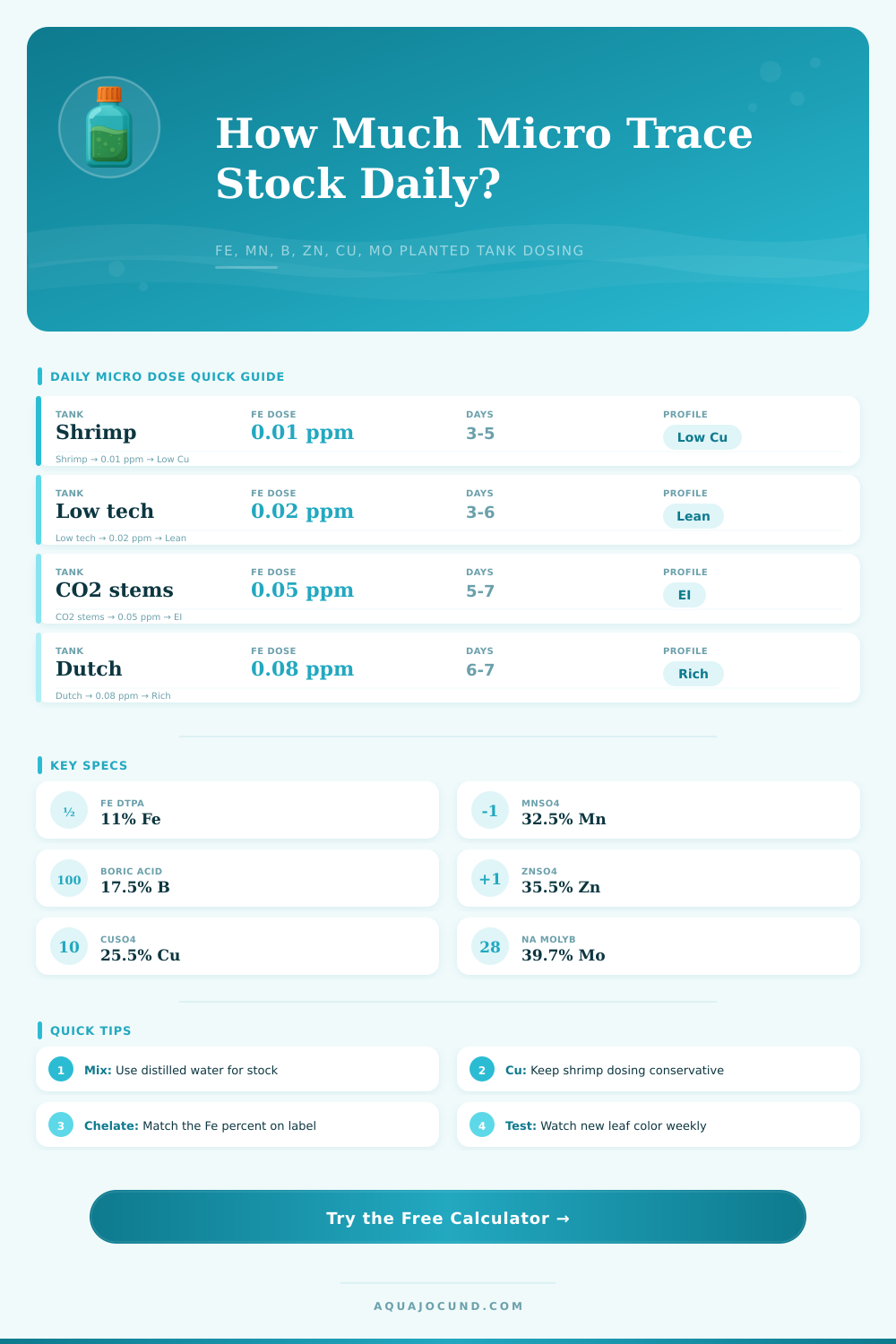
| Profile | Mn:Fe | B:Fe | Best fit |
|---|---|---|---|
| Classic CSM+B ratio | 0.286 | 0.186 | General planted tanks, EI-style trace balance |
| Lean daily ratio | 0.220 | 0.120 | Lower light tanks with steady but modest growth |
| Shrimp cautious Cu | 0.200 | 0.110 | Neocaridina and Caridina tanks where copper is minimized |
| Dutch stem rich | 0.330 | 0.170 | Fast stems, heavy trimming, bright CO2 aquascapes |
| Boron-forward new tips | 0.260 | 0.240 | Careful trial when distorted new tips persist |
| Zn/Mn recovery blend | 0.350 | 0.140 | Short correction phase after long trace starvation |
| Dry compound | Element supplied | Element fraction | Formula use |
|---|---|---|---|
| Iron chelate powder | Fe | User % Fe | grams = Fe mg / chelate fraction / purity / 1000 |
| Manganese sulfate monohydrate | Mn | 32.5% | MnSO4.H2O trace source |
| Boric acid | B | 17.48% | H3BO3 boron source |
| Zinc sulfate monohydrate | Zn | 35.5% | ZnSO4.H2O zinc source |
| Copper sulfate pentahydrate | Cu | 25.45% | CuSO4.5H2O copper source |
| Sodium molybdate dihydrate | Mo | 39.66% | Na2MoO4.2H2O molybdenum source |
| Tank style | Typical Fe per dose | Days per week | Notes |
|---|---|---|---|
| Shrimp moss or epiphyte tank | 0.005 to 0.020 ppm | 3 to 5 | Use a low copper profile and observe molts |
| Low-tech planted community | 0.015 to 0.035 ppm | 3 to 6 | Pair with stable macros and modest light |
| CO2 aquascape | 0.040 to 0.070 ppm | 5 to 7 | Daily trace helps keep new growth even |
| Dutch or farm-style stems | 0.060 to 0.100 ppm | 6 to 7 | High uptake tanks may need richer Mn and B |
| Check | Conservative range | Why it matters | Calculator field |
|---|---|---|---|
| Weekly Fe addition | 0.05 to 0.50 ppm | Good first pass for many planted tanks | Fe target x dosing days |
| Cu in shrimp tanks | As lean as practical | Trace copper is needed but livestock margin is small | Use shrimp cautious Cu |
| No-uptake ceiling | Below visible stress | Water changes reset unused traces | Water change and uptake fields |
| Stock concentration | Clear and fully dissolved | Precipitate means uneven dosing | Stock ml and dose ml |
The indications is obvious when a healthy planted tank is in balance: It’s clean water, and plants reaches for the lights without any hesitation. Also, new leaves come out with a rich, green hue indicating that photosynthesis are occurring nicely. At first glance, this seems magical, but it isn’t. It’s precisely tuned chemistry.
While many hobbyists is aware that their plants must have iron for chlorophyll production, most view trace elements as an afterthought. Buying one is usually a random decision based off what is available at their LFS. Rarely does this succeed; remember, plants don’t take up individual nutrients separately. Rather, they relies upon a complete package of micronutrients (manganese, zinc, copper, boron, molybdenum) working together to fuel plant growth.
How to Use the Trace Element Calculator
Fortunately, the calculator on this page do it for you. It translates your random parts per million (ppm) goals into practical grams of dry salts. That’s important if you plan on making your own trace stock solution since ratios can be difficult to eyeball and getting them wrong will result in over- or under-dosing.
First, specify the real water volume of your aquarium, taking into consideration any displacement caused by hardscapes and substrates; most tanks holds less than their marked gallons due to such displacement (think 10-15% less). Next, specify the desired amount of each dose, as well as how frequently you intend to dose. Then select a ratio profile that matches your primary target element (e.g., iron), and let the calculator figure out how much of each remaining element should pair with your chosen primary element.
A Dutch-style stem tank may call for a larger dose of manganese to promote fast growth, whereas a shrimp tank need careful consideration when using copper since some inverts is not tolerant to elevated levels. The reason behind the ratios will help avoid the all-too-common misdiagnosis of overdosing on something like iron when your plants are actualy starving for something else (boron).
Boron is required in very small quantities. Too little can cause stunted plant tips and odd-looking growth due to improper cell wall formation. Adding more iron won’t help if your plant don’t have adequate boron. On the page’s reference table, you’ll see how various profiles shifts these other elements around in relation to iron.
If you’re running a low tech community tank with moderate lighting, maybe a leaner set of day-to-day ratios makes sense. An EI style set up, however, require increased levels throughout to keep pace with the high metabolism.
You also need to know about the iron source itself, which is where the chelator comes in. In other words, what are you sourcing the iron from and how much? Iron is an unstable element in water; without a chelator (like EDTA or DTPA), it will fall out of solution rapidly and not be available for uptake by plants. Within certain pH ranges, these chelators will dissolve the iron and keep it available for plant.
The calculator asks for the percentage of elemental iron in your chelated iron powders, since different products can have wildly different amounts. Fe EDDHA may have as little as 6% iron whereas Fe DTPA has up to 11%. If you don’t plug the correct value into your mental math, you’ll end up underdosing which explains why so many tank stagnate even when being regularly fed. This tool compensates for that error by calculating exactly how much powder to use in order to obtain the desired concentration.
Another nuance is purity. Some technical grade salt products has only ninety-eight percent of the desired compounds and two percent inert fillers or moisture. You might not think that makes much difference. However, if you’re dosing with copper or molybdenum in milligrams, those two percent can make a big diffrence. To account for this, the calculator includes a purity allowance to help your final stock concentration match what you theoretically calculated.
These details keep your aquarium from slowly slipping into deficiency. This deficiency eventually kills aquariums over time, not overnight. And lastly, keep in mind that when you change water you reset your baseline. Even with ideal dosing, your nutrients will still build up if plant uptake and weekly water changes does not balance them out. It would of also tell you what your ceiling of no uptake would be so you can judge how aggressive your dosing is (i.e., enough to promote growth vs. Too much so it becomes toxic between water changes).
Pay attention to your new leaves, nudge the ratios if they look distorted, and know that being steady beats being intense each and every time. Get the chemistry right and the tank will reward you with vigor and color.