🐟 Methylene Blue Dosing Calculator
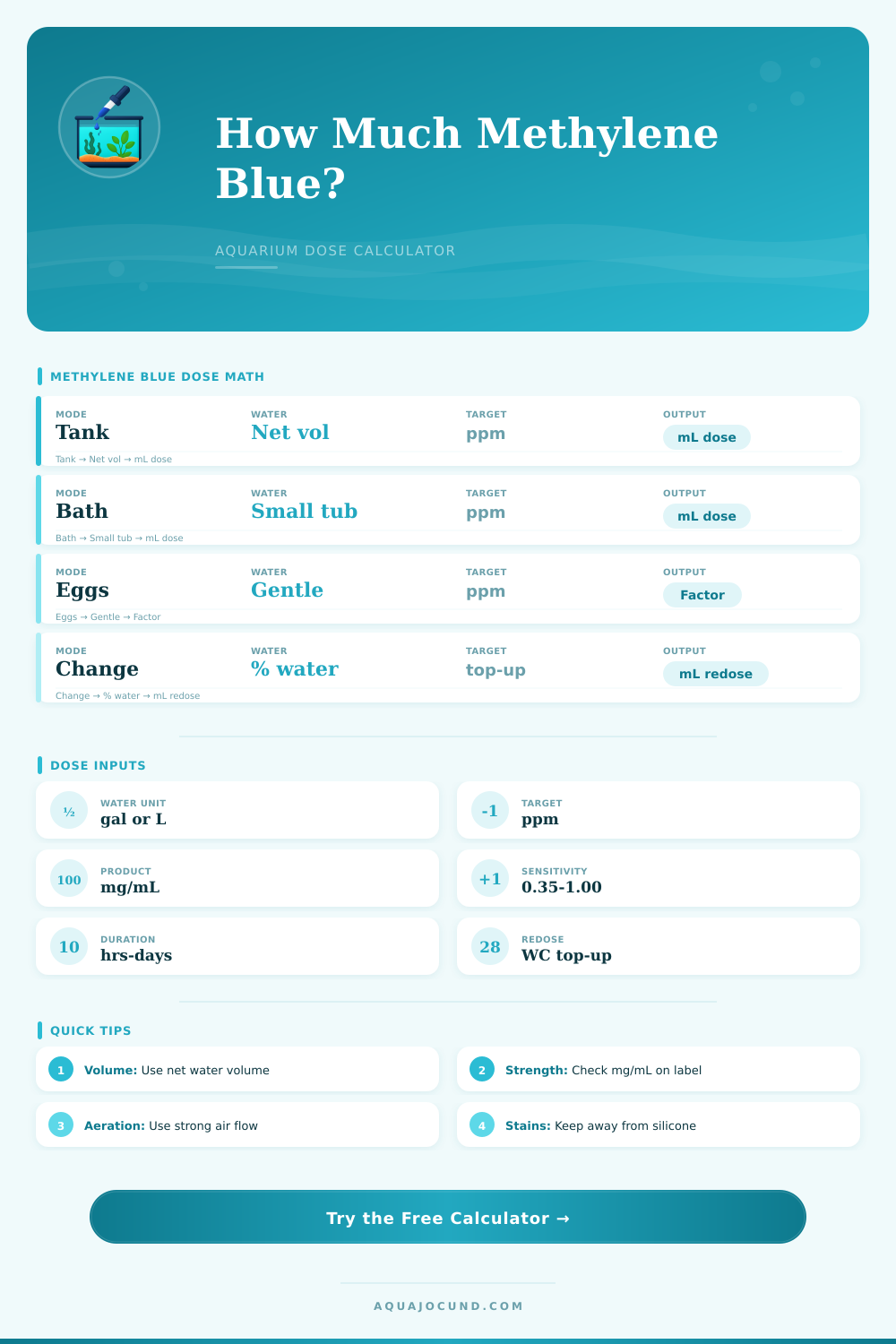
Convert a confirmed methylene blue target into product volume for tank dosing, short baths, egg containers, sensitivity adjustments, duration planning, and water-change redose math.
✅ Dose Conversion Result
| Mode | Typical water volume | Sensitivity option | Duration input | Calculator output |
|---|---|---|---|---|
| Whole tank reference | Net aquarium volume | Standard or sensitive | Hours or days | Initial mL and top-up mL |
| Short bath reference | Separate tub or bucket | Standard or sensitive | Usually shorter | Small-volume product amount |
| Egg container reference | Tray, jar, or tumbler | Eggs or very delicate | Hatch-window planning | Reduced target conversion |
| Water-change top-up | Existing treated water | Same as current plan | After water change | Amount to replace dilution |
| Product entry | Approx active strength | 100 mg active needs | 500 mg active needs | Measurement note |
|---|---|---|---|---|
| 2.303% solution | 23.03 mg/mL | 4.34 mL | 21.71 mL | Common strong stock example |
| 2.0% solution | 20 mg/mL | 5.00 mL | 25.00 mL | Percent w/v x 10 |
| 1.0% solution | 10 mg/mL | 10.00 mL | 50.00 mL | Lower-strength liquid |
| 5 mg/mL liquid | 5 mg/mL | 20.00 mL | 100.00 mL | Measure larger volumes |
| Dropper estimate | mg/mL divided by drops | Varies | Varies | Calibrate each dropper |
| Adjusted target | Water change | Replacement level | Post-change level | Top-up needed |
|---|---|---|---|---|
| 2 ppm | 25% | 0 ppm | 1.50 ppm | 0.50 ppm |
| 2 ppm | 50% | 0 ppm | 1.00 ppm | 1.00 ppm |
| 1 ppm | 30% | 0 ppm | 0.70 ppm | 0.30 ppm |
| 3 ppm | 20% | 1 ppm | 2.60 ppm | 0.40 ppm |
| 0.8 ppm | 40% | 0.4 ppm | 0.64 ppm | 0.16 ppm |
| Reference item | Why it matters | Calculator field affected | Practical note |
|---|---|---|---|
| Strong aeration | Bath containers can lose oxygen quickly | Mode and duration | Use vigorous air movement during reference baths |
| Staining | Blue dye can mark silicone, tubing, nets, and fabric | Mode selection | Separate bath tubs reduce display-tank staining |
| Carbon and resins | Chemical media can remove dye from water | Removal adjustment | Only enter a loss factor when you have a reason |
| Live plants and biofilter | Display tanks may react differently than bare baths | Sensitivity | Use reference math with label or professional guidance |
Convert to active mg/mL before measuring. If your bottle lists percent solution, the calculator can convert it; if it lists drops per gallon, calibrate the dropper before using small bath volumes.
Keep stain and aeration planning separate from dose math. The tables above flag common reference checks, while the result section only converts your entered target and product strength.
A dosing calculator help a person to calculate the proper amount of methylene blue that should be added to a water system. Methylene blue is a chemical that are often used to treat fish or egg, and the amount that is used must be precise. A dosing calculator take three pieces of information to calculate the amount of methylene blue that should be added to the water system in units of milliliter.
These three pieces of information are the target concentration for the methylene blue, the volume of the water in the system, and the strength of the methylene blue product. Without the dosing calculator, a person may use the wrong amount of methylene blue in the water system, which can cause the treatment protocol to fail or to negative affect the fish that are treated with the methylene blue. The dosing calculator allows a person to choose between two mode of using methylene blue.
How to calculate methylene blue dose for fish tanks
Tank mode is used for treating an entire water system, but bath mode allow a person to treat only a separate container of water within the system. Bath mode is preferred for using methylene blue away from the main display of fish, but tank mode will affect every fishes in the display system. There is no automatic mode for the dosing calculator to choose between these modes, but the person must choose the modes to calculate the proper amount of methylene blue to be added.
A person must enter the volume of the water systems water. This value can be entered directly into the dosing calculator or estimate using the dimensions of the display tank. A common underestimation of the water volume is accounting for how much of the tank is occupied by substrate, rock, and other filter media.
These item take up space that would normally be filled with water. Therefore, a person can enter a percentage for the displacement of the substrate and other media into the dosing calculator. If the amount of water that the substrate displaces is not account for, the resulting concentration of methylene blue will be more stronger than the target concentration for the water system.
Another piece of information that must be entered into the dosing calculator is the strength of the methylene blue product. The methylene blue bottles has a percentage value for the strength of the methylene blue or the amount of methylene blue in milligrams per milliliter. These two value are interchangable; for instance, a percentage of 2.3 will be the same as a value of 23 milligrams per milliliter.
The dosing calculator can convert these two values into one another to make it convenient for the user to input one instead of other. A person must enter the products strength into the dosing calculator for the math within the dosing calculator to be correct. The dosing calculator include settings for people who are treating more sensitive species.
For example, if a person knows that the target concentration of methylene blue that is recommended for a system with eggs is too much for those eggs, the dosing calculator allow the user to reduce the target percentage to something lower, like 50% of the standard dose. The dosing calculator accounts for this percentage in its calculations and will provide an output for the user according to this reduced target concentration. One of the functions of the dosing calculator is to allow people to calculate how much methylene blue is needed for water changes and for redosing methylene blue into the system.
If a person performs a water change, the concentration of methylene blue in the system will decrease. Therefore, a person can use the dosing calculator to calculate how much methylene blue is needed to redose the water system after a water change. The dosing calculator will only calculate the amount of methylene blue, though.
It cannot account for the interaction between methylene blue and the physical system in which the water live. For instance, methylene blue will stain silicone and fabric. Additionally, methylene blue will react with carbon or other resin in the filter.
These components will remove methylene blue from the water system, so the actual amount of methylene blue in the water may be less than the amount calculated by the dosing calculator. Finally, the dosing calculator provide a level of consistency in the addition of methylene blue to a water system. When a person calculates the amount of methylene blue in the system with the dosing calculator, it will provide a number in units of milliliters.
A person must manually add that amount of methylene blue to the water system. A person must also manually observe the fish and the eggs in the system with the dosing calculator. The dosing calculator will calculate the math for methylene blue, but a person must provide the observations for the systems fish and eggs.