🌊 Marine Salt Mix Calculator
Calculate dry salt mix for reef tanks, fish-only systems, brackish batches, and measured salinity corrections.
✅ Salt Mix Estimate
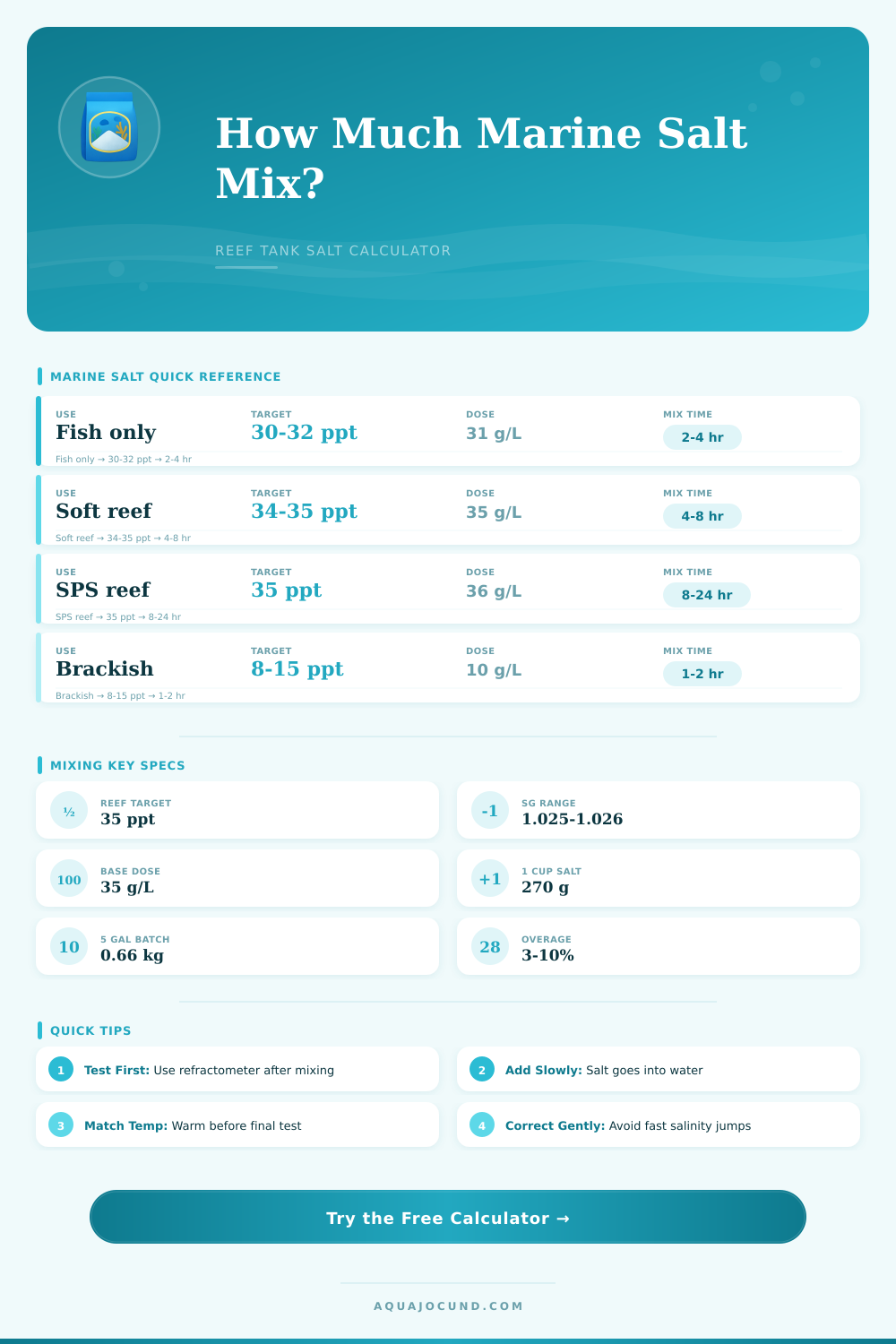
| Mix Type | Best Use | Dose at 35 ppt | Alkalinity Style | Typical Mix Time |
|---|---|---|---|---|
| Standard Marine | Fish-only, hardy coral | 35 g/L | Balanced | 2-6 hours |
| Reef Crystals Style | LPS, soft coral, mixed reef | 36 g/L | Elevated | 4-12 hours |
| Pro Reef | SPS and dosing systems | 34 g/L | Lower / stable | 8-24 hours |
| Natural Seawater Formula | General reef target | 35.5 g/L | NSW-like | 4-12 hours |
| Fast Dissolve | Quick changes, quarantine | 35 g/L | Balanced | 1-4 hours |
| Brackish Mix | Mollies, puffers, gobies | 33 g/L scaled | Low mineral | 1-2 hours |
| High Alk Reef | Nutrient-rich coral systems | 37 g/L | High alkalinity | 8-24 hours |
| Batch | Volume | 35 ppt Standard Salt | Approx Cups | Typical Use |
|---|---|---|---|---|
| Small bucket | 5 gal / 18.9 L | 1.46 lb / 0.66 kg | 2.45 cups | Nano reef change |
| Quarantine batch | 10 gal / 37.9 L | 2.92 lb / 1.33 kg | 4.91 cups | Hospital or QT tank |
| Medium can | 20 gal / 75.7 L | 5.84 lb / 2.65 kg | 9.82 cups | Weekly reef change |
| Brute can | 32 gal / 121 L | 9.35 lb / 4.24 kg | 15.7 cups | Large water change |
| Half barrel | 55 gal / 208 L | 16.1 lb / 7.29 kg | 27.0 cups | Display fill support |
| Large station | 100 gal / 379 L | 29.2 lb / 13.25 kg | 49.1 cups | Fish room reserve |
| System Type | PPT Target | Approx SG at 77°F | Notes |
|---|---|---|---|
| Brackish Low Brackish | 5-10 ppt | 1.003-1.007 | Raise slowly for livestock acclimation |
| Brackish High Brackish | 12-18 ppt | 1.009-1.013 | Species-specific target matters |
| Marine Fish Only | 30-32 ppt | 1.022-1.024 | Often kept slightly lower than reef |
| Reef Soft / LPS Reef | 34-35 ppt | 1.025-1.026 | Stable salinity is more important than chasing |
| Reef SPS Reef | 35 ppt | 1.026 | Match alkalinity and temperature before use |
| Marine Hypersaline Holding | 36-40 ppt | 1.027-1.030 | Specialized use only |
| Step | Target | Why It Matters | Calculator Check |
|---|---|---|---|
| Start with RO/DI | 0 TDS preferred | Prevents unknown minerals from shifting alkalinity | Current salinity = 0 ppt |
| Add salt to water | Slow pour, strong flow | Reduces precipitation and hot spots | Use cup estimate as rough guide |
| Heat and circulate | Match display temp | SG readings shift with temperature | Use target ppt for final decision |
| Retest after clearing | Stable reading | Dry mix density varies by humidity and brand | Fine-tune with small additions |
| Correct livestock tanks | No fast jumps | Rapid salinity changes stress fish and coral | Use correction mode with current ppt |
Use the cup result only as a practical starting point. Humidity compacts salt mix, so a kitchen scale and a calibrated refractometer give the most repeatable reef batches.
When current salinity is above zero, the calculator estimates the added salt needed to move that batch upward. For live tanks, spread large corrections across several water changes.
To maintain a reef tank, you have to mix some salt and water to reach the specific salinity level that the reef fishes and corals requires. Salinity is a measurement of the amount of salt in the water. Salinity is necessary for the reef fish and corals to breathe and grow proper.
If the salinity are too high or too low, the animals in the reef tank will suffer and there health will begin to decline rapidly. Different brands of salt contains different amounts of minerals. For these reason, you cant simply add salt to the reef tank based off guesswork.
How to Mix Salt Water and Check Salt Level for a Reef Tank
Some salts are only for fish since they lacks the amount of calcium that fish need. On the other hand, there is salts that are specifically for stony corals that contain high amounts of calcium and alkalinity. As a result of these different composition of salt brands, the amount of salt that must be added to the water vary depending on the type of salt that is used.
In order to calculate the amount of salt that is needed for the reef tank, it is necessary to calculate the volume of the actual water that will be contained within the tank. The volume of the reef tank is not the same than the tanks total capacity. To calculate the actual volume of the tank, you have to deduct the volume that the sand and the live rock takes up from the total tank capacity.
Furthermore, it is also necessary to consider the actual water level of the tank. Reef tanks are not always filled to the very top of the tank. If these variable are not taken into consideration, you will add too much salt to the reef tank.
Adding too much salt to the water will lead to too high salinity level. One more variable that must be considered when adding salt to the reef tank is the temperature of the water. Salt will dissolve at different rate depending upon the temperature of the water.
Furthermore, the temperature of the water will impact the readings that the refractometer that measures the salinity of the water provides. If the salinity of the water is measured when the water is cold, it is possible that the refractometer will display an inaccurate reading. If the salinity reading from the refractometer is inaccurate, it is possible that too much salt will be added to the reef tank.
It is, therefore, necessary to ensure that the water reach the target temperature prior to measuring the salinity with a refractometer. It is also necessary to ensure that the measurements of the salt is consistent. Many reef aquarium keeper use measuring cups to measure the amount of salt that will go into the reef tank.
However, salt can compact depending upon the humidity of the air in the room in which the reef tank is located. It is possible, therefore, that the amount of salt that is measured in a measuring cup can vary depending upon the humidity of the room. For these reasons, it is best to weigh out the salt in gram with a kitchen scale.
It is important to ensure that each batch of saltwater has the same amount of salt in order to provide the same conditions to the fish and corals in the tank. While reef fish and corals can tolerate salinity level that are slightly different than the target level, they cannot tolerate conditions where the salinity level change dramatically over time. Salinity level that change dramatically within the tank can negatively impact the corals within that tank.
If it is necessary to even further correct the salinity level for the water that is already in the tank, it is important to ensure that the process is slow. Adding a high salinity level mixture into a low salinity level tank all at once can shock the fish and corals in the tank. The amount of salt that you must calculate will allow for the salinity level to be raised in a slowly and gentle manner to provide for the livestock in the tank.
Finally, once the salt and water is mixed, it is important for the saltwater to aerate and circulate in the tank. Depending upon the type of salt that is used, it may take several hour for the salt to completely dissolve in the water. Furthermore, if the salt dont completely dissolve in the water, minerals may come out of the water.
It is important for the salt to circulate in the tank prior to adding it to the aquarium. Only after the salt has completely dissolved and the salinity level stabilize on the refractometer should you add the saltwater into the reef tank.