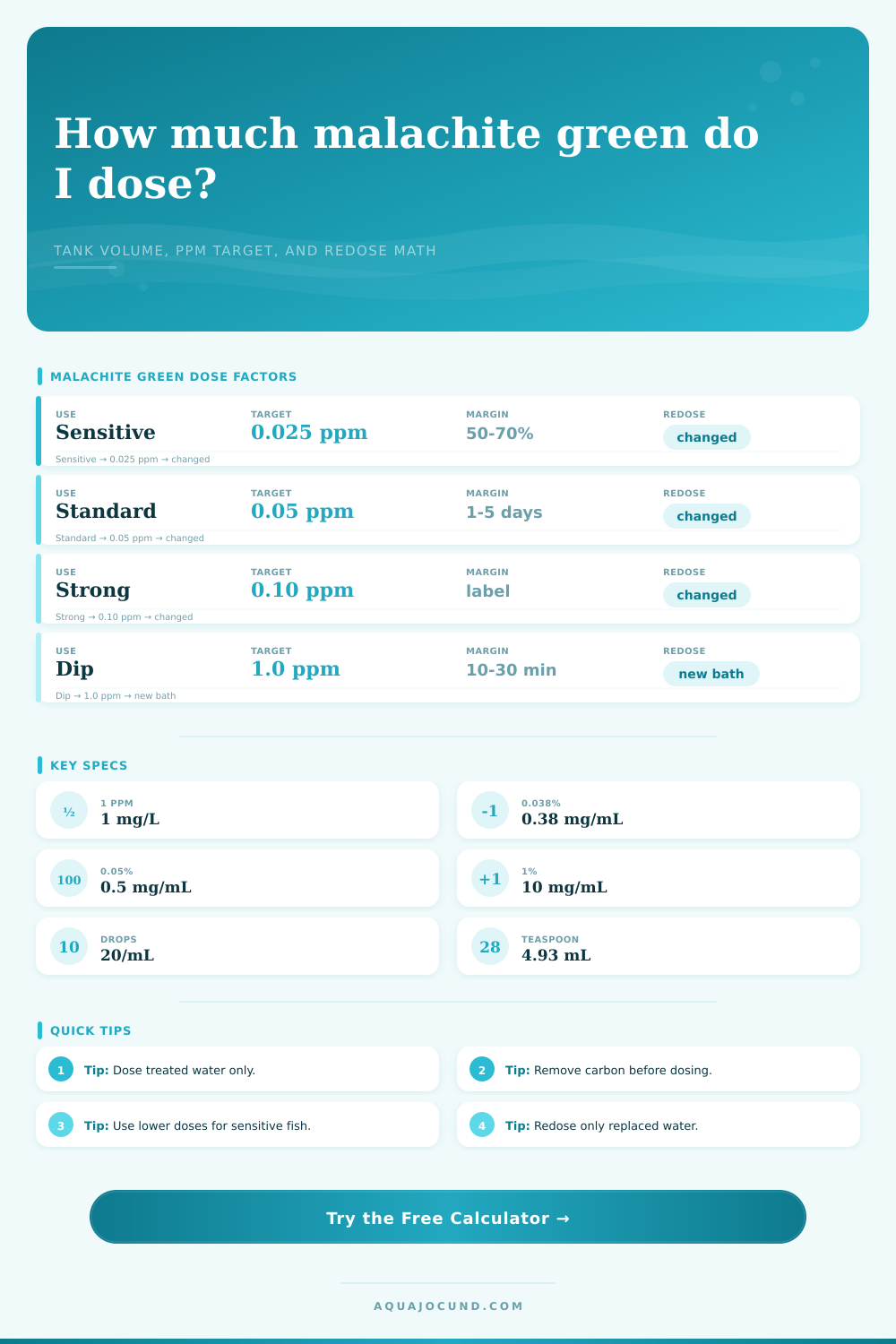
Malachite Green Dose Calculator
Estimate active malachite green, product volume, treatment strength, and water-change redose from real treated water volume.
🐟Quick Aquarium Presets
⚙Dose Inputs
Use actual water level, not rim height.
Redose only the new water when following repeat-dose labels.
Use only when the product label gives a bath direction.
📊Formula Reference
🧪Common Treatment Strengths
| Setting | Target ppm | Best fit | Calculator note |
|---|---|---|---|
| Sensitive caution | 0.025 ppm | Loaches, weak fish, first exposure | Starts at half of a 0.05 ppm dose |
| Standard tank dose | 0.05 ppm | Quarantine tanks and many label directions | Matches about 5 mL of 0.038% stock per 10 gallons |
| Moderate tank dose | 0.075 ppm | Hardy fish under label supervision | Use only when the label permits it |
| Strong tank dose | 0.10 ppm | Short, monitored treatments | Extra aeration and close observation matter |
| Dip or bath | 1.00 ppm | Separate timed container | Not a display-tank default |
📏Stock Strength Comparison
| Label strength | Active mg per mL | mL for 10 gal at 0.05 ppm | Typical measuring tool |
|---|---|---|---|
| 0.038% malachite green | 0.38 mg/mL | 5.0 mL | Oral syringe or cap line |
| 0.05% malachite green | 0.50 mg/mL | 3.8 mL | 1 mL or 5 mL syringe |
| 0.10% malachite green | 1.00 mg/mL | 1.9 mL | Fine syringe |
| 0.20% concentrate | 2.00 mg/mL | 0.9 mL | Graduated syringe |
| 1.00% lab stock | 10.00 mg/mL | 0.2 mL | Dilute before aquarium dosing |
🏠Common Tank Dose Examples
| Tank | Inside dimensions | Net water used | 0.038% stock at 0.05 ppm |
|---|---|---|---|
| 5 gallon hospital | 16 in × 8 in × 10 in | 4.4 gal / 16.7 L | 2.2 mL |
| 10 gallon quarantine | 20 in × 10 in × 12 in | 8.6 gal / 32.6 L | 4.3 mL |
| 20 long | 30 in × 12 in × 12 in | 15.8 gal / 59.8 L | 7.9 mL |
| 40 breeder | 36 in × 18 in × 16 in | 34.3 gal / 129.8 L | 17.1 mL |
| 75 gallon | 48 in × 18 in × 21 in | 59.2 gal / 224 L | 29.5 mL |
⚠Dosing Cautions
| Situation | Calculator setting | Why it matters | Practical check |
|---|---|---|---|
| Activated carbon in filter | No dose change | Carbon can remove dye-based medication | Remove carbon before dosing |
| Scaleless fish or weak fish | 50% or 75% | Some fish tolerate dye medications poorly | Observe breathing and balance |
| Reef, shrimp, or snails | Avoid display tank | Invertebrates can be highly sensitive | Use a separate hospital tank |
| Repeat dose after water change | Changed water % | Full redose can overdose remaining water | Replace only the removed dose |
⏱Duration and Redose Patterns
| Plan | Dose count formula | Exposure window | Use in calculator |
|---|---|---|---|
| Single display dose | 1 dose | About 24 hours | Shows one full dose plus water-change replacement |
| Daily replacement plan | Days rounded up | 3 to 5 days | Multiplies dose events and active mg handled |
| Every 48 hours | Days × 24 / 48 | Longer monitored plan | Useful when labels separate repeat doses |
| Timed bath | New bath each event | Usually minutes | Treats bath water as a separate container |
💧Practical Calculation Tips
If you are battling fungal issues, make sure to get your doses correct. While malachite green works well to treat fungal outbreaks, it’s still a powerful chemical and a little too much will kill your fish. So while haste makes waste, so does mathematics. Make sure you gets it right.
Net water volume is real amount of water in your tank. In most cases, it’s not equal to the nominal tank size. Filters, driftwood, substrate, etc., reduce the volume inside a tank. For example, a 10g is typicaly smaller than 10 gallons of water. Overdosing the tank assumes you dosed it like the glass capacity rather than the water volume. To correct this mistake, the tool prompt you for the amount of displacement and fill height. By doing so, it ensure that the dose is calculated based off the volume of water the fish live in. That little fix avoids inadvertent toxicity.
Why You Need a Malachite Green Calculator
So how do I know which product strength to use for my concentration? Malachite green are available in several strengths, ranging from concentrated stock to very dilute. A concentrated form in a syringe designed for a weaker solution will kill everything in tank. When you input the type of product you’re using and its percent on the label, it calculates exactly how many milliliters to give to achieve your chosen concentration in parts per million. A common treatment goal for most fish is 0.05 ppm. More sensitive fish such as scaleless species or loaches can be damaged by this level and should starts at lower doses. The calculator takes this sensitivity into account. If you don’t know what the impact might be on your livestock, it provide a safe place to start.
The process requires specific timing and maintenance. Activated carbon removes malachite green and light speeds up breakdown. Covering the tank slows it down. Turn off any carbon filter. Also, you’ll need to do water changes to remove the waste. However, the waste will dilute the treatment. The calculator takes that into account. Rather than guess at how much malachite green needs to be added back following a partial water change, the calculator tell you what the redose should of be. That ensures that levels stay within therapeutic range. No more doubling the dose and poisoning the tank. No more stopping treatment prematurely.
This is not for SH shrimp keepers or reef tanks. Dye based meds are very toxic to inverts. Snails and especially shrimps will die even with trace amounts. If you keep any invert, do not use malachite green in your display tank. This calculator is intended only for hospital/quarantine tanks for ornamental fish. With that type of setup, you’re in charge of the environment. Using it in a mixed ecosystem is asking for trouble that no amount of precise dosing can fix. Precise dosing doesn’t solve the invertebrate issue.
You want enough medicine that it will kill the pathogen but not so much then to stress the host. An exact amount of medicine is what makes the balance possible and the calculator does just that. It translates general label directions into an exact dosage. It takes into account the strength of your products, size of your tank, and the sensitivity of your fish. Yes, you must still monitor water parameters and your livestock. But, at least you know how much medicine to administer. If you take accurate measurements, then the odds is in your favor.
Use a conservative estimate first. Monitor your livestock carefully. Re-dose only if needed. Such caution helps make the hobby more manageable.