Magnesium Consumption Rate Calculator
Estimate magnesium ppm drop, tank volume, correction dose, product amount, and a safe daily dosing schedule.
Magnesium Dose Results
| Source | Typical Strength | Best Use | Calculator Setting |
|---|---|---|---|
| Balanced liquid magnesium | 35-60 mg/ml Mg | Routine correction with ion balance | Liquid mg/ml |
| Magnesium chloride liquid | 40-55 mg/ml Mg | Raising Mg with limited sulfate addition | Liquid mg/ml |
| Magnesium sulfate liquid | 25-45 mg/ml Mg | Occasional correction where sulfate is planned | Liquid mg/ml |
| Dry magnesium chloride hexahydrate | About 12% Mg by weight | Bulk stock solution or dry mixing | Dry % Mg |
| Dry magnesium sulfate heptahydrate | About 9.9% Mg by weight | Blend component, not only long-term source | Dry % Mg |
| Dry chloride/sulfate blend | Often 10-12% Mg by weight | Large reef adjustments with measured mixing | Dry % Mg |
| System Type | Estimated Mg Demand | Coralline Factor | Testing Pace |
|---|---|---|---|
| Fish only | 0.05 ppm/day | Minimal | Every 2-4 weeks |
| Soft coral reef | 0.10 ppm/day | Low | Weekly to biweekly |
| Mixed reef | 0.25 ppm/day | Moderate | Every 3-7 days |
| LPS dominant | 0.35 ppm/day | Moderate | Every 3-5 days |
| SPS dominant | 0.55 ppm/day | High | Every 2-4 days |
| Heavy coral growth | 0.80 ppm/day | High | Every 2-3 days |
| Tank | Dimensions | Net Water | Mg Needed For 50 ppm |
|---|---|---|---|
| 10 gallon | 20 x 10 x 12 in / 51 x 25 x 30 cm | 32 L after 15% displacement | 1,600 mg Mg |
| 20 long | 30 x 12 x 12 in / 76 x 30 x 30 cm | 64 L after 15% displacement | 3,200 mg Mg |
| 40 breeder | 36 x 18 x 16 in / 91 x 46 x 41 cm | 128 L after 15% displacement | 6,400 mg Mg |
| 75 gallon | 48 x 18 x 21 in / 122 x 46 x 53 cm | 241 L after 15% displacement | 12,050 mg Mg |
| 125 gallon | 72 x 18 x 21 in / 183 x 46 x 53 cm | 402 L after 15% displacement | 20,100 mg Mg |
| Correction Gap | Conservative Rise | Normal Rise | Retest Point |
|---|---|---|---|
| 10-25 ppm | 1 day | 1 day | Next test cycle |
| 26-50 ppm | 2 days | 1 day | After final dose |
| 51-100 ppm | 3-4 days | 2-3 days | Midpoint and end |
| 101-150 ppm | 5-6 days | 3-4 days | Every 50 ppm |
| Over 150 ppm | Slow staged plan | Verify first | Retest before dosing |
Reef tanks can’t live without magnesium. Unlike pumps and skimmers, you don’t notice it working. However, corals continuousy consume magnesium in order to create their skeleton. As a result, if you have insufficient magnesium, then alkalinity will be unstable (ions precipitate out). Therefore, you need to know not only how much magnesium you have in your tank now but also how fast it’s being consumed. That way, you can track its depletion rate and adjust accordingley.
The calculator above does that by using actual test results instead of a guess and by taking into account the following variables: Magnesium is one of those numbers most hobbyists view as a static value on a chart. Once every few weeks they’ll check it and freak out when it drops below 1200 parts per million. This completely overlooks how fast magnesium are used up. Some tanks with just soft corals will hardly dent their magnesium supply. Others filled with nothing but SPS can burn through grams of supplement within days. If you understand that variation, you change the way you maintain your chemistry. You switch from chasing emergencies to maintaining stability. The calculator considers system type and visible coralline algae coverage, helping put this into perspective.
Why You Need to Track Magnesium in Your Reef Tank
Why do these matter? Calcification is the biggest cause of magnesium deficiency. Your alkalinity may look good on paper, but more growing tissue equal greater demand. Where many people fall down is in their volume calculations. Twenty gallons of water isn’t going to fit in a twenty gallon tank if you have any equipment or substrate in there like sand and/or live rock. Those things will reduce available volume by as much as 15-20%. So when you plug in the max volume, you’ll end up with more supplement in your water than necessary which equals overdose. When you type in your tank’s dimensions and your displacement percentages, the amount of space taken up by rocks, sand, etc., the tool handles the math for you.
Then it looks back at your old test value and compares it to your new one. So let’s say last week you ran a test and it was thirteen hundred parts per million but today it’s down to twelve hundred. That means you are losing ten parts per million each day. That determines how quickly you need to dose. It also shows how fast you should of build up your inventory of bulk chemicals to get the best deal.
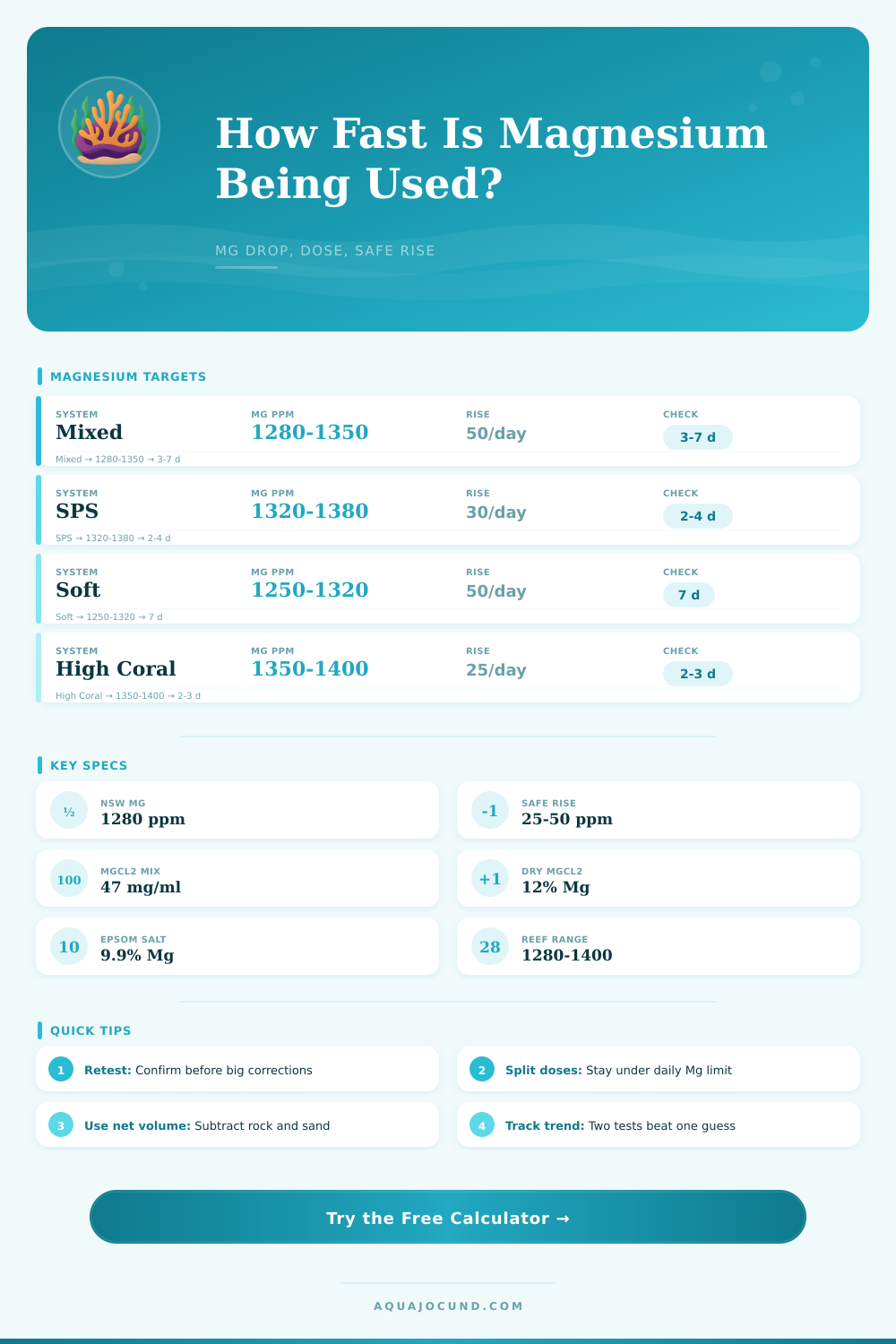
Ease of use is also an issue with different sources. How balanced is it? For instance, which one do you choose: magnesium chloride hexahydrate (dry mix), liquid supplement, etc.? You’ll need to know either the percent by weight of dry mix or the mg/ounce of liquid solution. Either way, the calculator does all the math for you. Just enter what type of solution you want to add (liquid or dry) and your target range into the calculator, and it will tell you exactly how much to dose to achieve your desired level safely. It won’t allow you to make the most common error of pouring too much on at any given time. Too fast of a spike can be just as jarring as too slow of a crash. Typically, a gradual increase of no more than 50 parts per million each day is considered to be a safe rate if the drop wasn’t large.
Splitting doses is a little habit with big rewards. Rather than a giant corrective dose, split the dose into two or three doses (depending on your safe rise threshold and split limit). This maintains stable parameters as they circulate through the tank. The tool will schedule that for you according to your desired split limit and safe rise threshold. And it takes into account water changes, since many salt brands also add some magnesium back in the mix. Not factoring that offset in means creeping overshoots can occur over time.
Track the trend not the data point. One bad test kit reading is an outlier, but a steady downward slope across three tests are a pattern to trust. Saves stress and money. It all comes down to rhythm not reaction when managing magnesium. Feed the tank what it uses but don’t flood the tank with so many extra ions that they starts competing against everything else.
The calculator above does most of the work (conversions, projections) but you need to understand how to interpret the output in the context of your tank. Treat the daily consumption number as an order guide for dosing/supply schedules. Maintain roughly a constant level within the range of 1300-1400 parts per million for most mixed reef tanks. Increase that slightly if you are running lots of SPS which tend to require additional “structural” support. It’s all about consistency. Once magnesium starts riding a less wild seesaw, then alkalinity will stabilize, calcium becomes predictable, and finally those darn corals can stop focusing on survival and start focusing on growth.