Macroalgae Nutrient Export Calculator
Estimate nitrate and phosphate export from refugium harvests, algae tissue content, feeding load, light schedule, and target nutrient removal.
🧪Export inputs
Macroalgae export estimate
🌿Species and tissue assumptions
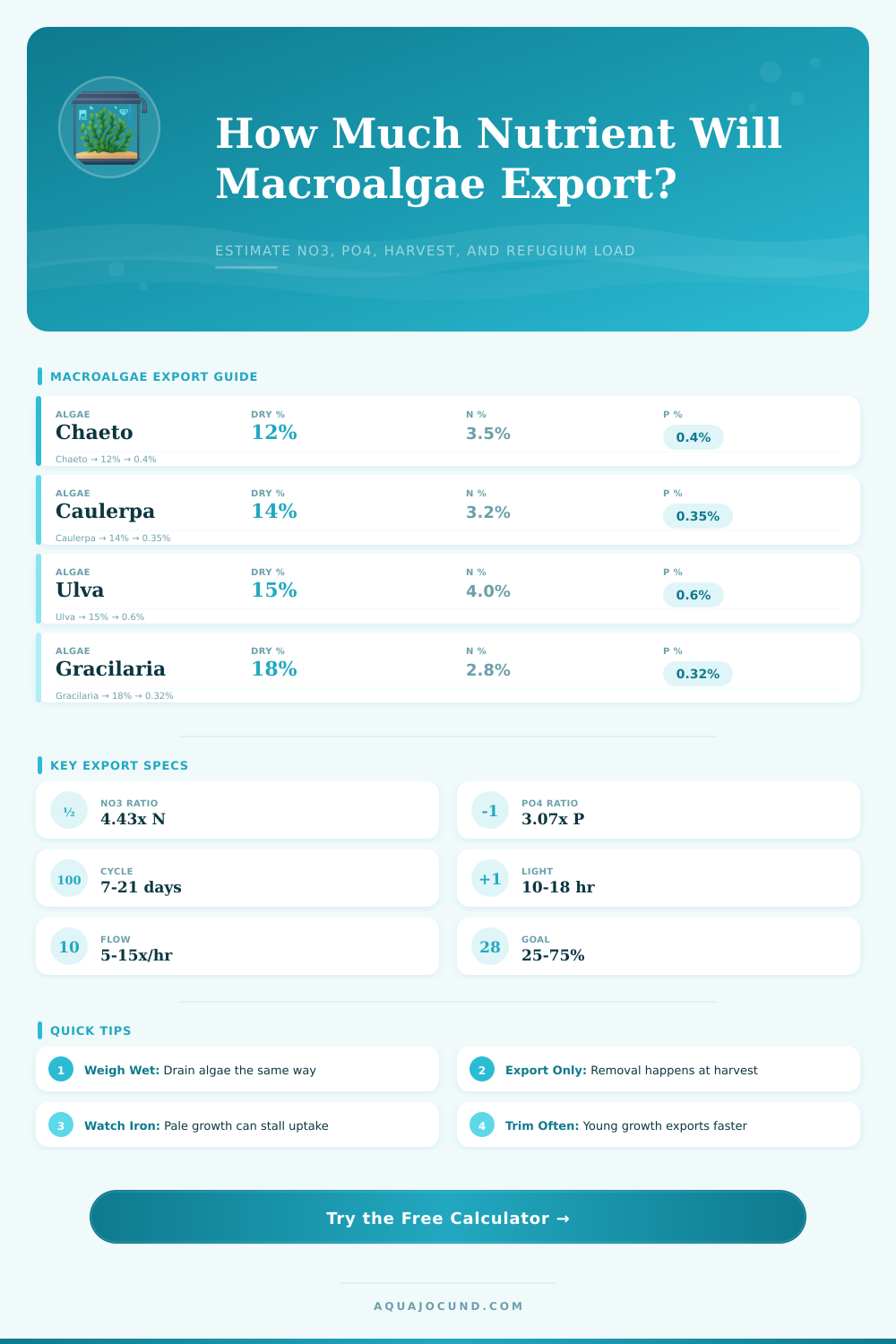
| Macroalgae | Dry matter | N in dry mass | P in dry mass | Best use |
|---|---|---|---|---|
| Chaetomorpha | 10-14% | 3.0-4.0% | 0.30-0.55% | General reef refugium, tumbling basket |
| Caulerpa prolifera | 12-16% | 2.8-3.6% | 0.25-0.45% | Rooted bed, soft coral systems |
| Ulva | 13-17% | 3.5-4.5% | 0.45-0.75% | Fast sheet growth, high nutrient lagoons |
| Gracilaria | 16-20% | 2.4-3.2% | 0.25-0.40% | Display macro, tang food harvests |
| Halimeda | 18-25% | 1.5-2.5% | 0.12-0.28% | Display macro; slower nutrient export |
| Mixed refugium | 11-16% | 3.0-3.8% | 0.30-0.55% | Mixed chaeto, turf, film, and detritus |
📊Harvest planning table
| Wet harvest | Dry mass at 12% | NO3 exported | PO4 exported | Use case |
|---|---|---|---|---|
| 50 g | 6 g | 930 mg NO3 | 74 mg PO4 | Nano maintenance trim |
| 150 g | 18 g | 2.79 g NO3 | 221 mg PO4 | Medium reef weekly export |
| 300 g | 36 g | 5.58 g NO3 | 442 mg PO4 | Heavy feeding or large sump |
| 600 g | 72 g | 11.16 g NO3 | 883 mg PO4 | High nutrient fish system |
💡Refugium intensity guide
| System style | Refugium volume | Light footprint | Flow target | Export goal |
|---|---|---|---|---|
| Low nutrient SPS | 5-10% | 1-2 sq in/gal | 5-8x/hr | 25-40% of input |
| Mixed reef | 10-20% | 2-3 sq in/gal | 6-12x/hr | 40-60% of input |
| Heavy fish load | 15-30% | 3-5 sq in/gal | 8-15x/hr | 60-75% of input |
| Lagoon macro display | 20%+ | 4+ sq in/gal | 4-10x/hr | Balanced with feeding |
⚖Reading the result
| Indicator | Low | Balanced | Aggressive | Adjustment |
|---|---|---|---|---|
| Load coverage | Under 25% | 40-70% | Over 85% | Resize harvest goal |
| Harvest cycle | Over 21 days | 7-14 days | Under 7 days | Match growth rate |
| Lighted area | Under 1 sq in/gal | 2-3 sq in/gal | Over 4 sq in/gal | Spread algae thinner |
| Flow turnover | Under 4x/hr | 6-12x/hr | Over 18x/hr | Avoid packed dead zones |
Macroalgae are organisms that will remove the nutrients from your reef tank. Macroalgae removes nutrients in the same way that many other organism remove nutrients from an ecosystem: by absorbing nitrogen and phosphorus into the tissue of the macroalgae. By taking up nitrogen and phosphorus by the macroalgae, those nutrients is removed from the reef tank along with the harvested macroalgae.
Thus, in order to remove nutrients, it is necessary to grow macroalgae within the system, and then to harvest those macroalgae to remove the nutrients from the system. Each of these process requires that the keeping of the reef tank determine the amount of macroalgae that should be grown, as well as the frequency with which those macroalgae should be harvested. Many reef keeper utilize a refugium for their reef tank.
Using Macroalgae to Remove Nutrients from Your Reef Tank
A refugium is an area in which macroalgae can be grown in large volumes. The water that passes through the refugium contains dissolved nitrate and phosphate from the waste of the fish that is contained in the reef tank, as well as from the food that is added to the reef tank. The macroalgae that grows within the refugium takes up the nitrate and phosphate into the tissue of the macroalgae.
Thus, when the reef keeper removes the macroalgae from the refugium, the nutrients are removed from the reef tank along with the macroalgae. It is important to remove macroalgae from the refugium that contains the same amount of waste that is added to the reef tank each day. If too little macroalgae is removed from the refugium each day, the nutrients will remain within the reef tank.
Conversely, if too much macroalgae is removed from the refugium each day, the effort that is invested in harvesting the macroalgae is wasted. Several factor can influence the amount of nutrient that is removed from the tank by a single harvest of macroalgae. For instance, different species of macroalgae contain different percentage of nitrogen and phosphorus within their dry tissue.
The amount of dry matter within a clump of wet macroalgae will change the weight of the macroalgae, indicating that the weight of the macroalgae does not necessarily indicate the amount of nutrients that are within the macroalgae. Additionally, the squeezing of the macroalgae, the length of time that the refugium is exposed to light, and the amount of water flow through the refugium can influence the amount of nutrient that is exported from the refugium by harvesting the macroalgae. Each of these factors will have an impact on the amount of nutrient that is removed from the reef tank by harvesting macroalgae from the refugium.
Another factor that can influence the nutrient content of the reef tank is the amount of food that is added to that reef tank. The food that is added to the reef tank contains nutrients. For instance, the protein contained in the food will become nitrate within the tank, and the phosphorus contained in the food will become phosphate within the tank.
People often utilize calculators to calculate the amount of nutrients that are added to the reef tank each day, based off the amount of food that is added to the tank each day. By determining the amount of nutrients that the adding food to the tank adds to the reef tank each day, the reef keepers are able to compare that amount of nutrient to the amount of nutrient that can be removed from the reef tank each day by harvesting macroalgae from the refugium. Many reef keepers make mistakes in the care of their refugium.
For instance, some reef keepers may add macroalgae to a basket within the refugium, but they may only harvest that macroalgae when it begins to look full. Such an approach to managing a refugium is often incorrect. Nutrient export only occurs when the macroalgae is removed from the refugium.
Thus, if the macroalgae remains in the refugium for several weeks without being harvested, the nutrients will remain within the reef tank. Instead, it is better to perform modest harvests of macroalgae, as opposed to harvesting large amounts of macroalgae infrequently. The younger the macroalgae, the more fast that it will take up nutrients.
In addition to the factors related to the refugium itself, the amount of light that is provided to the refugium, as well as the amount of water flow through the refugium, can impact the amount of nutrient that is exported by harvesting macroalgae. If the amount of light that is provided to the macroalgae within the refugium is too low, the growth of the macroalgae will be slow. Similarly, if the amount of water flow within the refugium is too high, the macroalgae may get packed too tightly together.
In these instances, the water will not be able to reach all of the macroalgae. Another reason that nutrient export from the refugium may fail is due to iron limitation. If the macroalgae within the refugium appears to be pale in color, or if the growth of the macroalgae within the refugium has halted, it is possible that the macroalgae is not able to adequately perform the processes of nutrient export due to the lack of iron within the system.
In this case, adding a small and regular dose of iron to the refugium will restore the color of the macroalgae, as well as restore the export of the nutrients from the macroalgae. Adding iron is more likely to be successful in fixing this problem than increasing the amount of light provided to the macroalgae, or increasing the amount of macroalgae that is harvested from the refugium. It is not always the goal of reef tank keepers to remove all nutrients from their reef tank.
For example, some reef tanks require the addition of a small amount of nutrients to support the color of the corals within those tanks, as well as to allow for the corals to respond to the feeding of the tank. In other instances, however, nutrient export is required in order to prevent nuisance algae from establishing itself within the reef tank. Each of these tanks have different targets for nutrient levels within the reef tank.
These targets can be set within a calculator for setting nutrient goals for reef tanks. Thus, if reef keepers utilize the refugium in which macroalgae is grown and harvested as a means of controlling nutrients within the reef tank, the macroalgae should be weighed, the reef keepers should determine the amount of food that is added to the reef tank, and the two variable should be balanced relative to one another.