Lumens Per Liter Calculator
Estimate aquarium lighting from fixture lumens, tank volume, water depth, plant demand, LED efficiency, coverage, and photoperiod.
Lighting Result
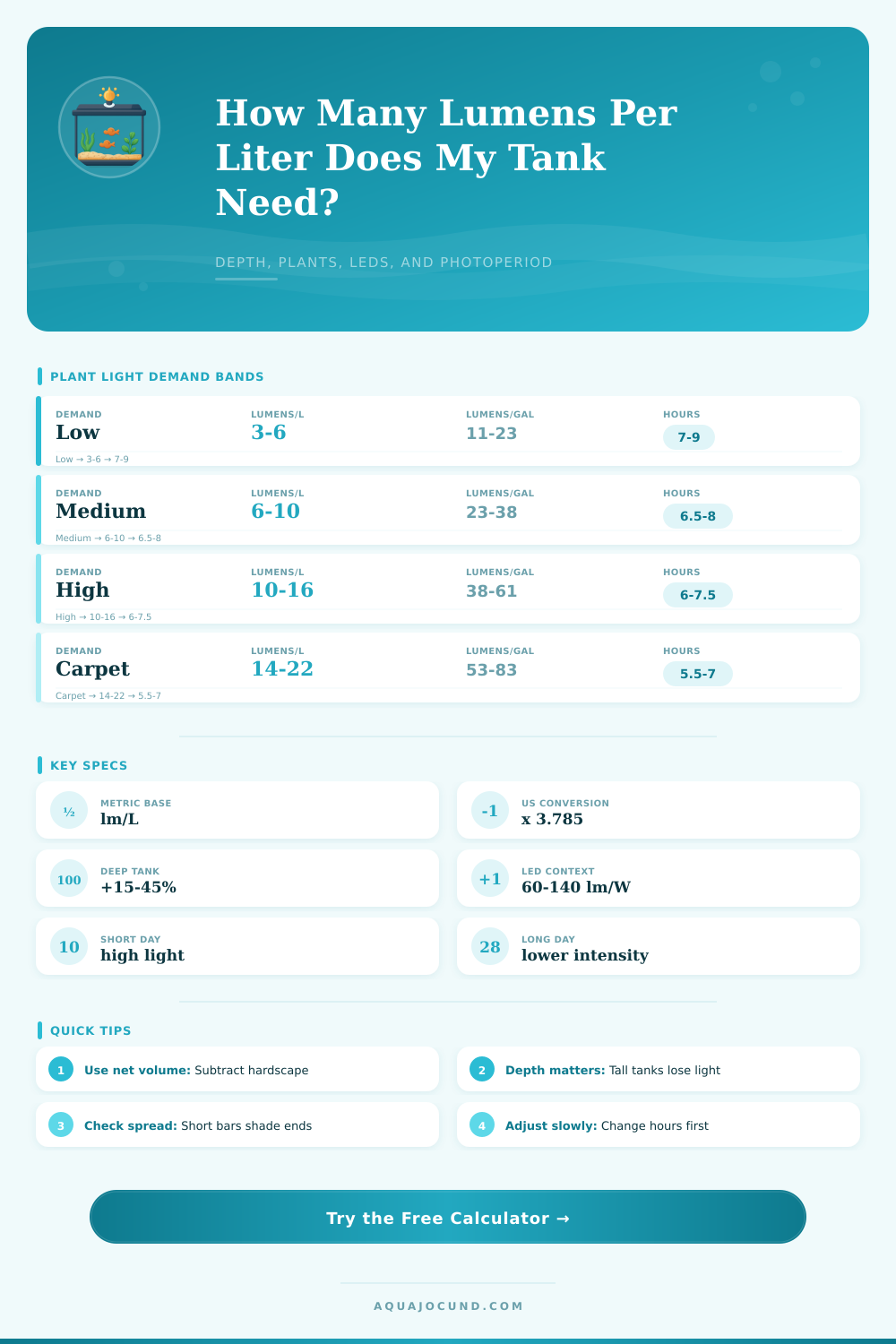
| Demand Band | Raw Lumens/L | Raw Lumens/Gal | Typical Photoperiod | Context |
|---|---|---|---|---|
| Blackwater / shaded | 1.5-4 | 6-15 | 6-8 hr | Tannins, floaters, very low plant demand. |
| Low plants | 3-6 | 11-23 | 7-9 hr | Moss, fern, Bucephalandra, Anubias, Crypts. |
| Medium planted | 6-10 | 23-38 | 6.5-8 hr | Most mixed community planted aquariums. |
| High planted | 10-16 | 38-61 | 6-7.5 hr | Dense stems, red plants, strong nutrition. |
| Carpeting foreground | 14-22 | 53-83 | 5.5-7 hr | Needs consistent CO2 and careful algae control. |
| Emergent / riparium | 8-14 | 30-53 | 8-11 hr | Leaves above water use light more directly. |
| Fixture Type | Typical lm/W | Spectrum Usefulness | Spread Note | Calculator Role |
|---|---|---|---|---|
| Economy white LED strip | 60-85 | Moderate | Narrow bars may shade front and back. | Good low-light starting point. |
| Standard planted LED bar | 75-105 | Good | Usually broad enough for shallow tanks. | Default mixed planted choice. |
| High output planted LED | 90-130 | High | Often dimmable; keep margin available. | Useful for high demand bands. |
| RGB planted LED | 55-95 | High visual color | Lower lumens can still grow plants well. | Correction favors spectrum quality. |
| Wide panel LED | 80-120 | Good | Even coverage reduces end losses. | Helpful over wider aquascapes. |
| T5HO fluorescent | 55-90 | Good | Very even if reflectors are clean. | Works as an older benchmark. |
| Tank | Dimensions | Volume | Medium Target | High Target |
|---|---|---|---|---|
| 30 L nano | 40 x 25 x 30 cm / 16 x 10 x 12 in | 30 L / 7.9 gal | 180-300 lm | 300-480 lm |
| 60 L standard | 60 x 30 x 33 cm / 24 x 12 x 13 in | 60 L / 15.9 gal | 360-600 lm | 600-960 lm |
| 80 L long | 80 x 30 x 33 cm / 31 x 12 x 13 in | 80 L / 21.1 gal | 480-800 lm | 800-1280 lm |
| 120 L planted | 90 x 40 x 35 cm / 35 x 16 x 14 in | 120 L / 31.7 gal | 720-1200 lm | 1200-1920 lm |
| 180 L display | 100 x 45 x 40 cm / 39 x 18 x 16 in | 180 L / 47.6 gal | 1080-1800 lm | 1800-2880 lm |
| 300 L display | 120 x 50 x 50 cm / 47 x 20 x 20 in | 300 L / 79.3 gal | 1800-3000 lm | 3000-4800 lm |
| Daily Hours | Intensity Adjustment | Best Match | Watch Point |
|---|---|---|---|
| 5-6 hr | Increase target by 10-18% | High tech starts, algae reset periods | Plants may need stable CO2 before lights on. |
| 6-7.5 hr | Baseline range | Most planted tanks | Good balance of intensity and control. |
| 7.5-9 hr | Reduce target by 5-12% | Low and medium demand tanks | Long days magnify excess light. |
| 9-11 hr | Reduce target by 12-25% | Riparium, viewing schedule, low light | Avoid pairing long days with high lm/L. |
The box says you’ll get lots of bright light, you buy the fixture but you don’t get that sudden burst of growth, you just get algae bloom. What’s going on? Water doesn’t act like air; light acts differrently under water. Water is generally pretty cloudy and it does not allow light to travel down very far before it fades (gets dimmer). Different tanks has different levels of clarity.
Photosynthesis cares about the spectrum much more then the total amount of light. In reality, lumens alone are rarely enough. After you input your fixture specs and dimensions, the calculator do the math. It forces you to face the fact that you can’t use the same lighting logic for a deep forty-gallon long as you would a shallow nano tank. It also eliminates the need to guess about unit conversions and depth coefficients.
Why Plant Tank Lighting Is Different
If you’re comparing two tanks that have similar dimensions but standard height(s), the raw lumens per liter figure are a pretty good place to start. But most of us don’t keep tanks that neatly fit inside such boxes, we have lids that shade top corners and hardscapes that block some of the bottom. Both of these things reduces the amount of light that reaches the surface of a plant’s leaves. That’s where the corrected value kicks in… it takes all of that lost light into account and gives you a number that represents what your plants is probably seeing instead of simply what the bulb is putting out.
Success in planted tanks depends heavily on depth (light doesn’t punch into water as well as air). Light is absorbed and scattered. So, if you have forty-five centimeters of water above your substrate, much of the light from the surface won’t reach it. Here’s where many newbies fall down. They see the rating on the package and automatically think it’ll work throughout the whole volume. It won’t.
The tool takes this into account. It considers how high your fixtures is mounted above water and how much water you actualy have in the tank. That depth correction matters more if you’re keeping a big display tank or a deep cube. Otherwise, you’ll either underestimate what a modest bar can do or overbuy a light.
The demand bands of plants goes beyond just those numbers. Some plants can be happy in the shade (Java fern, Anubias, etc.) and don’t care if you blast them with all-day light. Other plants are total opposite animals. Plants such as Dwarf Hairgrass or Monte Carlo is carpet plants. To have them grow and hold their place in the foreground, they want high intensity, well adjusted carbon dioxide injection, nutrient dosing, and more. If you put a carpeting plant in low light, then its stems will turn brown and its leaves melts.
This is all laid out in the reference table. It shows how much intensity should of been paired with each photoperiod. This matters to prevent unwanted algae and keep your biological balance intact. Note that these numbers also depend on LED efficiency. New planted LEDs are pretty efficient; they output lots of lumens per watt. But not all those lumens is equal. For example, a highly-lumen fixture with low blue/red spectrum coverage may appear very bright to our human eyes but be starving your plants of the wavelengths necessary for them to make chlorophyll. Efficiency bands in the calculator help put this into context: Is my light outputting something I can use (visible light) or merely heat/glare?
So, in conclusion, lighting a planted tank isn’t about brute force. It’s about balance. You don’t want too much light driving photosynthesis but you don’t want to little light that allows algae to outcompete plants either. Use the estimates from the tools as a starting point but rely on your eyes over all other metrics. Add a bit more duration if you feel like your plants need more, and then add some intensity if you feel they are still lacking. But cut down the hours first if algae starts appearing, as that is a small detail that matters.
Go slow and observe how your plants grow. And know there are many things happening here so don’t let light be the only thing. The goal isn’t to make your tank as bright as possible. The goal is finding the sweet spot which increases the growth of your plants while minimizing your tank becoming a green sludge factory. That balance will result in vibrant colors throughout the aquascape and keep the water clean and clear for months to come.