Lumens Per Gallon Calculator
Estimate aquarium lighting from fixture lumens, tank volume, depth, plant demand, coverage, water clarity, and photoperiod, with PAR and DLI checks.
💡Lighting Presets
📐Tank, Fixture, and Plant Inputs
Lighting Estimate
🔎Lighting Comparison Grid
🌱Plant Demand Targets
| Demand | Raw Lumens/Gal | Corrected Target | Estimated PAR Range |
|---|---|---|---|
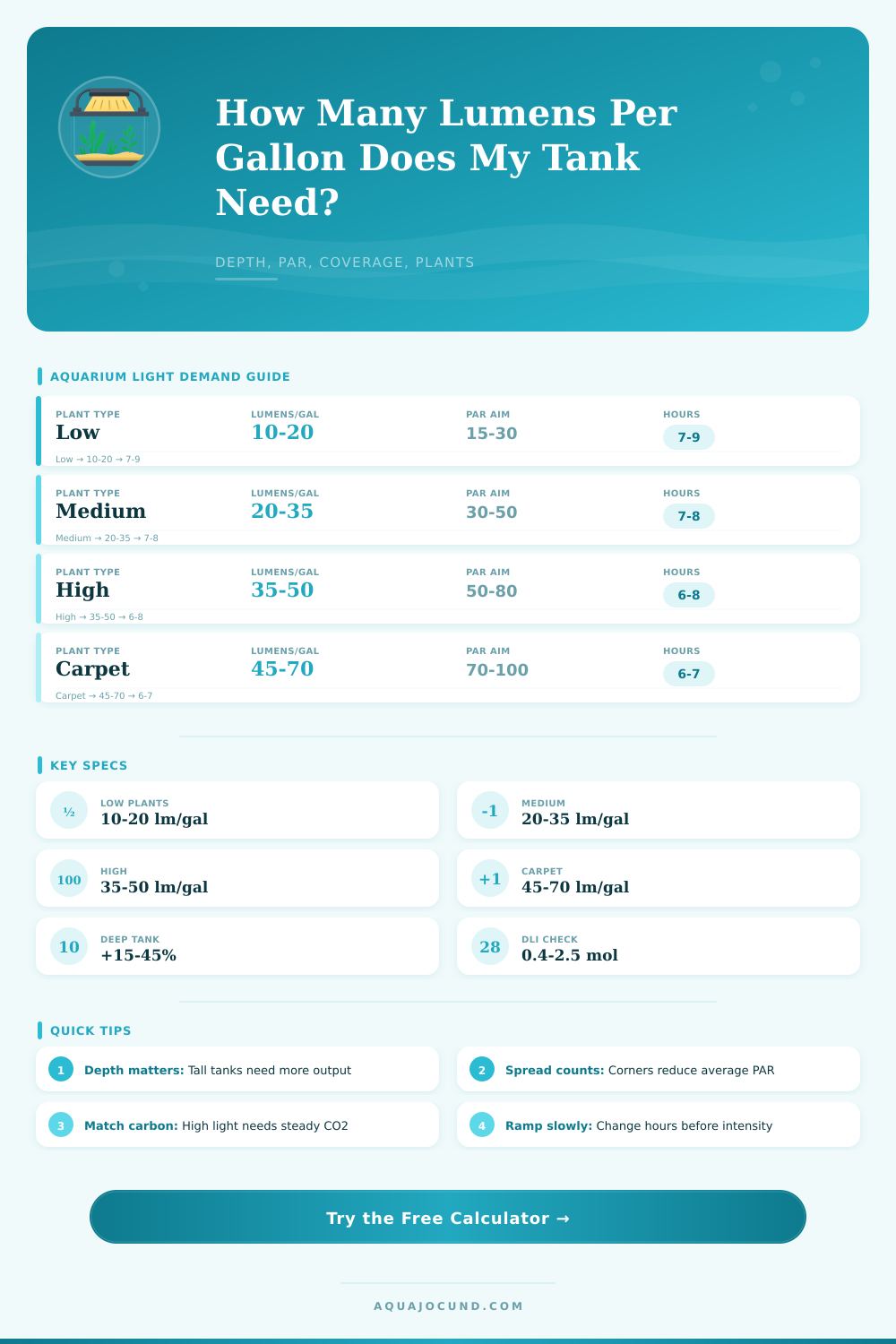
| Low moss, fern, Anubias | 10-20 | 12-24 usable | 15-30 PAR |
| Medium stems and rosettes | 20-35 | 24-42 usable | 30-50 PAR |
| High light planted tank | 35-50 | 40-60 usable | 50-80 PAR |
| Carpeting foreground plants | 45-70 | 55-84 usable | 70-100 PAR |
| Soft coral reef display | 30-55 | 35-65 usable | 60-120 PAR |
| High light reef zones | 55-90 | 65-105 usable | 150-250 PAR |
📊Fixture Type Comparison
| Fixture Type | Lumen Usefulness | Spread Behavior | Best Use |
|---|---|---|---|
| Basic white LED strip | Moderate | Even but shallow | Low demand tanks |
| Planted spectrum LED bar | Good | Wide front-to-back | Community planted tanks |
| High output RGB LED | High PAR per lumen | Strong center line | CO2 planted aquascapes |
| T5HO fluorescent | Predictable | Very even spread | Long tanks and grow-out |
| LED panel | Good | Soft wide coverage | Cube and breeder tanks |
| Pendant spotlight | PAR heavy | Narrow, shaded edges | Deep displays |
| Blue-heavy reef LED | Lumens understate it | Lens dependent | Coral-focused systems |
📏Depth and Coverage Corrections
| Tank Condition | Typical Loss | Correction | Notes |
|---|---|---|---|
| 10-12 in water depth | Low | 0-10% | Nano and shallow tanks |
| 14-18 in water depth | Moderate | 10-25% | Most community aquariums |
| 20-24 in water depth | High | 25-45% | Needs stronger fixture or lens |
| Dark tint or heavy floaters | Variable | 15-40% | Measure after trimming floaters |
| Short fixture on long tank | Edge loss | 10-35% | Use coverage percent input |
🐟Common Tank Size Reference
| Tank | Dimensions | Volume | Medium Target |
|---|---|---|---|
| 5 gallon nano | 16 x 8 x 10 in | 19 L | 100-175 lm |
| 10 gallon | 20 x 10 x 12 in | 38 L | 200-350 lm |
| 20 long | 30 x 12 x 12 in | 76 L | 400-700 lm |
| 29 gallon | 30 x 12 x 18 in | 110 L | 580-1015 lm |
| 40 breeder | 36 x 18 x 16 in | 151 L | 800-1400 lm |
| 55 gallon | 48 x 13 x 21 in | 208 L | 1100-1925 lm |
| 75 gallon | 48 x 18 x 21 in | 284 L | 1500-2625 lm |
| 125 gallon | 72 x 18 x 21 in | 473 L | 2500-4375 lm |
💧Lighting Calculation Tips
The standard wisdom amongst most aquarium keepers is that “the more light I give my plants, the better they grow.” While this holds true in many cases, you put up a powerful fixture and your expensive stem plant rot while the glass turns green with algae growth. Weak light isn’t necessarily the issue. In most of these situations, there is too much light for the chemical support structure you have created.
Raw lumens per gallon numbers are merely a general starting point, and don’t account for how water acts as a physical barrier. Water is different then air in how it conducts light. As photons travel from surface to substrate they get absorbed and scattered. Energy is lost. In a small shallow 10g bowl much of that remains. In a large deep 30″ display tank much of it have been lost before the light ever strikes the bottom where plants try to do their thing.
How to Choose the Right Light for Your Aquarium Plants
The calculator accounts for this loss due to water depth and clarity, taking into account any obstructions like a lid or floating debris on the surface. It also translates raw fixture output into usable light down at the substrate. That’s what distinguishes a plan from a guess. Your fixture might put out thousands of lumens, but before those light particles touch plants, twenty percent may be lost. So you’re actualy running on lower numbers than anticipated.
Output is important, but so is geometry of fixtures. Some lights are narrow spots (concentrate energy into one central hot spot), which can burns moss in the center while leaving edges in twilight. Other LEDs are wide panels (light spreads evenly) but is less intense per sq in. This calculator factors in those things, coverage percentages and beam angle, so it’s a good way for you to see that trade off visually. For instance, if you have a long tank with a short fixture you must up your target lumen count considerably because otherwise the ends will be dark. But it isn’t about making everything bright all at once. It’s about having consistent minimums from end to end. This ensures no part of the planted area drop below the point where plants stop growing and start decaying.
The other side of the equation is plant demand. High tech carpeting plants need high amounts of direct overhead sunlight to lay down fresh runners. Meanwhile, lower light plants like Java Ferns and Anubias does just fine on more modest levels of lighting reminiscent of a shaded forest stream. Meeting the livestock’s need for light means no extra stress on it.
Pushing high intensity light into a low nutrient tank lacking injected carbon dioxide invite algae growth. There’s too much energy with nowhere to go but into undesirable life forms. Keeping pace with fast growing plants’ metabolism mean good liquid dosing or steady gas injection to balance the system. This all ties together with light cycles, which has been a silent but key factor.
Whenever I find my rocks covered in green dust, many aquarists freak out and rush to turn down lights. Often times it’s counter-productive. Reducing the light period by 1 hour will decrease overall light exposure (which plants need) but not necessarily the peak intensity (which plants do not need). This way plants has a chance to recover from the day while having sufficient energy available when needed. The calculator factors this in as part of its conclusion, so you know whether or not your set-up should of needs more or less support.
In the end, the amount of wattage isn’t nearly as important as being precise in your aquarium lighting. The goal is enough light to encourage plant growth without having so much that it cause problems. Proper spread coverage and depth corrections guarantee that the released energy reach the intended destination. Combine this with available nutrients and the appropriate plant requirements and presto…you have a stable tank.
The plants take hold, the water clarifies, everything settles into place and the entire ecosystem hums along. As it turns out, doing the proper math initially can mean less drama later.