Lily Pipe Diameter Calculator
Size aquarium glassware from real canister flow, hose ID, planted tank style, target outlet velocity, and the number of outflows.
Lily Pipe Diameter Result
| Style | Target Velocity | Turnover Cue | Pipe Direction |
|---|---|---|---|
| Shrimp or fry safe | 2.5-4 cm/s | 3-5x per hour | Broad surface sweep |
| Low tech plants | 3-5 cm/s | 4-6x per hour | Gentle circular flow |
| Nature aquarium | 5-8 cm/s | 6-10x per hour | Front-to-back loop |
| Carpeted aquascape | 6-9 cm/s | 7-10x per hour | Low, even return path |
| High CO2 stem tank | 8-12 cm/s | 8-12x per hour | Long circulation loop |
| River style display | 12-20 cm/s | 10-15x per hour | Directional lengthwise push |
| Nominal Hose | Usual Hose ID | Matching Glass ID | Practical Flow Range |
|---|---|---|---|
| 8/12 mm | 8 mm | 8-9 mm | 40-140 L/h |
| 10/13 mm | 10 mm | 9-10 mm | 70-220 L/h |
| 12/16 mm | 12 mm | 10-13 mm | 150-520 L/h |
| 13/17 mm | 13 mm | 12-13 mm | 220-650 L/h |
| 16/22 mm | 16 mm | 13-17 mm | 350-1000 L/h |
| 19/25 mm | 19 mm | 17-20 mm | 700-1500 L/h |
| 25/34 mm | 25 mm | 20-25 mm | 1200-2500 L/h |
| Pipe ID | At 4 cm/s | At 7 cm/s | At 10 cm/s |
|---|---|---|---|
| 9 mm | 92 L/h | 160 L/h | 229 L/h |
| 10 mm | 113 L/h | 198 L/h | 283 L/h |
| 12 mm | 163 L/h | 285 L/h | 407 L/h |
| 13 mm | 191 L/h | 335 L/h | 478 L/h |
| 16 mm | 290 L/h | 507 L/h | 724 L/h |
| 17 mm | 327 L/h | 572 L/h | 817 L/h |
| 20 mm | 452 L/h | 792 L/h | 1131 L/h |
| 25 mm | 707 L/h | 1237 L/h | 1767 L/h |
| Outlet Type | Effective Area | Best Use | Diameter Effect |
|---|---|---|---|
| Standard lily flare | 100% | General planted tanks | Baseline |
| Mini lily pipe | 95% | Nano aquariums | Slightly higher velocity |
| Spin pipe | 120% | Soft circular flow | Can be a bit smaller |
| Poppy pipe | 135% | Gentle surface spread | Can be smaller for calm flow |
| Jet pipe nozzle | 70% | Long directional push | Needs larger ID for same velocity |
| Violet high flow pipe | 85% | Strong planted circulation | Moderately larger ID |
| Calm wide mouth | 150% | Broad low-velocity return | Smaller tube, broad mouth |
| Glass spray bar | 110% | Distributed return | Per-hole velocity matters |
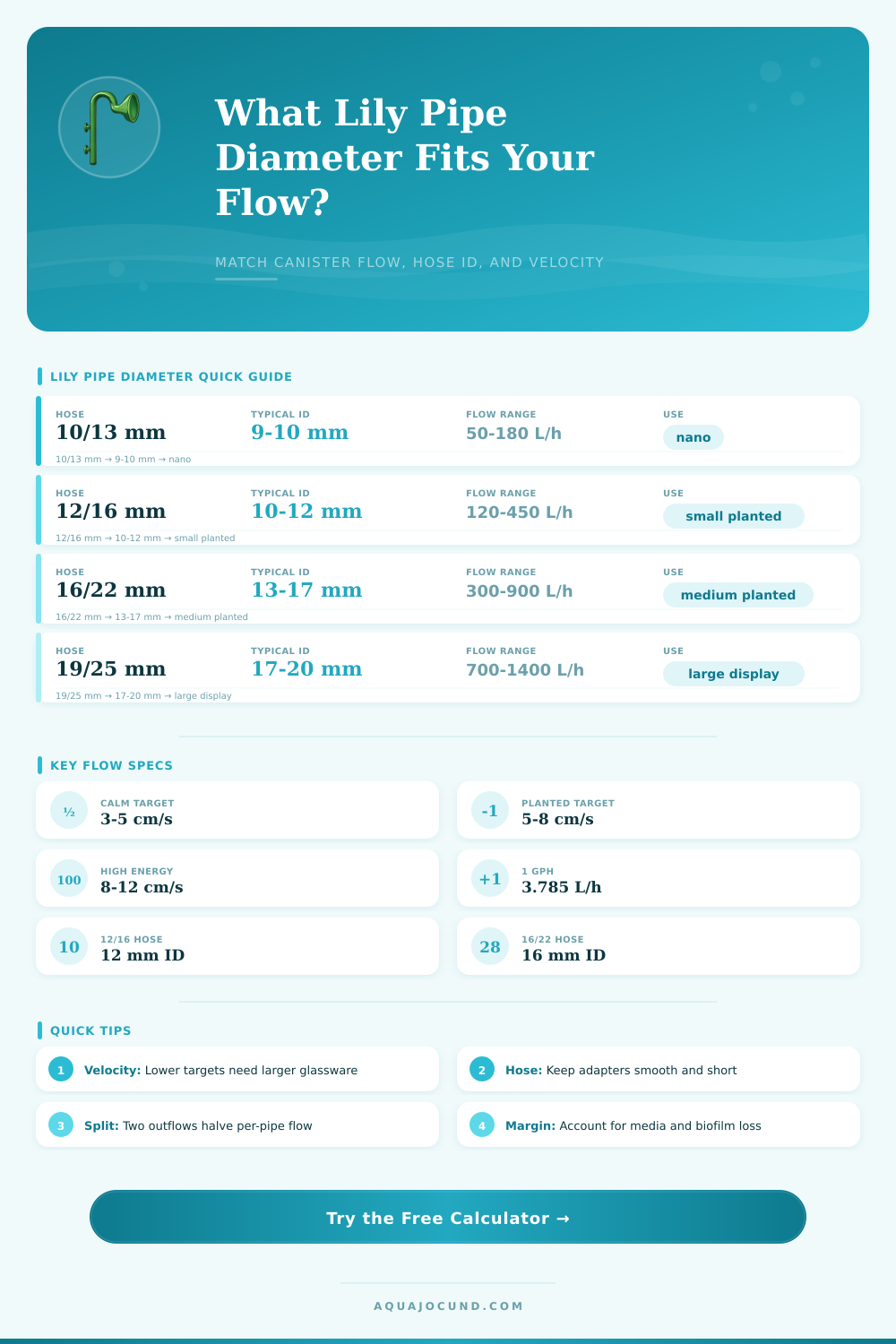
In order to choose a correct lily pipe for your aquarium, it is first necessary for you to understand the relationship between water velocities within the aquarium and the actual flow of water that exit the canister filter. A lily pipe that is too narrow will create a high velocity of water that can potentially damage the aquarium plants and livestocks. A lily pipe that is too wide will create a low velocity of water that may not effectivelyly move the debris within the aquarium or provide sufficient level of carbon dioxide to the aquarium’s inhabitants.
The types of lily pipe that you should select is dependent upon the measured return flow from the canister filter. The return flow from the filter is often less than the flow indicated by the rated capacity of the canister filter. The factor that contribute to the reduction of the return flow include the presence of filter media, the bend within the tubing, the presence of heaters, and the potential for the formation of biofilm within the lily pipe.
How to Choose the Right Lily Pipe for Your Aquarium
The velocity of the water that exits the lily pipe will determine the type of lily pipe that you should choose for your aquarium. For instance, if your aquarium feature plants that have broad leaves, you should choose a lily pipe that provides a gentler velocity of water to those plants. For aquarium plants that have leaves that grow in a stem fashion, you will need to ensure that the water velocity from the lily pipe is strong to ensure that the nutrients reaches each leaf of the plant.
Finally, if your aquarium contain small creature like shrimp or fry, you will want to ensure that the lily pipe provides a broad but slow water flow to prevent the shrimp and fry from being swept into the intake of the filter. The internal diameter of the hose will influence the function of the selected lily pipe. If you choose a lily pipe that is significantly smaller in diameter than the hose return from which the water is exiting the canister filter, then the lily pipe will create back pressure within the filter.
The creation of back pressure will force the filter to work harder to move the water through the system. In contrast, if the diameter of the lily pipe is similar to the diameter of the hose, the restriction of water through the lily pipe will be low. However, the velocity of the water through the lily pipe may be too high for the aquarium inhabitant.
The shape of the return of the lily pipe can also influence the velocity of the water. For instance, a lily pipe having a wide-mouth or poppy-shaped return will spread the water that emerges from the lily pipe over a more expansive area, resulting in a calmer water flow. In contrast, a lily pipe that has a nozzle-shaped return will focus the water from the canister filter in a specific area.
In some instance, you can employ the split returns with your lily pipes. Split returns allow for the division of the total water return of the canister filter to be distributed into two or more lily pipes. For instance, if you employ two lily pipes, the canister filter will divide the water return between the two lily pipes.
Each pipe will have a smaller diameter than the hose that distribute the water to the aquarium. The same mathematical concept can be applied to three lily pipes for those who wish to employ the return water from canister filters into very large aquarium display. Another thing to account for when choosing the appropriate lily pipe for your aquarium is the margin for loss.
Over time, biofilm will begin to build up within the lily pipe. Therefore, you will want to account for that loss in your calculations for the diameter of the lily pipe. It is likely that the lily pipe will become more restrictively over time due to the biofilm.
Thus, you should of account for some headroom in your calculations for the size of the lily pipe. By choosing the correct lily pipe, the surface of the water will remain gently broken, the detritus from the aquarium will move toward the intake return into the aquarium, and the plants will exhibit steady growth within the aquarium display.