Light Duration Ramp Calculator
Plan aquarium light ramp-up or ramp-down schedules from starting photoperiod, target duration, PAR, CO2 stability, plant mass, tank maturity, nutrients, and algae pressure.
💡Aquarium Light Ramp Presets
⚙Light Ramp Inputs
Light Ramp Schedule Estimate
🧭Ramp Strategy Comparison Grid
📊PAR and Photoperiod Load Reference
| Average PAR | Light category | Typical duration | Ramp note |
|---|---|---|---|
| 15-30 PAR | Low light | 7-9 hours | Slow plant growth, lower algae pressure |
| 30-50 PAR | Moderate low | 6.5-8.5 hours | Good for easy plants and low-tech tanks |
| 50-80 PAR | Medium planted | 6-8 hours | Balance with consistent nutrients and flow |
| 80-120 PAR | High planted | 5.5-7.5 hours | CO2 stability becomes a limiting factor |
| 120+ PAR | Very high light | 4.5-6.5 hours | Use careful ramps and dense plant growth |
🌱Tank Condition Adjustment Table
| Condition | Lower risk cue | Higher risk cue | Schedule adjustment |
|---|---|---|---|
| CO2 timing | Stable before lights | Late or fluctuating CO2 | Slow ramp or hold |
| Plant mass | 60%+ active growth | Open substrate and sparse stems | Use smaller steps |
| Tank age | Stable for 6+ months | First 6 weeks | Add observation days |
| Nutrients | Repeatable dosing | Skipped or unknown dosing | Fix routine before more light |
| Algae trend | Declining or absent | Spreading fresh growth | Ramp down or pause |
⏱Common Aquarium Light Ramp Schedules
| Scenario | Start | Target | Recommended pace |
|---|---|---|---|
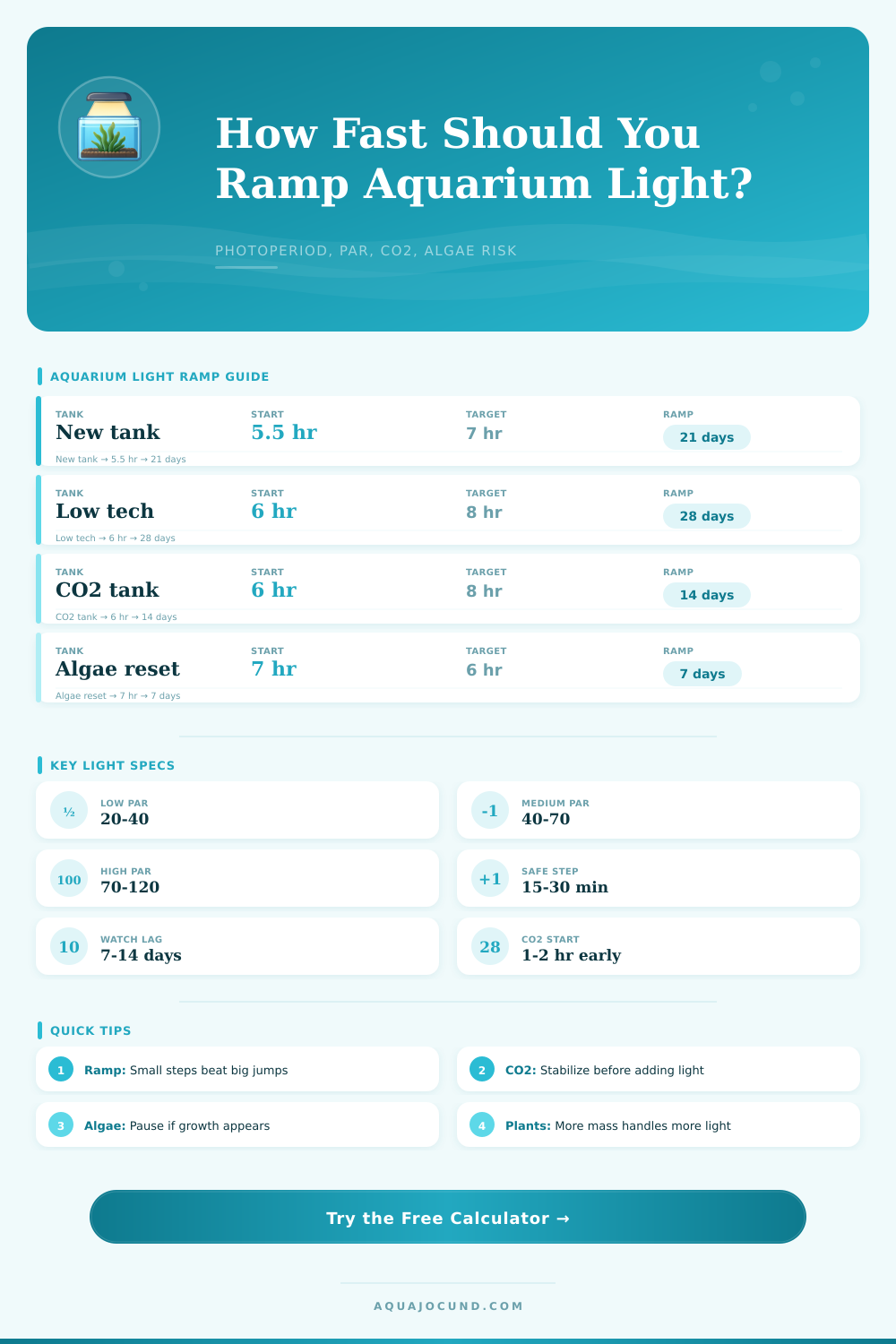
| Freshly planted low-tech tank | 5-6 hr | 7-8 hr | 15 min every 7-10 days |
| Established low-tech tank | 6 hr | 8 hr | 30 min every 7 days |
| Injected CO2 aquascape | 6 hr | 7.5-8 hr | 30 min every 4-7 days |
| High PAR carpet tank | 5.5 hr | 7 hr | 15-30 min with close observation |
| Algae correction period | 7-8 hr | 5.5-6.5 hr | Reduce in 30-60 min steps |
| Split siesta schedule | Two blocks | Same total hr | Keep total duration conservative |
🔬CO2 Stability and Algae Risk Guide
| CO2 state | Light tolerance | Risk pattern | Calculator interpretation |
|---|---|---|---|
| No added CO2 | Lower PAR and moderate duration | Light can exceed carbon supply | Conservative ramp recommended |
| Liquid carbon only | Similar to low-tech tanks | Not a substitute for gas stability | Small duration changes work best |
| Injected but unstable | Limited until timing improves | Hair algae and plant stalling | Hold or slow ramp |
| Mostly stable injection | Moderate to high planted loads | Risk rises with big jumps | Balanced ramp usually works |
| Stable before lights | Best support for longer duration | Still limited by nutrients and plant mass | Faster ramp may be acceptable |
You buy a new LED fixture and turn it on for hours at full brightness. It works. For a while. You look in the tank and everything looks nice initially. But then there’s algae everywhere on the glass. Instead of having bright stem plants, they might even start looking stressed. Before long, you’re not growing an aquarium garden…you’re fighting algae.
This is the most common mistake that most aquascapers make: treating light as a switch. Light is fuel. If you add too much fuel all at once, the fire gets out of control. Biological lag are the primary problem.
Why You Should Increase Tank Light Slowly
When you step up your lights (duration and/or intensity), it doesn’t mean plants will immediately wake up. They require time to adjust their photosynthetic machinery. Rooted plant are slower than algae, which act as opportunistic scavengers. Jumping from six hours to ten overnight simply means excess energy. There’s no efficient consumer for that energy at that point. You don’t get lush. What you get is usually something like black beard algae or brown string algae covering all surface.
A gentle ramp lets both the increasing light load and the ecosystem itself mature together. Once you input your unique variables, the above calculator does the math for you. There’s no more guessing how aggressively you should of push it. This is because it takes into account the relationship between plant biomass, carbon availability, and photon flux. And based off that, it recommends a pace that maintains balance. If you understand what factors into those recommendations, you’ll trust them too. Because you’ll know when the tool says to go slow, you’ll know why.
Now, there is such a thing as PAR (Photosynthetically Active Radiation), which is the real amount of light energy that becomes usable by the plant during photosynthesis. For example, a high PAR tank that blasts out a hundred units will have a higher risk of causing an algae outbreak compared to a low PAR tank that only runs thirty units. That means that a lower PAR tank can get away with a longer photoperiod different than a high PAR tank. The total daily light integral is calculated using this number in the calculator. In other words, it’s asking how much total energy your plants receive within a twenty-four hour period. If it’s low, you should go faster. If it’s high, you need to slow down the ramp.
However, perhaps the least considered aspect of those choices is carbon dioxide stability. Light is used by plants to grow, they require CO2 for that purpose. When you increase your photoperiod without providing some amount of stable CO2 injection prior to lighting up, it’s an issue. Imagine applying additional throttle pressure to your vehicle while depressing the brake pedal. The engine doesn’t go faster; it overheats. Use smaller increments if your CO2 injection is spiking wildly or is absent. Longer observation periods will help prevent you from exceeding the system’s metabolism.
Plants act as a buffer. Carpet plants and/or moss also absorbs light rapidly to compete with algae. They are great at out-competing algae. Plants may be sparse, perhaps with only a few stems in an otherwise bare substrate. This leaves lots of energy available for opportunistic invaders to use. To account for this, the calculator rates your tank’s risk level based on how much you think is covered. If there are lots of plants, that means lots of consumers. Maybe a slightly faster increase would be OK. Not many plants? Be patient.
A mature tank is different because newly set-up tanks are still immature, chemically speaking. As beneficial bacterial colonies develops, nitrates and phosphates fluctuate dramatically. Introducing light stress at this time sets you up for trouble. Mature tanks present stable water conditions with known levels of nutrients. They’ve developed a cycle. That means you can be more aggressive. To me, that’s the difference between a one-year-old display vs. This is a newly set-up tank (e.g., 6 weeks). That changes the timeline.
And there’s your dashboard warning light: Algae means it’s time to cut back on fuel addition. That is especially true if it is already growing a moddern amount. First reduce duration or intensity before you do anything else. Fortunately, the calculator knows that and will suggest a gradual decrease if that describes your situation. Starve algae by reducing light duration by 15 minutes every few days. Plants won’t mind. Take away is usually easier than giving. But still, gradually.
The most inexpensive nutrient for any tank is patience. Moving too quickly with your light schedule costs you in treatment chemicals. It also costs you hours of scrubbing glass. Going slow does not cost you anything other than time. If you’re serious about this hobby then you have plenty of time. Go slow, start small, observe carefully, and let the plants show you the way.