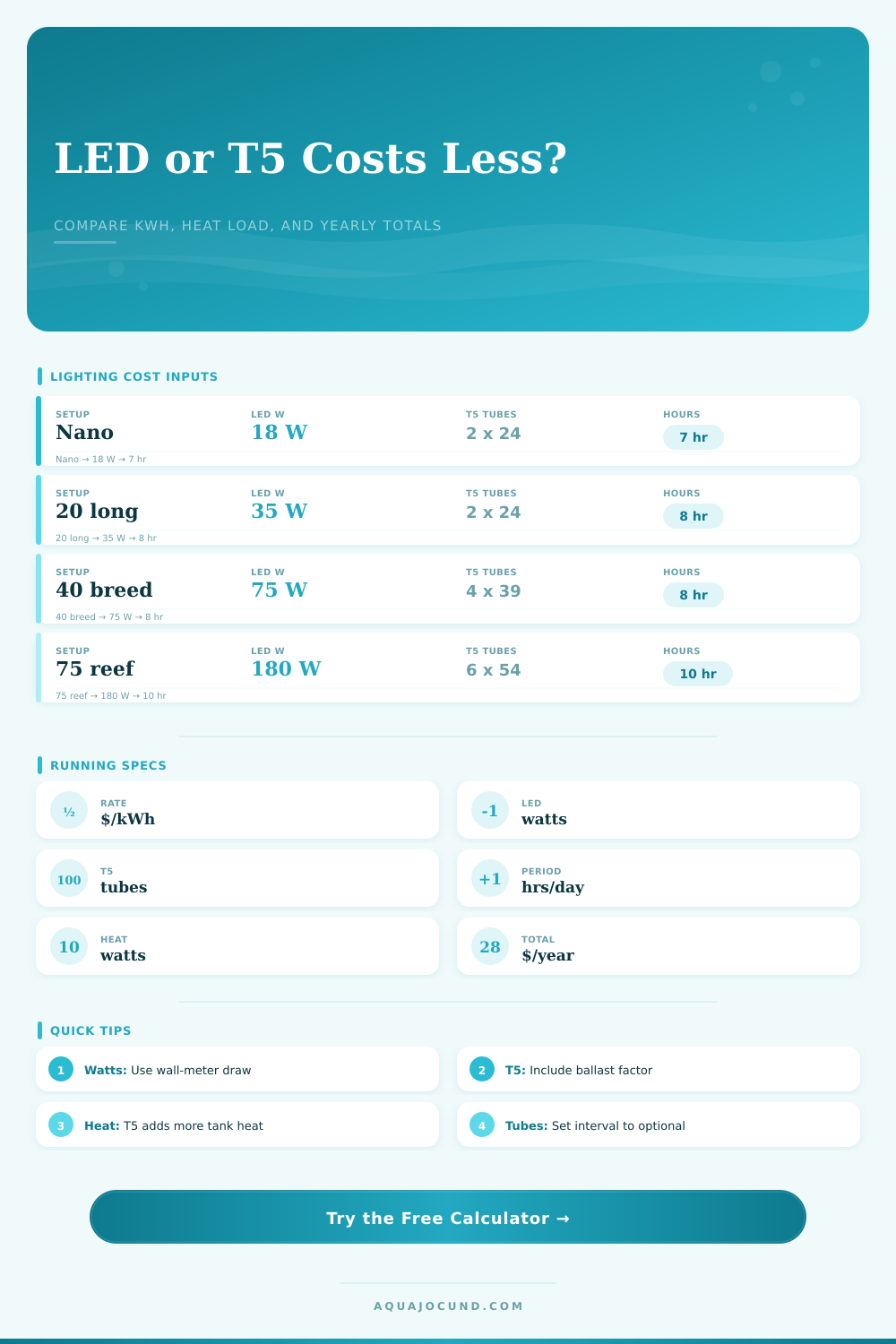
LED vs T5 Running Cost Calculator
Compare aquarium light energy use, annual electricity cost, optional lamp replacement allowance, and heat load from LED and T5 fluorescent setups.
Calculation Breakdown
| Lighting Setup | Typical Input | Annual kWh at 8 hr/day | Heat Note |
|---|---|---|---|
| Small LED strip | 15-30 W | 44-88 kWh | Low radiant and canopy heat |
| Medium LED planted light | 45-90 W | 131-263 kWh | Depends on dimming and mounting |
| 2 x 24 W T5HO | 50-55 W with ballast | 146-161 kWh | Noticeable fixture warmth |
| 4 x 39 W T5HO | 160-170 W with ballast | 467-496 kWh | High canopy heat potential |
| 6 x 54 W T5HO | 335-355 W with ballast | 978-1037 kWh | Strong water and room heat load |
| Large reef LED array | 150-300 W average | 438-876 kWh | Fan-cooled heat mostly to room |
| Tank | Typical LED Draw | Comparable T5 Setup | Typical Annual Energy Gap |
|---|---|---|---|
| 5 gal nano / 19 L | 8-18 W | 1-2 compact T5 tubes | Small, schedule dependent |
| 10 gal planted / 38 L | 15-30 W | 2 x 24 W T5HO | About 50-100 kWh |
| 20 long / 76 L | 30-50 W | 2 x 24 W T5HO | About 10-70 kWh |
| 29 gal community / 110 L | 35-65 W | 2 x 24 W or 2 x 39 W | About 40-170 kWh |
| 40 breeder / 151 L | 60-100 W | 4 x 39 W T5HO | About 150-300 kWh |
| 55 gal planted / 208 L | 80-130 W | 4 x 54 W T5HO | About 250-420 kWh |
| 75 gal reef / 284 L | 140-220 W | 6 x 54 W T5HO | About 350-700 kWh |
| 125 gal display / 473 L | 220-360 W | 8 x 54 W T5HO | About 450-900 kWh |
| Component | Common Interval | Calculator Entry | Running Cost Role |
|---|---|---|---|
| T5HO tube | 9-18 months | Cost per tube x tube count | Annualized if enabled |
| LED fixture or cluster | 48-84 months | Cost per fixture x count | Optional allowance only |
| Hybrid LED + T5 | Separate schedules | Use T5 fields for tube portion | Shows tube service load |
| No replacement estimate | Leave unchecked | Energy only comparison | Keeps annual electricity pure |
| Step | Formula | Uses | Output |
|---|---|---|---|
| LED effective watts | Fixture watts x count x output % | LED draw and dimming | Input watts |
| T5 effective watts | Tube watts x tubes x ballast % | T5 lamps and ballast | Input watts |
| Annual energy | Watts / 1000 x hours x 365 x days/7 | Photoperiod schedule | kWh/year |
| Annual energy cost | Annual kWh x rate | Electricity rate | Cost/year |
| Heat load | Watts x heat % and watts x 3.412 | Water heat estimate | W and BTU/hr |
| Replacement allowance | Cost x count x 12 / interval | Optional lamp service | Annual amount |
LED lighting = lower electric bill, right? It doesn’t quite work out like it sounds in retail packaging.
Moddern LED arrays aren’t only different than T5 fluorescents in terms of color range and light output. There’s also the question of how the array translate to your electric meter, and what that mean in running costs for a year’s worth of daily operation. Running expenses matter, and they can be a big surprise when someone expects watts to simply equal watts.
True Cost of LED vs T5 Lights
Cost comparisons starts with this: the rate you’re paying per kilowatt hour for electricity. If your rate is expensive (which it likely is for many readers), every watt matters far more then it would if you were on a heavily subsidized grid. Most people gloss over that detail, as they stare at the price of the fixture but not the monthly dent its going to put into their pocketbook.
Plug your own rates into the calculator above, and it will do the number-crunching for you. You don’t need to memorize conversions or coefficients here. Just plug in your actual photoperiod and let it convert raw watts consumed to an annual dollar amount you can plan around.
The hidden variable that makes all the difference with T5s is ballast efficiency. The rated power of bulb may be forty watts, but adding the overhead of electronic or magnetic ballast changes that. Every hour they’re on, you’re paying for that additional drag. Typically, driver of LEDs is more efficient than the electronics that drive tubes, but you still need to account for the actual wall draw versus just diode rating. Nameplate ratings can be optimistic so using a plug-in watt meter is the cleanest way to get a comparison. It is a small detail, but it matter when you want to know where your money goes. This is your wallet.
Another consideration is heat load, though it’s an indirect effect on your wallet. T5 tubes tends to shed quite a bit of their energy as heat to both the canopy area and to the water itself. This puts more work on your air conditioner or aquarium chiller. Because LEDs are cooler, they aren’t passive. However, what little heat they produce is generally pushed away from the tank using fans that push that thermal load in the room air. Depending upon where you live, this redistribution of heat could have an impact on your total HVAC bill. The tool lets you adjust the percentage of heat being transferred to the water. This allows you to calculate the impact so you can better understand the full thermal effect.
Many hobbyists forget to factor in replacement intervals. Typically the T5 tubes will need to be replaced every year or two as they dim and their light quality shift. While LEDs are longer-lived, they too will fail eventually and also experience some degradation. By splitting out hardware maintenance from energy we get a clearer picture of the annual cost without needing to look solely at your electricity bill (which spreads the cost of replacements across time). This also maintain transparency around running costs by separating energy use from hardware maintenance. This allows you to decide if you want to see a purely energy-based comparison or a total cost of ownership comparison. You can choose to include or not include the cost of replacement.
The saving could be minimal for small nano tanks. At this scale, the number of kilowatt-hours used isn’t significant enough, especially since even the “absolute” difference between them will be very small. It’s more about aesthetics and convenience rather than cold hard cash at this level.
However, when you start getting into reefs, large planted tanks, etc., then the savings becomes much greater. Six T5 tubes on a high-output reef setup will consume a lot of electricity annually. This means a noticeable monthly cost which could of been reduced dramatically if you swap those out for the same size LED tube light. You’ll go from seeing a big line item on your monthly bill to something far less significant.
What this all boils down to is (it depends). It depends off your set up, your cost of electricity, etc. What works in one person’s house may not work in yours. That’s just as true for lighting as any other aspect of keeping fish. This calculator lets you calculate what it will mean for you based on the details that are relevant to you. Run it, trust the result, and use the reference tables on the page to get an idea of what sort of tank these represent so you can see how yours might fit into the mix. Use the input variables and have confidence in the results. Stop wondering if you should spend the money on the new light or not and know precisely what it will cost you to illuminate your tank.