LED Lifespan Hours Calculator
Estimate L70 wear, daily equivalent hours, replacement timing, and remaining output for aquarium LED fixtures.
| Operating Style | Channel Load | Heat Factor | Lifespan Effect |
|---|---|---|---|
| Open-top low-tech planted | 45-60% average | 0.85-1.00x | Often extends calendar L70 well past rating |
| General community display | 60-75% average | 1.00x | Usually tracks close to rated life |
| High-output reef schedule | 75-95% average | 1.05-1.25x | Shortens calendar life unless cooling is strong |
| Closed canopy with weak airflow | 70-100% average | 1.30-1.55x | Can reach useful replacement threshold early |
| Tank Use | Peak Hours | Ramp Hours | Typical Replacement Check |
|---|---|---|---|
| Low-light betta or shrimp tank | 6-7 h | 0-1 h | PAR check around year 8-10 |
| Moderate planted community | 7-8 h | 1-2 h | PAR check around year 6-8 |
| High-light aquascape | 8-9 h | 1-2 h | PAR check around year 5-7 |
| Reef with blue-heavy program | 9-10 h | 2-3 h | PAR check around year 4-6 |
| Frag or grow-out system | 10-12 h | 1-2 h | PAR check around year 3-5 |
| Output Target | Equivalent Hours vs L70 | Aquarium Meaning | Action |
|---|---|---|---|
| 90% output | About 30% of L70 rating | Small PAR drop, usually hard to see | Record baseline PAR if possible |
| 85% output | About 46% of L70 rating | Higher-demand plants or coral may notice | Compare readings at same settings |
| 80% output | About 63% of L70 rating | Useful early replacement point for reefs | Plan cleaning, recalibration, or replacement |
| 75% output | About 81% of L70 rating | Visible reduction on demanding systems | Replace or raise intensity carefully |
| 70% output | 100% of L70 rating | Standard L70 endpoint | Replace for light-sensitive livestock or plants |
| Fixture Condition | Factor | What It Means | Check |
|---|---|---|---|
| Cool open-top mount | 0.85x | Good airflow lowers thermal stress | Heat sink feels warm, not hot |
| Normal ventilated fixture | 1.00x | Use the rated L70 baseline | Fans and vents stay clear |
| Warm canopy or glass cover | 1.15x | Extra heat accelerates lumen loss | Salt creep and dust cleaned monthly |
| Hot enclosed hood | 1.30x | Calendar life can shrink sharply | Add airflow or reduce drive level |
| Blocked fan or failed cooling | 1.55x | High-risk thermal operation | Repair cooling before extending schedule |
After installing a new LED fixture on your tank, you see water looks clear and plants are vibrant. You think it’s an upgrade that will last for a while. But LEDs don’t burn out like those old incandescent bulbs. Instead they fade. And that fading occurs gradualy over many years until the plants no longer grows well or corals becomes less colorful.
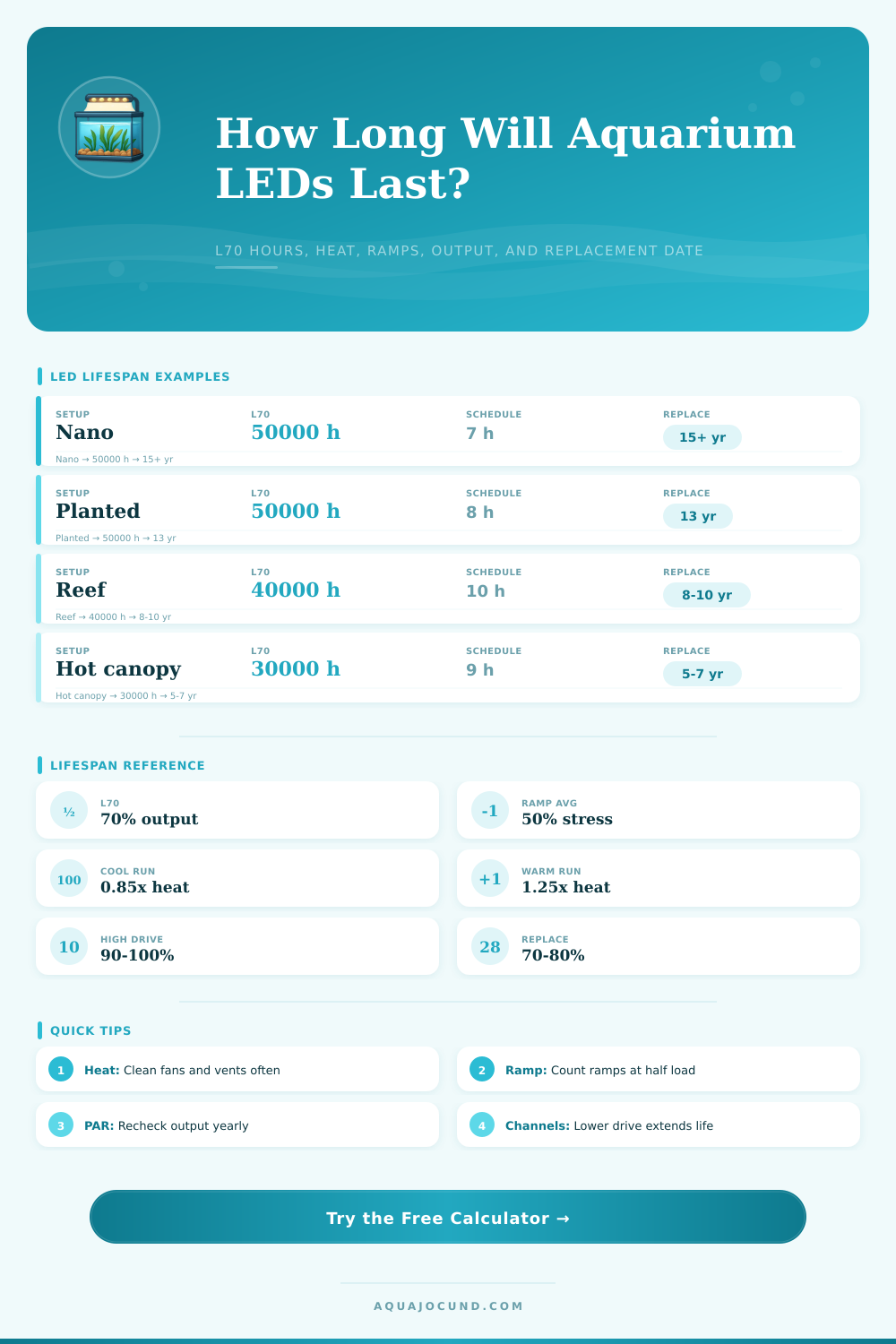
Entering your heat conditions and schedule into calculator does the math for you, allowing you to estimate how long the light will be effective. Many fixtures is rated for X number of hours of full intensity usage in ideal cool operating temperatures. Not your tank. Not in the real world. You operate your light on a schedule that includes gradual ramps. You have them mounted in a hood that retains heat. You also set their output to match requirements of the occupants.
How to Make Your Aquarium Light Last Longer
That’s why calculator considers these real-world factors by assuming that ramp times equate to half load stress vs. Full-on burn. And it adds multipliers for heat. Why? Because heat will shorten lifespan of LEDs. As semiconductor junctions run hot, they degrade faster. So those rated 50,000 hours will be gone much sooner when there’s little or no ventilation.
Hobbyists get confused by the term L70 life as if lights should of last till end of time or not at all. L70 is just the point that output has diminished to only 70% of the original brightness. That may not be noticeable in a low tech planted tank. In a high PAR reef system with intense lighting programs, this is line between healthy coral growth and bleached-out tissue death. To tweak this endpoint, just change replacement threshold setting on the tool. Serious reefers concerned with livestock health will probably bump up the limit. At that point the tool calculates estimated calendar date that you’d want to think about replacing unit prior to loss of performance.
It’s typically here that difference between theory and reality get wider. Lowering thermal stress is what makes a cool open-top fixture so much better than an enclosed hood with a failed fan. This oven effect causes light to fade much fasterer. Here’s how various ventilation scenarios affects effective lifespan based off the reference table on the page. Notice why it isn’t just aesthetics when you clean fans every month to remove accumulated dust. It protects your investment in lighting technology.
Intensity of the channel are more important than most realize. Cranking a fixture to 100 percent on high-light aquascaping is much more stressful then running it at 40 percent in a betta tank. Lower drive levels is considered to be lower wear, so they extend the diode‘s useful life. This encourages a thoughtful approach toward scheduling. Rather than blast maximum power all day long, schedule longer photoperiods at moderate intensities. Not only does this mimic natural light cycles better, but your livestock will generaly like it better because it eliminates algal blooms and other visual fatigue caused by harsh peaks.
You can only know if it works by testing it; or by measuring it. Take initial measurements (with a PAR meter) at the time of purchase. This provides a solid benchmark to compare later results and see if drop-off follows the trend line. Physics (unlike marketing stats) doesn’t lie. Using your PAR meter provides a real starting point and allows you to know how much the intensity has dropped over time. Don’t get suckered into increasing the wattage, which would be pointless anyway. All you’ll succeed in doing is adding more heat and stress to already-aging diodes. This creates a vicious cycle that speeds up their failure.
In the end it just makes sense, if you can change out your light before it fails in the middle of a delicate coral acclimating process or that special fish spawn then you are set. You don’t have to scramble, rush and spend money on a new one because corals aren’t growing well. You will eventually notice a decline. But with some reality and reasonable expectation, you know how long it’ll last. This lets you plan to match and save up for an upgrade in a relaxed manner. By keeping the hardware clean and cool, you can get as much performance out of those rated hours as possible. When you take care of the hardware, that new shine lasts longer.