Lanthanum Chloride Phosphate Dose Calculator
Estimate a cautious lanthanum chloride dose from tank volume, measured phosphate, target phosphate, product strength, dilution, drip time, and capture efficiency.
Calculated lanthanum chloride plan
| System | Net water | 0.10 ppm PO4 | La needed | 6.7 mg/mL product |
|---|---|---|---|---|
| 20 long reef | 18 gal / 68 L | 6.8 mg PO4 | 10.0 mg La | 1.5 mL before split |
| 40 breeder | 36 gal / 136 L | 13.6 mg PO4 | 19.9 mg La | 3.0 mL before split |
| 75 gal reef | 68 gal / 257 L | 25.7 mg PO4 | 37.6 mg La | 5.6 mL before split |
| 125 gal display | 113 gal / 428 L | 42.8 mg PO4 | 62.6 mg La | 9.3 mL before split |
| Input type | What it means | Formula used | Best use |
|---|---|---|---|
| mg La per mL | Elemental lanthanum concentration | dose = mg La need / strength | Labeled aquarium removers or known DIY stock |
| Percent anhydrous LaCl3 | Mass percent of LaCl3 without water of hydration | mg La/mL = percent x density x 1000 x 0.5663 | Lab or pond products with clear assay data |
| Percent LaCl3 . 7H2O | Mass percent of hydrated lanthanum chloride | mg La/mL = percent x density x 1000 x 0.3740 | Hydrated salts and dry crystal calculations |
| Dry stock mix | Known dry grams made up to final milliliters | mg La/mL = dry grams x La fraction x 1000 / stock mL | Custom diluted dosing reservoirs |
| Situation | Daily PO4 drop | Drip window | Mechanical capture |
|---|---|---|---|
| First use on a stocked reef | 0.03 to 0.05 ppm | 4 to 12 hours | 1 to 10 micron with close observation |
| Routine maintenance dose | 0.05 to 0.10 ppm | 2 to 8 hours | 5 to 10 micron sock or roller mat |
| High phosphate correction | 0.10 to 0.20 ppm | Split across repeated sessions | Fresh fine media, changed as it loads |
| Coarse filtration only | Use a smaller test dose | Slow drip only | Upgrade capture before large corrections |
| Tank name | Typical dimensions | Display volume | Typical net water |
|---|---|---|---|
| 10 gallon | 20 x 10 x 12 in | 10 gal / 38 L | 8 to 9 gal after decor |
| 20 long | 30 x 12 x 12 in | 20 gal / 76 L | 17 to 19 gal after decor |
| 40 breeder | 36 x 18 x 16 in | 40 gal / 151 L | 34 to 37 gal after decor |
| 75 gallon | 48 x 18 x 21 in | 75 gal / 284 L | 64 to 70 gal after decor |
| 125 gallon | 72 x 18 x 21 in | 125 gal / 473 L | 106 to 116 gal after decor |
Your phosphate test indicates a little too much phosphate. You pick up lanthanum chloride container. It’s going to grab the phosphates and bind them as a solid that won’t dissolve. But beware, it doesn’t forgive missing the mark. Dosing strategy is what typically make the difference between a clear and a clouded tank, not the chemical being used.
Just as with a vitamin pill, most hobbyists tend to use full dose all at once. It is rarely the right answer. It’s easy math, until you quit doing it in your head. How much lanthanum do you actualy have in the bottle? It is not about how many milliliters of solution you have, but how many milligrams (or micrograms) of actual lanthanum.
How to Use Lanthanum Chloride Safely
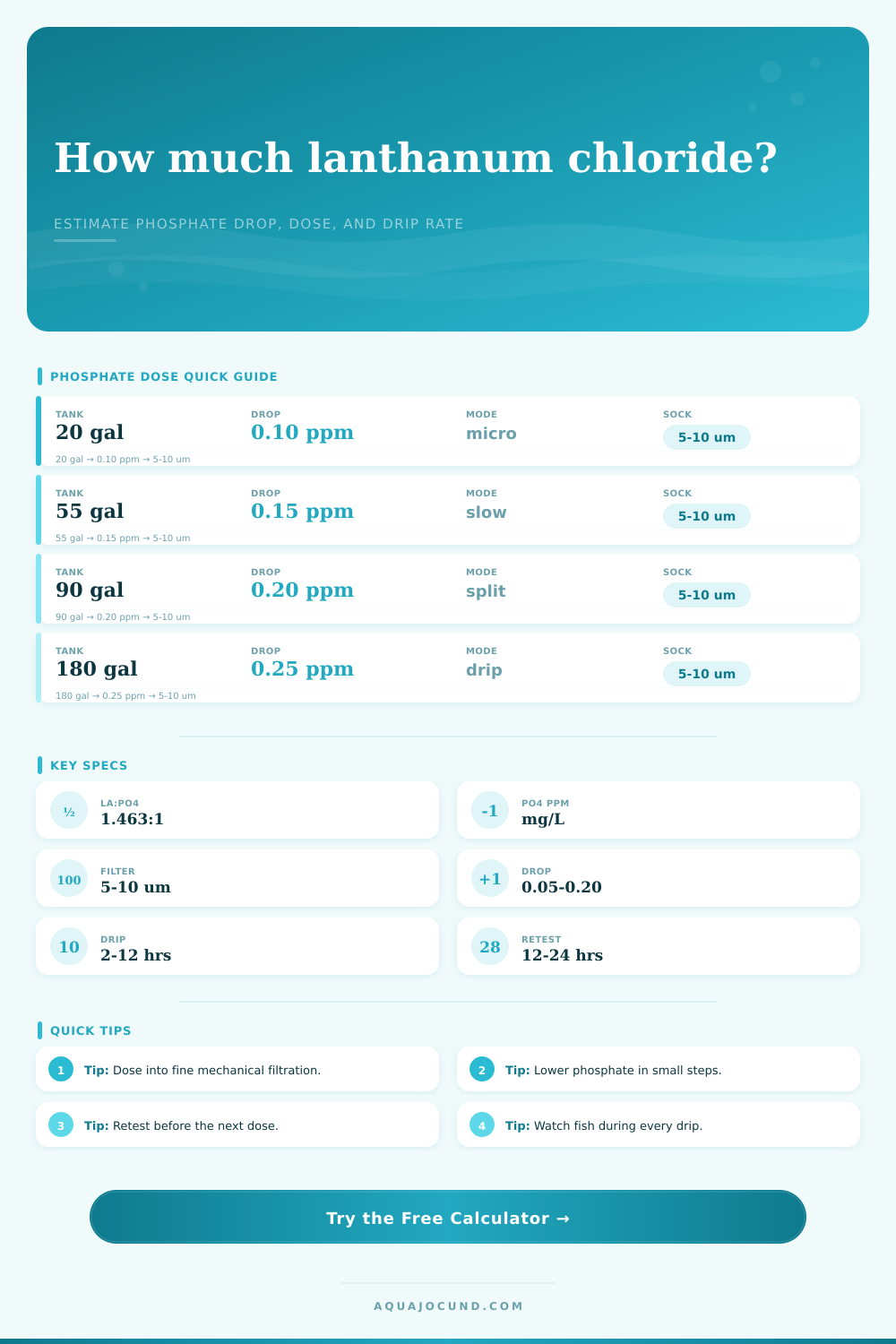
Here’s where the calculator comes into play: It converts both your tank volume and the strength of your product into an exact number of milliliters. Then, it accounts for the lanthanum/phosphate bond by using a ratio of about 1.46 milligrams of elemental lanthanum for each milligram of phosphate removed. That ratio will serve as basis of the math you’ll perform. Without it, you’re simply guessing.
Half the equation is raw number. Half the equation is the delivery. Lanthanum phosphate are heavy, so if you dump it all in one place it will sink and settle. It settles as a cloud which may coat your rocks or drift across your sand bed. This may coats the gill filaments of sensitive fish/corals.
Slow the dose over several hours so mechanical filtration has time to capture the particles before they have a chance to disperse. Let the filtration do the work for you. Don’t dump it all at once and let the filtration mix. It all depends based off your filter sock size.
For this process, you need a fine sock (five to ten microns) which serves as your net catching the precipitate. Using a coarse fifty micron pad will let most of the bound phosphate through. This add fine debris to your system and doesn’t change your water chemistry at all.
The tool adjusts its recommendations according to your capture efficiency; however, there is nothing an algorithm can do when your filter isn’t working. Be honest about what’s in your sump.
One last thing (be patient). You’re tempted to rush to a phosphate reading of 0.50 ppm ASAP. Often, chasing after it aggressively means overshooting. Pushing too quickly or too far with lanthanum will cause it to strips out important trace elements. Incremental little drops are safer. Allow the phosphate to drop slowly so that your living system has time to adapt. This allows you some breathing room to catch any mistakes before they becomes crises. Dosing half what you think you should of dose and waiting a day to retest creates a buffer.
For example, the calculators comes with a table of reference values for standard tank sizes so that you can quickly sanity check your input. Aquaria is not so simple though. Real tanks gets complicated. You have overflows boxes, you have live sand depth, and you have rock volume. All of these impact the amount of water in your tank and, therefore, how much chemical you need to use for dilution. Dosing for these factors is what differentiates newbies from those who know their stuff.
What’s the volume of a twenty gallon tank? It is fifteen if it’s full of sand and rocks. The missing five gallons make a big difference in your dose.
It’s not a sledgehammer. It’s a scalpel. When used properly, i.e., with precision and respect, this chemical are very useful. Proper use involves slowly dripping it on, measuring it carefully, and allowing the filter to clean up after you.
What you’re seeing in that clear tank isn’t accidental; it was accomplished intentionaly. And that clarity is something special. It’s also something worth taking the time for.