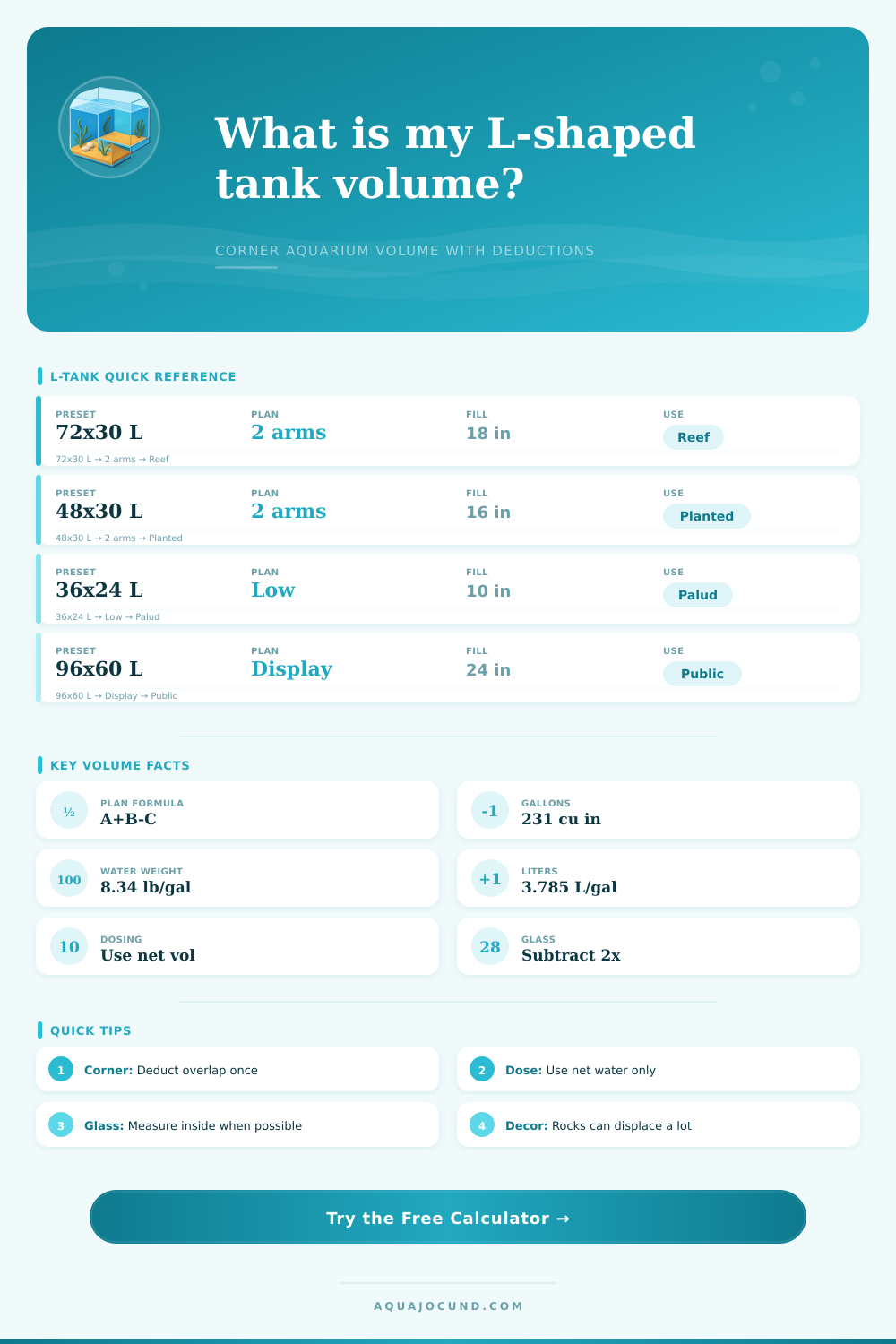
📐 L-Shaped Aquarium Volume Calculator
Estimate corner-tank capacity from two rectangles, overlap deduction, fill height, glass thickness, substrate, decor, water weight, and dosing volume.
✅ L-Shaped Aquarium Result
| Preset | Long Arm | Short Arm | Typical Fill | Best Fit |
|---|---|---|---|---|
| 72 in Corner Reef L | 72 x 24 in | 48 x 24 in | 21 in | Reef corner display with sump dosing |
| 60 in Living Room L | 60 x 20 in | 40 x 18 in | 19 in | Freshwater community in a room corner |
| 48 in Planted Nook | 48 x 18 in | 30 x 18 in | 16 in | CO2 planted aquascape with hardscape |
| 90 in Plywood Corner | 90 x 30 in | 60 x 30 in | 26 in | Large plywood build or fish room corner |
| 36 in Desk Paludarium | 36 x 18 in | 24 x 16 in | 10 in | Low-water paludarium with land mass |
| 72 in Turtle Paludarium | 72 x 30 in | 48 x 24 in | 14 in | Turtle water section with basking buildout |
| 96 in Public Display L | 96 x 36 in | 60 x 30 in | 24 in | Lobby or classroom display tank |
| 48 in Mangrove Corner | 48 x 24 in | 48 x 18 in | 12 in | Brackish paludarium or mangrove island |
| 84 in Cichlid Rock L | 84 x 24 in | 42 x 24 in | 20 in | Rock-heavy African cichlid layout |
| 60 in Lowboy Frag L | 60 x 30 in | 36 x 24 in | 12 in | Shallow reef frag or coral grow-out |
| Material | Practical Solid Fraction | Water Volume Impact | Use In Calculator |
|---|---|---|---|
| Bare bottom | 0% | No substrate displacement | Use for quarantine, frag, or breeder layouts |
| Fine sand | About 62% | Moderate to high displacement | Good default for planted and cichlid tanks |
| Rounded gravel | About 55% | Moderate displacement | Leaves more pore water than fine sand |
| Aquasoil pellets | About 48% | Lower displacement | Porous media keeps more water between grains |
| Soil with sand cap | About 58% | Moderate displacement | Useful for deep planted corners |
| Dense rock rubble | About 70% | High displacement | Use for rubble zones, caves, and stacked rock beds |
| Reference | Imperial | Metric | Why It Matters |
|---|---|---|---|
| Volume conversion | 231 cu in = 1 gal | 1000 cu cm = 1 L | Converts the L-shaped prism into aquarium volume |
| US gallon to liter | 1 gal | 3.785 L | Shows both unit systems for supplies and labels |
| Freshwater weight | 8.345 lb/gal | 1 kg/L | Useful for floor load planning and stand checks |
| Dosing label base | mL per 10 gal | mL per 37.85 L | Converts medication or fertilizer labels to net water |
| Safety factor | 80% to 95% | 80% to 95% | Reduces overdose risk when rock or land area is uncertain |
| Step | Formula | Input Detail | Result Meaning |
|---|---|---|---|
| Long rectangle | Long length x long width | Internal dimensions after glass | Main run of the aquarium footprint |
| Short rectangle | Short length x short width | Internal dimensions after glass | Return arm of the L shape |
| Corner deduction | Long width x short width | Shared inside corner already counted twice | Prevents double-counting overlap volume |
| Filled prism | Footprint x fill height | Fill height capped by inside tank height | Gross water before substrate and decor |
| Usable water | Gross - substrate - decor | Net displacement removed | Best volume for livestock, dosing, and water changes |
If the tank already exists, measure the wet internal footprint directly and enter glass thickness as 0. For a proposed build from outside dimensions, include glass or acrylic thickness so the calculator subtracts wall thickness before finding the L-plan area.
Dose medication, conditioner, and fertilizer from usable water, not advertised gross size. Heavy rock walls, foam backgrounds, land shelves, and deep substrate can remove a surprisingly large portion of an L-shaped paludarium.
An L-shaped tank is an aquarium that consist of two rectangular section. In calculating for the volume of the L-shaped tank, it is important to exclude the corner that is shared by the two rectangular sections. Should the corner be excluded from the calculations, there will be an inaccurate measurement of the volume of the tank and the amount of water that can exist within the aquarium.
An inaccurate measurement of the volume of water that can be contained within the aquarium will impact the amount of medication that is dosed into the tank, as well as the amount of water that must be removed during a water change. In order to calculate the volume of the L-shaped tank, there are several specific measurements that you must provide to the calculator. Such measurements include the outside dimension of the tank, the thickness of the glass, the planned water line within the tank, and the type of substrate that will be use within the aquarium.
How to Calculate the Water Volume of an L-Shaped Tank
The thickness of the glass is required for calculating the volume of the tank because the tanks thickness reduces the amount of water that can be contained within the length and width of the tanks sections. Thus, you must subtract the thickness of the glass from the outside dimensions of the L-shaped tank to allow for the true dimensions of the tank (and the water that can fill it) to be calculated. Additionally, you must also take the depth of the water within the tank into consideration for calculating the volume of the L-shaped aquarium.
The planned water line for the aquarium is rarely in contact with the top of the tank. Thus, it is necessary to also calculate the depth between the planned water line and the top of the tank to account for the volume of the tank that will not contain water. The volume of substrate that will be used within the tank also impacts the volume of water that will be contained within the L-shaped aquarium.
Substrate refers to the type of material that is placed on the bottom of the tank (such as sand or gravel). Furthermore, not all substrate contain the same amount of space between each particle. For instance, fine sand will contain more space between each particle of sand then gravel.
Thus, substrate also impact the volume of water that will be within the L-shaped tank. It is necessary for calculating the volume of the tank to provide the depth of the substrate that will be placed into the tank. Additionally, any type of decoration for the tank will also impact the amount of water that can exist within the L-shaped tank.
Examples of decorations may include rocks, wood item, or even foam decoration that are placed into the aquarium to create visually interesting scenery for the fish. Depending upon the size of the decorations, the impact upon the volume of water within the tank will change. For instance, large rocks will displace more water than small rocks of the same type.
Thus, it is important to account for decorations within the tank; they may reduce the volume of water by many gallon. However, because most decorations are of irregular shapes, it is difficult to calculate the amount of water that such decorations will displace. Thus, in most cases, individuals use a conservative estimate to account for decorations within their L-shaped aquarium.
One more critical factor to consider when setting up an L-shaped aquarium is the weight of the water within the tank. Water weigh approximately eight pounds per gallon. Because the L-shaped tank will contain a specific number of gallons of water, the weight of the water is also a critical consideration in the setup of the aquarium.
For instance, you must know the weight of the water in order to determine if the furniture within the home will be able to support the weight of the L-shaped aquarium. Dosing medication into the aquarium requires that the volume of water within the aquarium is known. Should an individual use the advertised size of the tank for dosing medication, that individual may dose the aquarium with an incorrect amount of medication.
If too much medication is added to the tank, the medication may harm the fish that reside within the tank. Should too little medication be added, it may not effectively treat the tanks fish. Thus, many individuals use ninety percent of the calculated volume for dosing medication; this allows for a margin of error for medication that may be displaced by the aquarium decorations.
Finally, the maintenance of the L-shaped tank also rely upon these calculations. For instance, the water volume can be used to calculate how much water must be removed during a water change. The water volume also allows for the amount of water conditioner that must be added to the water that will be added to the aquarium to be calculated.
By knowing the exact volume of water that will be within the L-shaped aquarium, the chemistry of the water can be maintained. Thus, knowing the volume of water within the aquarium ensure that maintenance tasks are performed accurately. By accurately maintaining the L-shaped tank, the tank will remain stable for the tanks fish.