
In early spring, there is a point where koi fish naturaly respond to the warm up of water. Suddenly your adult fish will get energetic and restlessly move around again, something that has not been observed since winter. It’s not random activity. Biology are driving them.
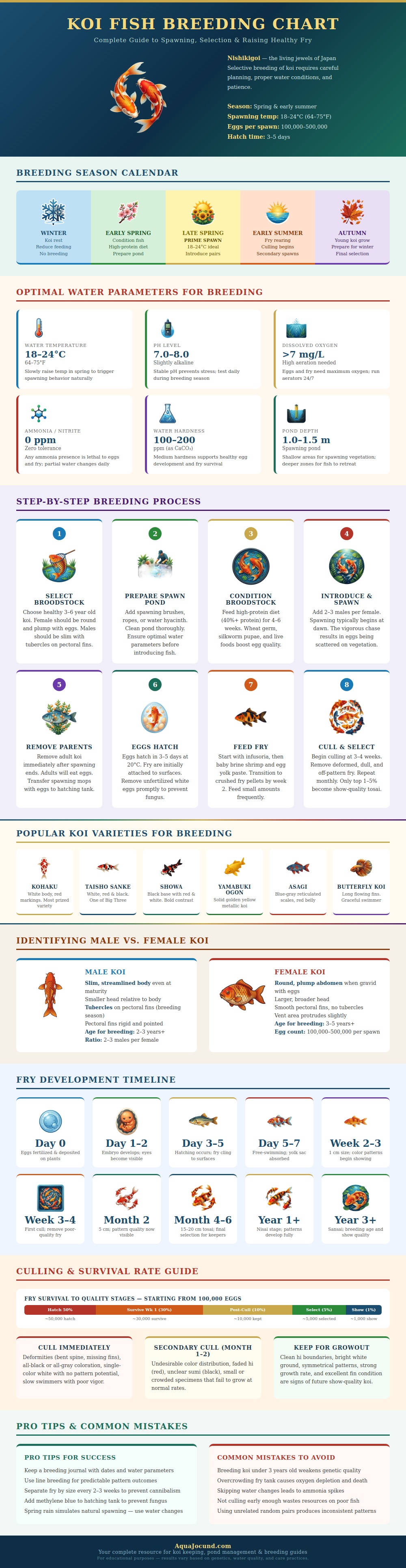
Timing is crucial if you aim at producing quality Nishikigoi. This can be seen very clearly on seasonal calendar (see infographic above). It starts with their winter dormancy, followed by an early spring conditioning period, and then the peak spawning window in late spring. Missing out on this rhythm lead most hobbyists astray, as they either force the process way too early or simply let it happen while they are unprepared. But before you lay an eye on one egg, there’s a lot that goes into the process.
How to Breed Koi Fish
For starters, you’ll want to pick your broodstock. This mean selecting fish that look like they’re ready, such as plump females with eggs and males with tubercles (small bumps) on their pectoral fins. Those bumpy little things aren’t fake, they’re a good indicator that the fish are ready.
After you’ve chosen your pairs, you’ll want to condition them by feeding them high-protein foods for at least a few weeks. It isn’t enough to just feed them more. It’s about transitioning them into a metabolic state where they’re able to make viable gametes. The chart emphasizes how critical this step is, it needs to contain far more protein than you’d feed over the winter.
The spawn occurs when water temps hit about 18, 24 degrees Celsius (typically in the early morning hours). The scene is total chaos. Males chases the females hard while releasing sperm, and the females scatter their eggs on spawning brush or other plants in the water.
At that point, you need to remove the adults ASAP. They will eat their own eggs! After all, parent fish are programmed to gobble up what they’ve just produced. Take the spawning mops out of tank and put them into another hatching tank where you can watch the fry develop closely.
This is where water quality becomes critical. These little guys is extremely delicate and require clean water, no ammonia, lots of dissolved oxygen, etc. The slightest change in water temperature and/or pH can spell disaster for thousands of eggs in a matter of seconds. Make sure you’re running your aerators 24/7. Stability is much more important then getting your numbers “perfect” one time and walking away. Stability helps biological processes happen within those clear shells.
The time to hatch is about 3-5 days. Once they are out of their shells, they will stick to something until their yolk sacs absorbs all the nutrition. At that point, which is usually day 5 or 7, you still don’t feed them. But when they can swim, usually a couple of days later, you will start feeding them with something like egg yolk paste or infusoria. Do it gradually so your fry’s gut won’t have any problems and also because this is how it happens in nature.
And here comes the most difficult task in koi breeding, the culling. Yes, I know it sounds cruel but there is no way around it. You may start with maybe tens of thousands of eggs and end up with only a few hundred, or perhaps even just dozens, of show quality koi. The loss is huge at every step. This happens even before they hatch, during their first week of swimming, and after your first round of selections.
How do you decide which fish to cull? This is a tough one for most of us. You can’t keep all of them. If you do, water quality will suffer, growth will be stunted, and there will be overcrowding. The visual guide shows the rapid decline in numbers to help explain why so few reaches the end of the line for the final cut.
Eyes wide open. Symmetry. It have a strong body. The lines of color are clean. There are patterns. Anything else is a distraction. Noise.
Your best weapon is patience. Give them time. Watch as they develop over months. Pick out the ones you think has potential (don’t expect perfection right now). Best of all, the best koi show themselves slowly. They won’t hit full display of their beautiful patterns until they’re multiple years old, which would of been the payoff when you wait.
