🥚 Killifish Egg Incubation Calculator
Estimate peat or water incubation timing, eye-up check dates, first wetting windows, and hatch spread for annual and non-annual killifish eggs.
Calculation breakdown
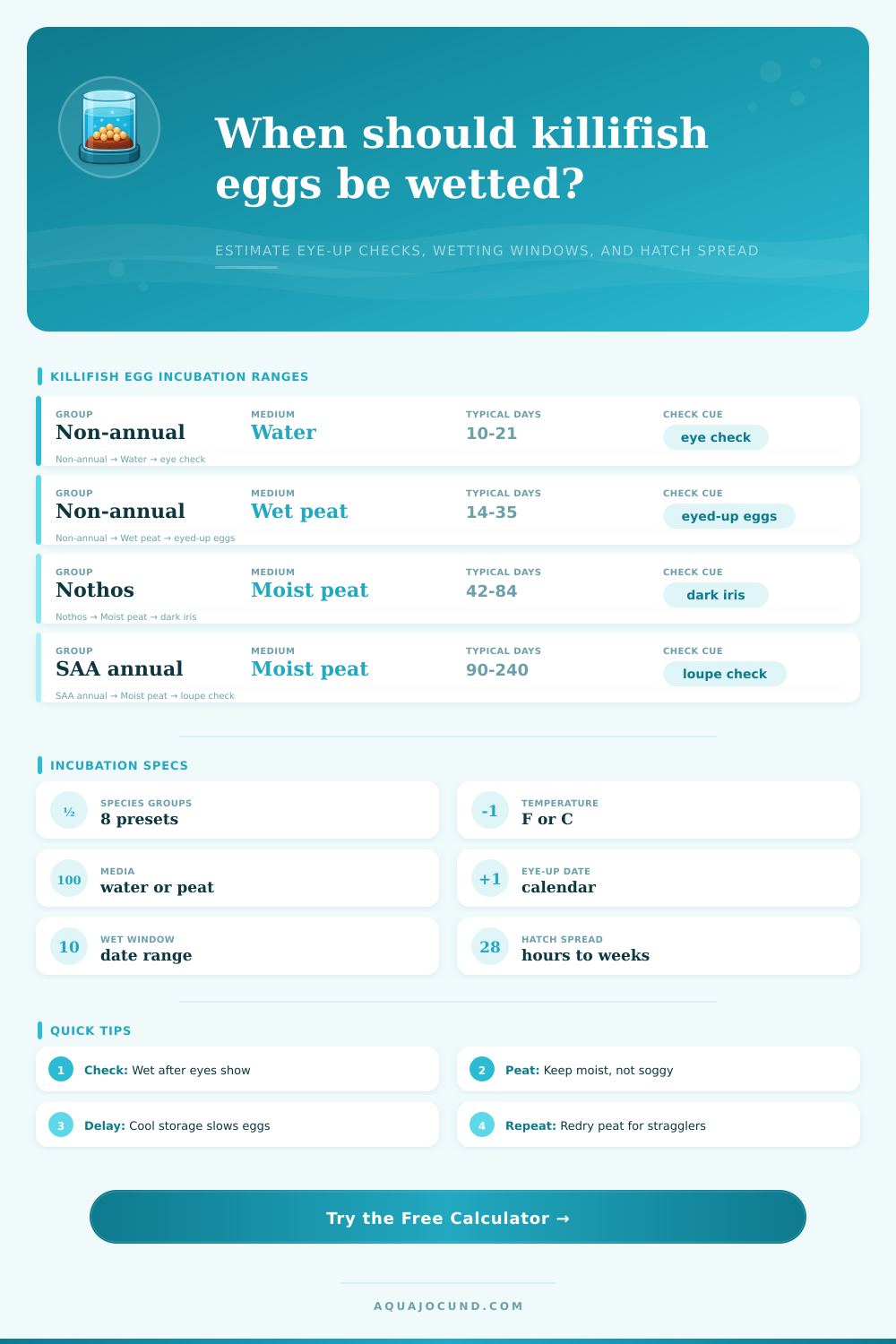
| Species group | Typical medium | Base incubation | Preferred temp | Eye-up check |
|---|
| Temperature band | Development effect | Calculator adjustment | Use note |
|---|---|---|---|
| 64-68°F / 17.8-20.0°C | Slow for many tropical eggs | Add 15-35% | Useful for slowing peat but risky for delicate non-annual eggs. |
| 69-75°F / 20.6-23.9°C | Common room-temperature range | Near baseline | Often used for non-annual eggs and cool peat storage. |
| 76-80°F / 24.4-26.7°C | Faster development | Subtract 5-18% | Check more often once eye-up begins. |
| 81-84°F / 27.2-28.9°C | Fast annual development | Subtract 12-28% | Warm notho peat may finish quickly but can dry faster. |
| Medium | Best suited for | Timing effect | Risk to watch |
|---|---|---|---|
| Water tray | Non-annual eggs that can be observed daily | Fastest hatch timing | Fungus, oxygen, and dead egg removal. |
| Wet peat or slurry | Non-annual and semi-annual eggs | Slightly slower than water | Eggs can be hidden in dark peat. |
| Moist bagged peat | Nothos and annual eggs | Baseline annual storage | Too wet can sour; too dry can stall. |
| Drier annual peat | Long annual storage or shipping | Slower development | Check that peat is still barely moist. |
| Mop or plant tray | Epiplatys, Aphyosemion, and Fundulopanchax | Similar to water or wet peat | Handle eggs gently and avoid temperature swings. |
| Stage | When to act | Calendar use | Expected result |
|---|---|---|---|
| First eye-up check | About 70-85% of the adjusted incubation time | Use the eye-up card | Look for iris rings, movement, or heartbeat. |
| First wetting | When most eggs are eyed-up or the planned date arrives | Use the wetting window card | Ready eggs may hatch within hours to 2 days. |
| Dry back | After 2 days if peat eggs do not all hatch | Use the rewetting row | Preserves delayed eggs for another attempt. |
| Second wetting | 2-6 weeks later by species plan | Use the rewetting date | Catches stragglers and diapause-spread eggs. |
| Readiness score | Result band | Typical meaning | Action |
|---|---|---|---|
| 80-100 | Wet soon | Timing, temperature, and eye-up status agree. | Prepare shallow hatching water and first foods. |
| 60-79 | Check closely | Approaching the predicted window. | Inspect with a loupe before wetting. |
| 40-59 | Hold and inspect | Some inputs suggest development is not complete. | Wait, check peat moisture, and recheck soon. |
| 0-39 | Delay wetting | Likely early, cool, dry, or poor-viability batch. | Delay unless eggs are clearly active and eyed-up. |
Killie keepers are often an anxious bunch. If they’ve got bags of peat moss around their houses, they’re thinking about dozens of tiny eggs in those bags, each waiting on a secret cue to wake up. It’s time to tend to them, but it’s easy to go too far and wash the fragile embryos away by being to hasty with water, or wait too late and find them dried into oblivion. There is a fine line between careful care and careless neglect.
Incubating is not as straightforward as setting an oven timer for 40 days and going about your business. Because there are various factors that affect how long it will take (species strain, peat consistency, water temperature), many newbies gets lulled into thinking “if it’s a 40-day species, I’ll count to 40 and go.” It doesn’t work that way. Incubation is far more flexibel. Time yourself by the egg’s biological clock.
How to Care for Peat Moss Eggs
This takes out all guessing: This handy little tool (link is above) converts these variables into a clear window of opportunity. Enter your egg collection date and the storage temp (either wet slurry or dry peat). It will calculate when to expect seeing eyes up first. It will also offer target range for the first time to wet things down, since they develops much more slowly at cooler temps. Eggs stored in a cool basement at 65 degrees would develop more slowlier than those resting on a hot radiator. The calculator accounts for that drift to avoid your wetting down dormant embryos which invites fungus.
Knowing when to water peat is important, but understanding what peat does are equally important. The stuff is a barrier and a buffer, stopping the life of annual species hardwired to withstand drought conditions. Get the moisture level correct. Adding moisture is like rain in their natural environment. Soggy peat will suffocate embryos by preventing oxygen from reaching them, but bone dry peat will stop all metabolic processes entirely. It should crumble in your hand, yet hold its shape when squeeze. That is a ideal peat texture, allowing for gas exchange while being moist enough to start hatching.
Whatever the calendar says, there’s still no better final check than to visually inspect. The best thing the calculator provides is a base-line, statistical estimate, but that doesn’t mean there isn’t something more certain with your eyes: look for the iris (the dark ring encircling eye of the embryo that will soon hatch). This shows up early in some eggs development, and waits ‘til the final days for others. Even better is movement, as small twitches and pulses of anything inside the peaty substrate signal the near-readiness of the embryos to depart.
Because all of your eggs is developing at slightly different rates, it’s smart to account for stragglers. Some eggs are closer to top or bottom of the peat bag. Others have fewer resources inside them. That means there won’t be one hatch day, there will be a spread. Let the first wetting period last a few days then re-dry the peat until you are ready to start again weeks later to accommodate any late bloomers. This saves many keepers from rushing things and actualy killing whole batch of eggs.
That’s about all there is to it; patience. Tools help. Math helps. But at the end of the day, you’re dealing with a careful balance between life and dormancy. Go with what you see. Believe when you see little fry darting around in the clear water that it should of been worth the wait.