KH From Baking Soda Calculator
Estimate sodium bicarbonate dose from water volume, current KH, target KH, purity, salinity profile, split-dose cap, and safety margin.
| Reference | Value | Formula role | Practical note |
|---|---|---|---|
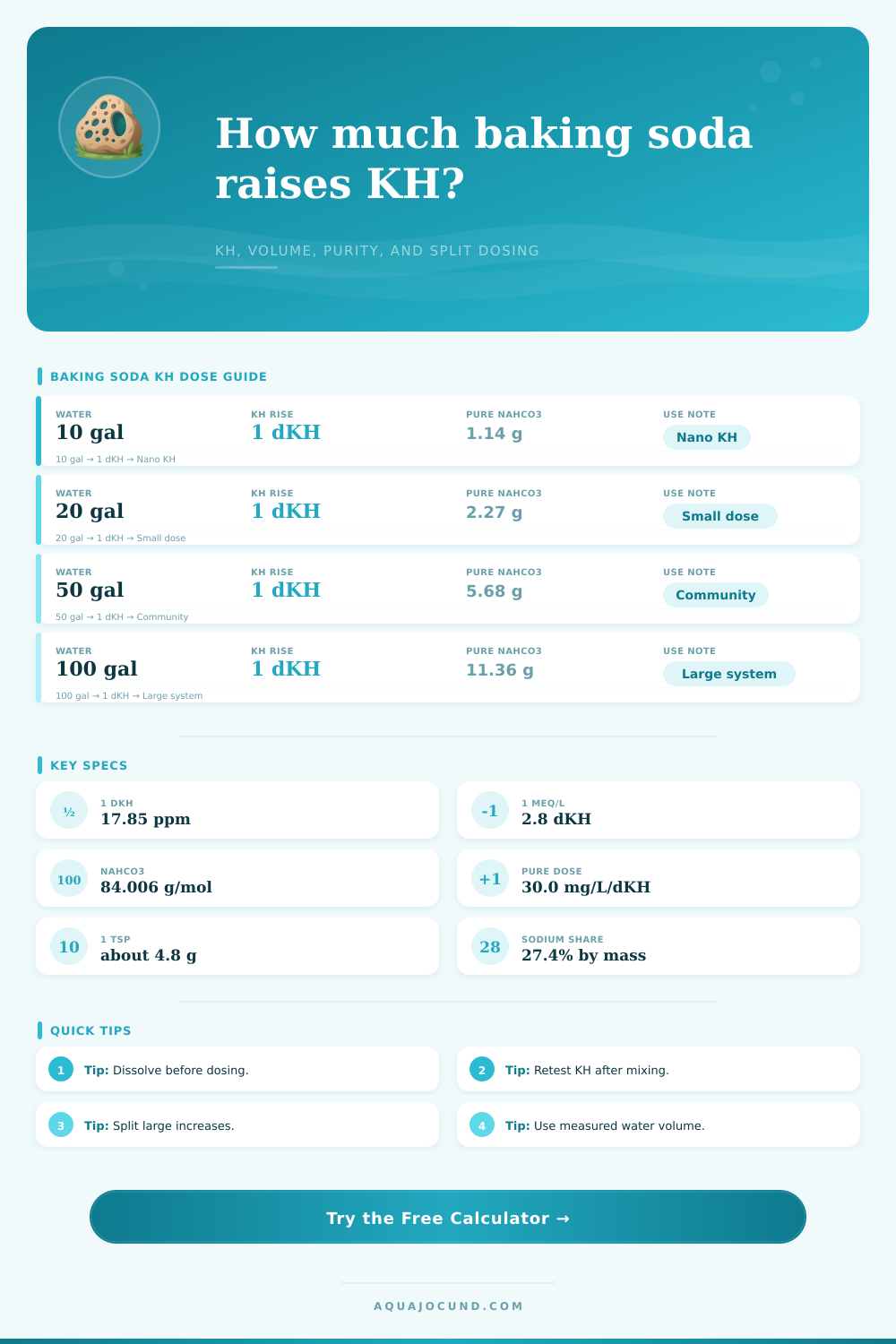
| 1 dKH | 17.848 mg/L as CaCO3 | KH target unit | Used by most aquarium KH kits |
| 1 meq/L alkalinity | 50.0 mg/L as CaCO3 | Equivalent conversion | 1 meq/L equals about 2.8 dKH |
| NaHCO3 equivalent weight | 84.006 mg/meq | Mass calculation | Gives 30.0 mg/L for each 1 dKH rise |
| Level teaspoon estimate | 4.8 g | Kitchen volume conversion | Actual scoop density varies; weigh when possible |
| Level tablespoon estimate | 14.4 g | Larger dry measure | Three teaspoons, still approximate |
| Profile | Typical KH range | Suggested single rise | Calculator behavior |
|---|---|---|---|
| Soft shrimp or sensitive planted | 0-4 dKH | 0.3-0.5 dKH | Flags aggressive changes quickly |
| Freshwater community | 3-8 dKH | 0.5-1.0 dKH | Uses moderate caution for fish and plants |
| Hardwater cichlid | 8-14 dKH | 1.0-1.5 dKH | Accepts higher targets but still stages big jumps |
| Brackish | 7-12 dKH | 0.8-1.2 dKH | Watches sodium stacking with salt mix |
| Marine reef | 7-11 dKH | 0.5-1.4 dKH | Recommends measured corrections and retesting |
| Marine fish-only | 7-12 dKH | 0.8-1.2 dKH | Allows moderate alkalinity correction |
| System | Net water | 1 dKH pure dose | 2 dKH pure dose |
|---|---|---|---|
| 10 gallon nano | 10 gal / 37.9 L | 1.14 g | 2.27 g |
| 20 gallon long | 20 gal / 75.7 L | 2.27 g | 4.54 g |
| 40 breeder | 40 gal / 151 L | 4.54 g | 9.08 g |
| 75 gallon display | 75 gal / 284 L | 8.52 g | 17.0 g |
| 125 gallon system | 125 gal / 473 L | 14.2 g | 28.4 g |
| 300 liter vat | 79.3 gal / 300 L | 9.00 g | 18.0 g |
| Use case | Common KH band | Why it matters | Dosing caution |
|---|---|---|---|
| RO planted tank | 1-4 dKH | Gentle buffering while keeping soft-water character | Small changes and CO2/pH review |
| Community freshwater | 3-8 dKH | Stable pH support for many tap-water setups | Avoid chasing daily test noise |
| African cichlids | 8-14 dKH | Hard alkaline water preference | Match GH and mineral balance too |
| Brackish aquariums | 7-12 dKH | Buffering usually comes from salt mix and carbonate sources | Do not ignore salinity readings |
| Reef aquarium | 7-11 dKH | Coral calcification and pH stability | Track daily alkalinity consumption |
What happens? Alkalinity drops and test strip indicates a darker color then desirable. That’s bad news because it probably means your pH follows suit and your ecosystem could start to fall apart unless you respond promptley.
In this case, most hobbyists freak out and reach for some baking soda, but throwing powder at something blindly based of guesswork poses risk. To solve the issue correctly, you require precision, not guesswork. After you plug in your tank size and goal parameters, the calculator do the rest. That takes away the guesswork of math factors and turns what was a chemical problem into a simple dosing plan.
How to Fix Low Alkalinity Safely
Yes, sodium bicarbonate will increase those test strip readings. However, it’s going to add sodium to the tank which might not be a good thing. It will also buffer the acidic environment. Get the dosage incorrect, and you may either shock your picky fish or upset the balance of beneficial bacteria.
The calculator adjust for purity since not all baking soda is equal. Generally speaking, food grade varieties tend to be 99% pure while others are blended with other ingredients. You want to ensure the baking soda doesn’t have any fillers, or else excess weight will skew your results a lot. What you put in matters as much as what you do with it.
The most frequent mistake made here is volume. When people pull out a calculator they’ll use the tank’s rated capacity (what appears on the glass). However, those figures are never your actual water volume because tanks have stuff in them: decorations, rocks, gravel, filters, etc. You will always have less water than what the tank says. So if you’ve got forty gallons but dose like you had fifty, you’re overdosing by twenty-five percent. This shock can kill delicate fry or shrimp.
The calculator has an adjustment for this to ensure that math matches reality rather than some form of marketing from a tank retailer. It also helps protect your livestock. Too fast an increase in alkalinity will cause pH shifts which are stressful to your animals. Even hardy species don’t care for sudden changes to their chemical world.
With split dosing, you can specify how much it should raise the parameter (up to a max) per dose and it will break up big changes into little ones. That keeps the change gradual so there’s no dramatic shift in water chemistry. Add a bit…wait….test again….repeat as needed. It’s force feeding patience, which is often what separates a healthy tank from a tank filled with stressed out fish.
The salinity profile will modify the output. Alkalinity is used by corals every day to build their skeleton, so marine keepers should have strict control of this value. Higher KH can be counter-productive for plants (too hard), especially for soft water species commonly kept in freshwater planted tanks. For cichlid keeping, harder water and higher pH are usually best, so you can use higher amounts. It takes into account these profiles and alerts you to use lower doses in reef systems as compared to your typical community tank.
On the page itself there are also reference tables that spell out the main conversion ratios which will let you double check the arithmetic. For instance, about 30 milligrams of pure sodium bicarbonate per liter equals one degree of carbonate hardness. This relationship lets you see why measuring slightly off makes a difference. A scoop is never exact; it’s merely an estimate. Scoopless methods like weighing your powder are always better than scoops. Why? Because kitchen measures simply aren’t accurate enough for chemical dosing. Accuracy counts.
Water changes remain the safest way to correct alkalinity if your tap water differs from your tank. Adding baking soda would of made sense if you have soft tap water and want harder tank water. But if you have hard tap water and your tank has low KH, a water change may be all that’s needed. Again, baking soda isn’t the foundation, it’s a supplement. It helps stabilize what you have, but doesn’t establish a balanced mineral profile by itself.
This isn’t about perfecting anything but achieving stable parameters. If fish can survive within certain parameters, they will adjust to them as long as changes aren’t too fast. And the calculator allows you to get to a set of parameters slowly without overshooting (which derails weeks of gradual conditioning). It also lets you know how much salt you’re adding with each gram of bicarbonate so that you can keep track of your sodium load. In a closed system, every gram of bicarbonate increase the salt concentration, which over time harms the health of your system. Keeping an eye on both your KH and your total dissolved solids maintains a healthy system over the long run.
You pick up the test kit strip and look again. Still not right. But this time you’ve got a plan. You know why you’re better off taking your time, exactly what amount to add, and how to break it into multiple additions. You measure out the needed powder, put it in another cup, and let it completely dissolve before pouring it into the line. That way there are no clouded undissoluble powders settling on the bottom. What you get is a gradual adjustment that settles the numbers and clears the water while life goes on.