Kelvin Blend Two Lights Calculator
Blend two aquarium light Kelvin ratings by lumen or PAR contribution, channel ratio, water depth, target color temperature, and photoperiod weighting.
Kelvin Blend Results
| Range | Visual tone | Aquarium context | Blend cue |
|---|---|---|---|
| 2700 to 3500 K | Warm amber white | Blackwater, sunset accent, shallow viewing | Use sparingly with plant lamps |
| 4000 to 5000 K | Neutral warm white | Natural display color and fish warmth | Good with a cooler second light |
| 5500 to 7000 K | Daylight white | Freshwater planted and community tanks | Common target for plant viewing |
| 8000 to 10000 K | Crisp cool white | Deep freshwater, bright display, shallow reefs | Adds clarity without heavy blue |
| 12000 to 20000 K | Blue-white reef look | Marine displays and coral fluorescence | Often balanced by a white channel |
| 20000 K plus | Very blue actinic look | Fluorescence periods and frag racks | Use PAR share more than lumens |
| Water condition | Warm loss | Cool loss | Best use |
|---|---|---|---|
| Very clear marine water | 0.10 per m | 0.05 per m | Clear reef and frag systems |
| Clear freshwater | 0.18 per m | 0.09 per m | Freshwater after maintenance |
| Typical community water | 0.26 per m | 0.14 per m | Normal display aquariums |
| Light tannins or haze | 0.42 per m | 0.24 per m | Wood, botanicals, mild film |
| Dark blackwater tint | 0.72 per m | 0.46 per m | Tea-colored botanical tanks |
| Green water or particulates | 0.90 per m | 0.68 per m | Bloom, dust, suspended waste |
| Schedule item | Weight rule | Example | Effect |
|---|---|---|---|
| Full photoperiod | Counts at channel percent | 7 h at 70% | Strong daily average weight |
| Total ramps | Counts as half output | 90 min ramps = 0.75 h | Adds softened contribution |
| Offset fixtures | Longer fixture weighs more | A 8 h, B 5 h | Blend shifts toward A |
| Target ratio | Uses depth-adjusted output | A 60%, B 40% | Suggests channel balance |
| Tank style | Fixture A | Fixture B | Typical target |
|---|---|---|---|
| Low-tech planted | 6500 K white bar | 3000 K warm accent | 5000 to 6500 K |
| Dutch planted | 6500 K daylight | 8000 K RGB-heavy bar | 6500 to 8000 K |
| Community display | 5000 K neutral white | 9000 K crisp white | 6000 to 7500 K |
| Mixed reef | 10000 K white channel | 20000 K blue channel | 12000 to 16000 K |
| SPS or frag rack | 14000 K reef white | 22000 K blue-heavy LED | 16000 to 20000 K |
| Blackwater display | 3000 K warm light | 6500 K daylight fill | 3500 to 5000 K |
| Step | Formula | Reason | Output |
|---|---|---|---|
| Mired conversion | 1,000,000 / Kelvin | CCT blends closer to reciprocal color temperature | Mired |
| Depth factor | exp(-loss x depth m) | Water reduces warm and cool channels differently | Transmission |
| Contribution | Output x channel x depth x hours | Effective light share at the aquascape | Weighted share |
| Blend Kelvin | 1,000,000 / weighted mired | Returns the estimated combined CCT | Kelvin |
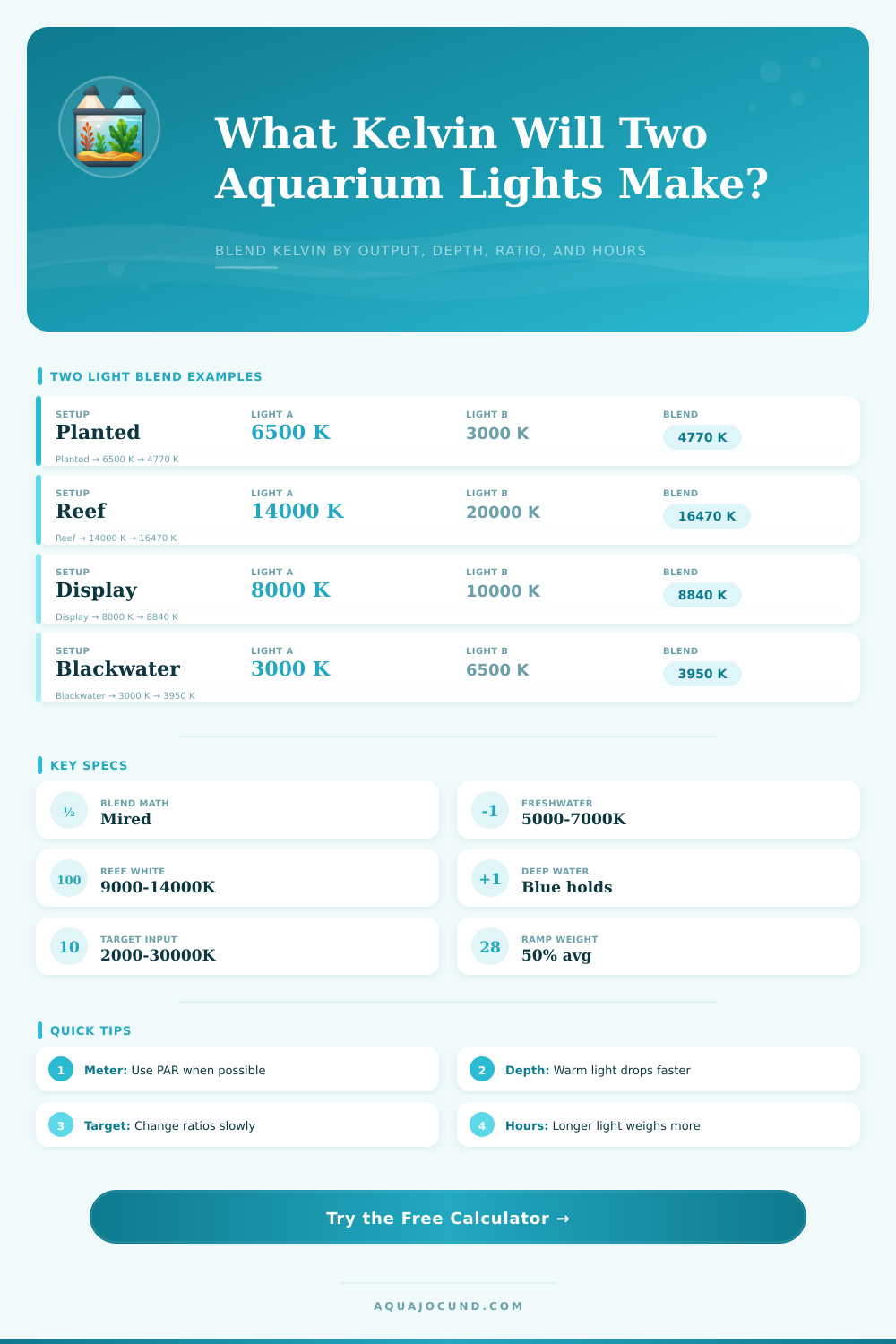
This means you’re standing in front of two pieces of aquarium equipment with different Kelvin numbers, and now you know combining their Kelvins isn’t a proper thought process. Maybe you have a cool ten thousand Kelvin fixture plus a warm sixty-five hundred kelvin bar? You add ’em up, hey look! That’s eight thousand two-hundred fifty. Sounds reasonable right? Then you look down on tank and see that your water is cloudy or your corals aren’t fluorescing as expected. Why the disconnection?
Color temperature isn’t a linear scale. Every degree doesn’t represent the same thing. Small increases at high Kelvin temperatures are huge while large degrees at low Kelvin temperatures hardly matter. In other words, color temperature is more like musical pitch or sound frequencys.
Why Adding Light Numbers Does Not Work
Once you know what’s in your tank and how they’re set up, simply feed all those variables into calculator above. It do the rest. It takes those Kelvin numbers and translates them into something called mireds. These are the reciprocal of color temperature. Mireds are the color temperature units that realy match the way we as humans see changes in warmness or coolness. Why? Because our vision isn’t linear.
So, given your inputs, the calculator will factor in relative contribution of every light according to its actual output versus its maximum potential output. For example, perhaps you’ve got one super-powerful blue light but you never run it at full throttle… Maybe 40% during your primary photoperiod, while other lights in your white channel are running full-blast all day. Even though the blue light is technicly capable of being very bright if you pushed it to max, because it only runs at forty percent capacity while your white light stay at full blast, the final mixture of colors produced by your lights will be weighted heavily towards the white light.
Another wrinkle (pun intended) is depth. Because water absorbs long wavelength light more rapidy than short, blue light penetrates much deeper than red and amber light. That means a mixed color that appears nicely balanced near surface can take on a decidedly cooler cast by the time it hits bottom of your 24 inch tall tank. There’s even a table on that page showing how fast various colors gets absorbed in a given volume of water depending on its clarity. Bottom line: clear marine water retains color better than some blackwater systems. Blackwater systems absorb warm hues pretty darn quick. If you’re going for a tea-color look or use a lot of botanicals, you would of had to dial the warmer fixture up a bit to keep things nice and cozy at the bottom.
The last part of the equation is photoperiod weighting. Duration of light is the multiplier. An 8-hour on/off fixture makes far greater impact on your cumulative daily impressions then an hour of light at dusk. The tool provides a good mix based on combination of channel percentages and ramp times. This is important if you are attempting to match natural lighting cycles, not just a snapshot of single moment in time.
Perhaps you desire a warm dawn followed by crisp daylight followed by deeper blue periods of moonlit night. All phases has their own local color temperature values, but how much of each color period do you wish to see in play? To many folks this ends up being a fixation on nailing down some number from a forum post or magazine article. That’s just a starting point. It’s not a law of physics. It won’t be the same for everyone because everyone’s water chemistry, decor, and particular hardware will change the outcome.
What we’re going for is a sweet spot between good plant photosynthesis, fish that display their best colors, and simply being able to look at the tank without straining your eyes (i.e., no harsh glare). So play with one thing at a time. Maybe increase length of blue channel first, then tweak the intensity. You’ll see that small tweaks makes a huge difference in mood.
This happens once you realize that light blending isn’t simple arithmetic, but a weighted average over depth and time. When you quit obsessing over perfect numbers and begin observing what the light does as it passes through the water column, the set-up becomes less calculated and more livig.