🌱 Iron Weekly Dose Calculator
Plan planted aquarium iron dosing from Fe target ppm, chelate stability, liquid stock strength, water-change reset, dose frequency, and plant demand.
| Iron source | Typical Fe content | Useful pH range | Dosing behavior |
|---|---|---|---|
| Iron gluconate | About 12% Fe as dry compound | 5.5-7.0 | Fast plant availability, lower water-column persistence. |
| Fe EDTA | About 13% Fe | 5.5-6.8 | Good in soft acidic tanks, weaker as pH rises. |
| Fe DTPA | About 11% Fe | 5.5-7.5 | Balanced planted tank chelate for many CO2 systems. |
| Fe EDDHA | About 6% Fe | 6.5-9.0 | Stable in alkaline water, may tint water at higher doses. |
| Ferrous sulfate heptahydrate | About 20% Fe | Fresh stock only | Inexpensive Fe source but oxidizes quickly in solution. |
| CSM+B trace mix | Often around 7% Fe | Depends on mix chelates | Iron arrives with other traces, so avoid chasing Fe alone. |
| Planting style | Peak Fe after dose | Weekly demand estimate | Best frequency |
|---|---|---|---|
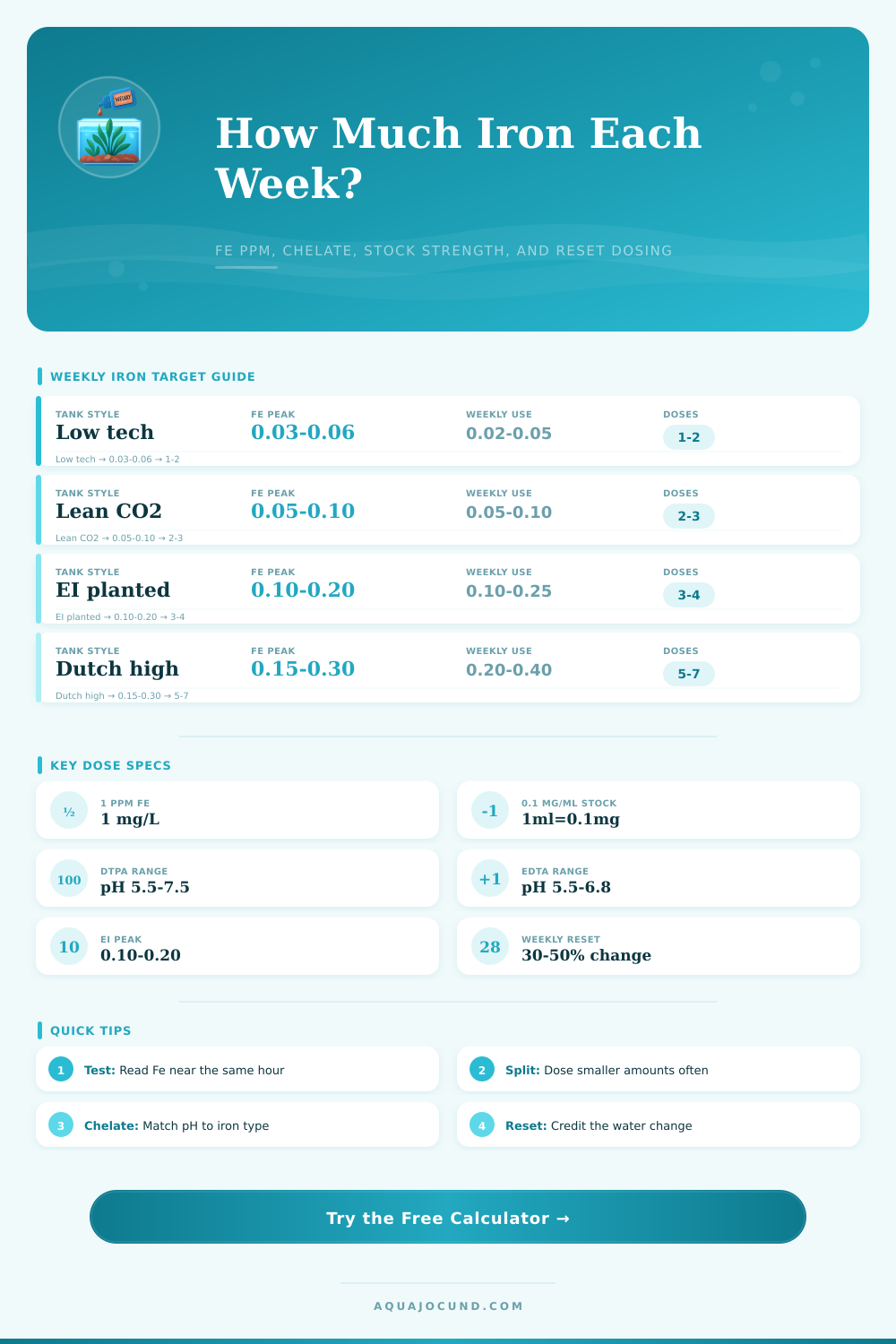
| Low-tech crypt, fern, anubias | 0.03-0.06 | 0.02-0.05/week | 1-2 doses |
| Lean CO2 community | 0.05-0.10 | 0.05-0.10/week | 2-3 doses |
| EI or rich water column | 0.10-0.20 | 0.10-0.25/week | 3-4 doses |
| Dutch stems and red plants | 0.15-0.30 | 0.20-0.40/week | 5-7 doses |
| Tank size | Common dimensions | Usable water estimate | Fe needed for 0.10 ppm |
|---|---|---|---|
| 10 gallon | 20 x 10 x 12 in / 51 x 25 x 30 cm | 8.8 gal / 33 L with 12% displacement | 3.3 mg Fe, or 33 ml of 0.10 mg/ml stock |
| 20 long | 30 x 12 x 12 in / 76 x 30 x 30 cm | 17.6 gal / 67 L with 12% displacement | 6.7 mg Fe, or 67 ml of 0.10 mg/ml stock |
| 40 breeder | 36 x 18 x 16 in / 91 x 46 x 41 cm | 35.2 gal / 133 L with 12% displacement | 13.3 mg Fe, or 133 ml of 0.10 mg/ml stock |
| 75 gallon | 48 x 18 x 21 in / 122 x 46 x 53 cm | 66 gal / 250 L with 12% displacement | 25 mg Fe, or 250 ml of 0.10 mg/ml stock |
| 125 gallon | 72 x 18 x 21 in / 183 x 46 x 53 cm | 110 gal / 416 L with 12% displacement | 41.6 mg Fe, or 416 ml of 0.10 mg/ml stock |
| Schedule | When it fits | Calculator meaning | Watch point |
|---|---|---|---|
| Weekly front-load | Low-tech or simple maintenance | One reset dose reaches the target peak after water change. | Single-dose ppm should stay modest. |
| Three times weekly | Most CO2 community tanks | Weekly Fe need is split into smaller water-column pulses. | Keep test timing consistent. |
| Daily | High light stems or sensitive livestock | The same weekly amount is delivered in steadier portions. | Requires reliable measuring or a doser. |
| After 50% reset | EI-style routines | Half of the previous residual is removed before the new dose plan. | Skipping the water change changes the math. |
The most common planted aquarium mistake begin well intentioned and finish as brown stains on your glass. Oh no! Those pale leaves look like an iron deficiency, so it is time for a little extra fertilizer. Oops… the water is now tea-colored within hours; free iron will nearly immediately rust when exposed to oxygen. Plants don’t absorbs precipitates. They sit there looking like neglect while the roots starve.
So how do we solve this? Not by chucking more of that raw chemical back into the tank. No, it’s about chelation and timing. You also need to know how much actual elemental iron your plants will take up before a water change reset the board. Once you enter your tank volume and desired peaks, the calculator does all the math for you. It saves you from having to convert mg/L of liquid stock into X number of drops yourself (or guess at coefficients).
How to Give Your Plants Iron
The bottom line is that how Iron performs vary based off the molecule used to bind it in solution. Consider the chelate as a protective shell that retains the iron in solution until the plants want to reach out and take it. In a low pH (below six and a half) soft water tank, EDTA‘s okay. It’s still stable and will remain in solution long enough for the roots to get their fill. If you raise your pH to be more alkaline, say seven or above, EDTA becomes unstable. Out of solution it comes…right away.
So why do so many folks discussing planted tanks talk about DTPA? Because DTPA holds together well through a pH of seven and a half. If you’re fighting hard alkaline water, EDDHA does the hard work and will keep things dissolved no matter how tough the chemistry gets.
The choice of chemicals is important but so is frequency. Out of sheer habit, many hobbyists will dose once per week. However, plants don’t stockpile iron over time. They can only absorbs what they need right then. This means if we give them a huge spike each week, it’s likely more than they can take up immediately and it goes to waste while attracting algae. Giving half that weekly total in three or four smaller doses provides a consistent baseline of iron in the water column. This is closer to how it naturaly diffuses instead of flooding suddenly. You can adjust how frequently you want to split using this tool.
Of course, there’s the other factor of doing a water change each week. That’s your nutrient level reset button too. Half of whatever iron you added last week goes out with that bucket if you change 50% of the tank volume on Sunday. But you don’t start back at zero come Monday morning. There will still be some iron left in the 40% of the tank volume that you didn’t replace. The calculator takes into account that decay. It sees what’s already there and removes what went out. It considers what new tap water adds. Then, it tells you exactly how much stock solution to add to return to your desired target.
It’s difficult to know exactly how high it needs to go because most test kits stinks for chelated metals. They are so good at keeping their shells closed that the reagent doesn’t have time to bust them open fast enough. This means you will under-read or see nothing at all on the drop counter. That causes a bout of panic dosing. More than following the drops, trust the schedule. Even if the test says 0.0, you might be on the right dose if you see some green growth. This is especially true if stem plant are stretching up instead of melting. In this case, consistent timing trumps accurate measuring.
Size of tank matter as well. Every drop goes a long way in a ten gallon nano. You can dose a hundred-gallon display like a sponge. Hardscape and substrate really cut down on your actual volume of water. If you have a twenty gallon tank that’s full of wood and gravel, it’s probably nowhere near twenty gallons of water. Understanding displacement helps improve your math to avoid overdosing. This prevents you from thinking there is more water in the tank than there realy is.
It’s not so much about nailing the right amount of an iron dose as it is keeping your dosing on a steady pace. Go low, observe leaf color changes, make slow adjustments…when you see the green come back…stay put. That consistent hand is what makes the tank clean and the plants happy.