🌡 Insulation Panel Heat Loss Calculator
Estimate aquarium heat loss through side glass, uncovered panes, panel R-value, lid condition, room temperature gap, and the resulting heater load reduction.
Calculation Breakdown
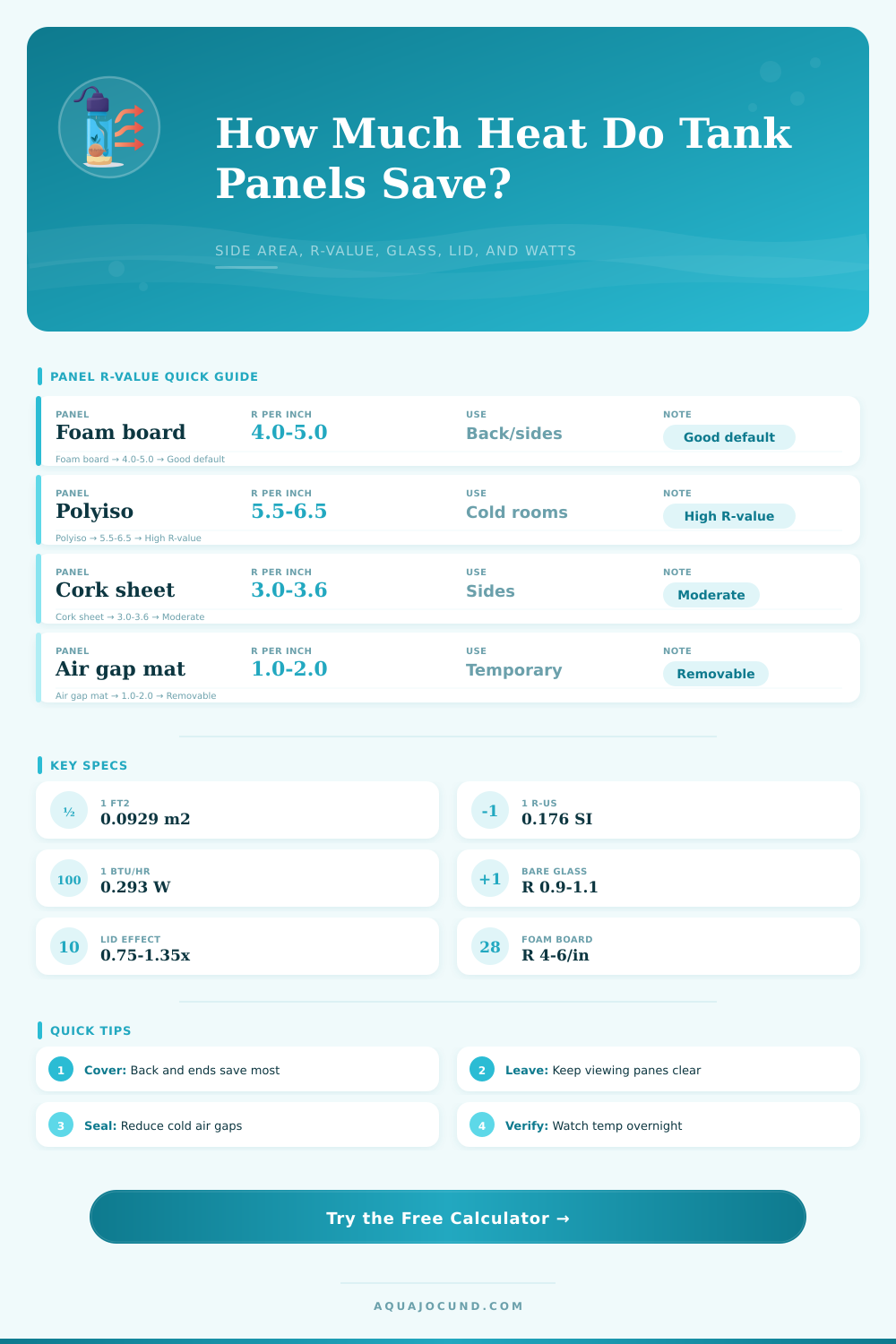
| Material | Typical R per inch | Best use | Calculator note |
|---|---|---|---|
| EPS foam board | 3.8-4.2 | Temporary back panels | Lightweight and easy to cut; protect it from splashes. |
| XPS foam board | 4.8-5.2 | Back and side panels | Good default for aquarium stands and cold walls. |
| Polyiso foam board | 5.5-6.5 | High R-value panels | Strong R-value, especially when the foil face stays dry. |
| Cork sheet | 3.0-3.6 | Visible or removable sides | Lower R-value but cleaner appearance for display edges. |
| Closed-cell rubber mat | 2.0-3.0 | Flexible wraps | Useful around sumps, tubs, and awkward shapes. |
| Reflective air-gap panel | 1.0-2.0 | Removable thermal shield | Needs an air space to perform well. |
| Moving blanket layer | 1.0-1.8 | Short-term overnight cover | Good for temporary holding tanks when kept dry. |
| Tank | Approx dimensions | Back area | Back + ends | Typical panel use |
|---|---|---|---|---|
| 10 gal | 20 x 10 x 12 in / 51 x 25 x 30 cm | 1.7 ft² / 0.15 m² | 3.3 ft² / 0.31 m² | Thin back foam in cool rooms |
| 20 long | 30 x 12 x 12 in / 76 x 30 x 30 cm | 2.5 ft² / 0.23 m² | 4.5 ft² / 0.42 m² | Back plus both ends |
| 40 breeder | 36 x 18 x 16 in / 91 x 46 x 41 cm | 4.0 ft² / 0.37 m² | 8.0 ft² / 0.74 m² | Foam back and ends |
| 55 gal | 48 x 13 x 20 in / 122 x 33 x 51 cm | 6.7 ft² / 0.62 m² | 10.3 ft² / 0.96 m² | Back panel near exterior wall |
| 75 gal | 48 x 18 x 21 in / 122 x 46 x 53 cm | 7.0 ft² / 0.65 m² | 12.3 ft² / 1.14 m² | Three-side cold room paneling |
| 125 gal | 72 x 18 x 21 in / 183 x 46 x 53 cm | 10.5 ft² / 0.98 m² | 15.8 ft² / 1.47 m² | Long back plus stand insulation |
| Status | Multiplier | Why it matters | Input hint |
|---|---|---|---|
| Open top | 1.35x | Evaporation increases total heater demand around the same delta. | Use for rimless tanks, fans, or large open sumps. |
| Mesh cover | 1.15x | Stops jumping but does little for evaporation. | Pair with side panels only if the room is cool. |
| Glass lid or canopy | 0.90x | Traps humid warm air above the water surface. | Good default for covered freshwater tanks. |
| Tight lid | 0.78x | Reduces evaporation and air exchange. | Use when gaps are small and the lid fits well. |
| Insulated cover | 0.68x | Applies to holding tubs or covered sumps. | Use for utility tanks where viewing is not needed. |
| Item | Formula or factor | Meaning | Used in calculator |
|---|---|---|---|
| Side heat loss | Area x delta T / R | BTU/hr through glass or glass plus panel. | Calculated separately for covered and uncovered glass. |
| Watt conversion | BTU/hr x 0.293071 | Converts thermal loss rate into heater watts. | Final heat loss and reduction cards. |
| Panel R-value | Thickness x R per inch | Added to the bare glass R-value for covered area. | Insulated side heat loss estimate. |
| Coverage | Selected area x coverage % | Determines covered glass and uncovered glass. | Shows paneled versus exposed panes. |
| Heater reduction | Before watts - after watts | How much side-panel load is removed. | Compared with current heater capacity. |
Because your aquarium sits in an ambient space (room), heat will leak from the tank through glass walls. So, the heater has to work overtime to maintain proper temperature. If you listen closely, you’ll notice that the thermostat click on intermittently every few minutes, wasting electricity and shortening the life of your heaters. This is something most aquarists endure as price we pay to keep our fish alive.
But by simply sticking a piece of foam to the rear wall, the balance of heat change. Glass is a poor insulator, and that’s where this begins based off a physics view. Glass will conduct warmth from warm water into cooler air very efficienty. So when you look at that gleaming window, what you see is a leak. The bigger the surface area and the greater the temperature gradient between room and tank, the more quickly energy escape. In winter, a fifty-five-gallon tank positioned next to an exterior wall is basically a radiator for your home. Insulation panels provide resistance, keeping that transfer from happening and keeps the heat where it should be, inside water column.
Why Insulate Your Aquarium Tank
Determining the actualy savings involves some variables and the calculator does this work for you. No guesses necessary. It converts Watts into square feet (ft2), R-Value, etc. You should of know how these inputs relate to your situation. For instance, consider the total area of all side of the tank exposed to air in the room. All sides aren’t created equaly. Often times just covering that one side provide more bang for buck than lightly wrapping four sides. The tank’s length, width, and height determines the total side area exposed to the room air.
The thicker the material, the greater its resistance (per inch). This is where material choice become so important. Some materials has much higher R-values than others. This means they adds more resistance for every inch of thickness. For example, polyiso foam have an extremely high R-value compared to expanded polystyrene foam board. This may not matter as much if you’re dealing with a warmer room, but it could be the difference maker if you’re trying to seal out drafts in a corner of your room or if you live in a super cold environment. One inch of high performance material might get the job done… Which means less space used up inside your stand with thinner panels. Here’s a reference table on that page comparing different materials.
One more thing: don’t ignore the top, as evaporation is a silent heat thief. If you have any water evaporating, then you’re losing that hidden heat along with it. So that’s energy removed from the system altogether. This can be reduced dramaticly by using a glass canopy or a tight lid. Because of this, the calculator adjust for whether you have a lid on or not, since an open tank lose heat much quicker via the surface than it does via the sides. You might have perfect insulation on all sides, but having an open top will negate that gain.
It is difficult to get full coverage with these insulating panels because many heaters has cords, hoses, and many filters. Chances are, you’ll have some gaps, which will still radiate heat but proportionately less than if the entire pane wasn’t covered at all. Enter the percentage coverage option to input how much of your pane you’re covering. This gives you a realistic idea of what it will do rather than an idealized picture.
So what does all this mean? In short it means that insulation make your tank stable and efficient. Your heater lasts longer and doesn’t have to cycle as often or as long. This means it draws less power and the system isn’t fighting a heat leak. As a result, your fish enjoy more stable temperatures. You save money, you’re comfortable, and you get some benefit from this little mod.
Insulate the back wall first, seal up the seams and let the heater do just a bit less work. You’ll hear it clicking less often. The room will be cooler and your tank warmer.