Inline Heater Size Calculator
Estimate aquarium inline heater wattage from tank volume, canister flow, hose diameter, target temperature rise, loop loss, dwell time, and safety margin.
Inline heater sizing result
| Hose profile | Inside diameter | Typical flow range | Best aquarium use |
|---|---|---|---|
| 1/2 in hose | 12.7 mm | 60-180 gph / 225-680 L/h | Small canisters, nano tanks, compact inline heaters |
| 5/8 in hose | 15.9 mm | 140-330 gph / 530-1250 L/h | Common freshwater canister returns and medium tanks |
| 3/4 in hose | 19.1 mm | 250-600 gph / 950-2270 L/h | Large canisters, reef returns, higher watt inline bodies |
| 1 in hose | 25.4 mm | 450-1200 gph / 1700-4540 L/h | Indoor ponds, sumps, and external utility loops |
| Tank setup | Example loop flow | Moderate rise | Typical inline wattage |
|---|---|---|---|
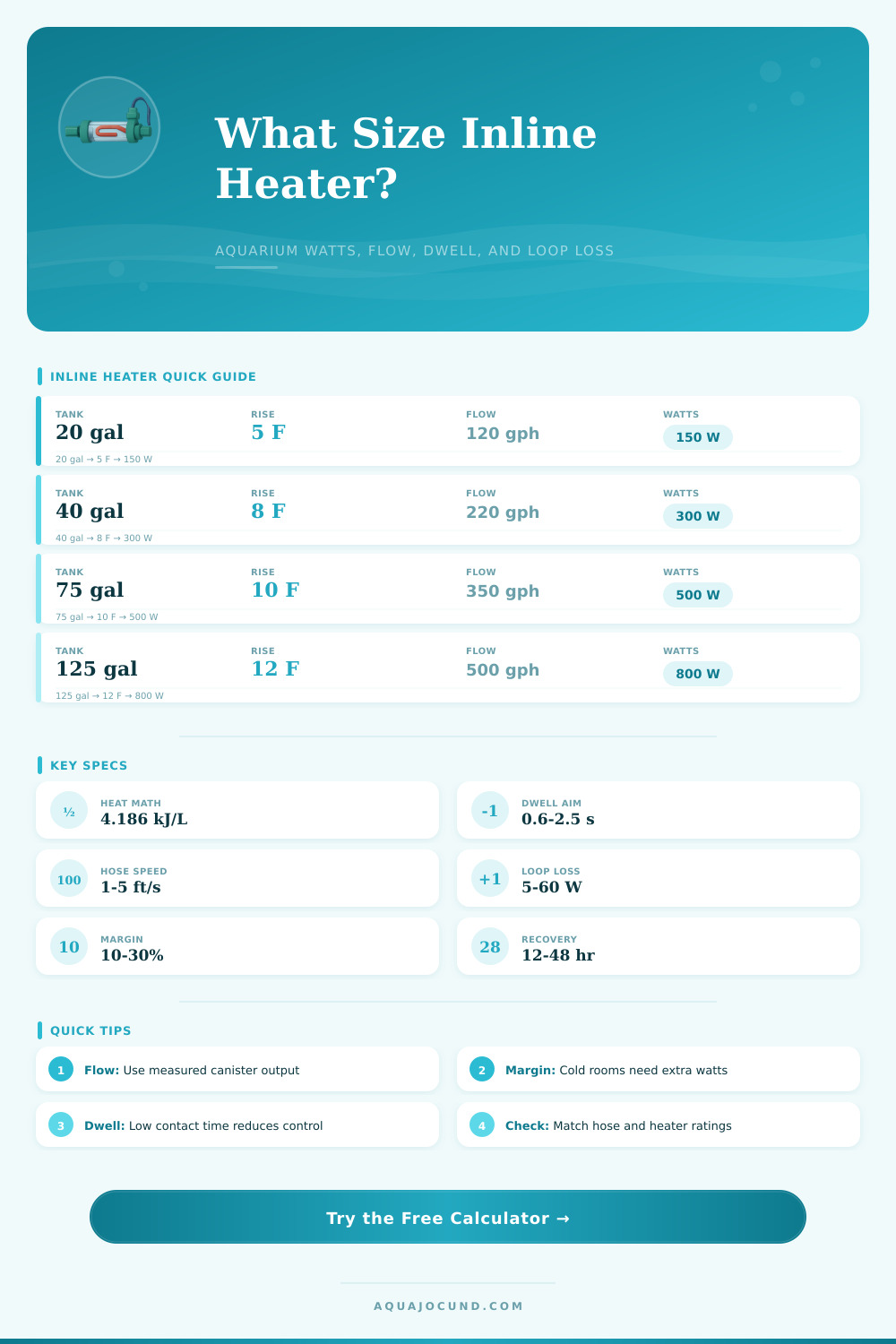
| 10 gallon nano with small canister | 70-110 gph | 5°F / 2.8°C | 75-150 W |
| 20 long community tank | 120-180 gph | 6°F / 3.3°C | 150-200 W |
| 40 breeder planted tank | 180-280 gph | 8°F / 4.4°C | 250-300 W |
| 55 gallon cichlid display | 240-360 gph | 8°F / 4.4°C | 300-400 W |
| 75 gallon reef or planted display | 300-500 gph | 10°F / 5.6°C | 400-500 W |
| 125 gallon cool-room aquarium | 450-700 gph | 12°F / 6.7°C | 600-800 W |
| Calculation factor | What it changes | Typical range | Sizing note |
|---|---|---|---|
| Tank volume | Total water mass to heat | 10-180 gal / 38-680 L | Larger volumes need more watts for the same recovery time. |
| Target temperature rise | Stored heat required | 4-14°F / 2-8°C | A cold room or large water change increases the required wattage. |
| Flow rate | Dwell and per-pass rise | 3-7x tank volume per hour | Fast flow lowers per-pass rise but still moves total heat well. |
| Hose diameter | Velocity and contact volume | 1/2-1 in / 12-25 mm | Too-small hose at high flow can be noisy and restrictive. |
| Canister loop loss | Continuous watts lost outside tank | 5-80 W | Long exposed hoses and cold cabinets need added wattage. |
| Safety margin | Extra capacity above the math | 10-30% | Margin helps the heater recover after cycling and water changes. |
The factors that determines the need for heat maintenance in an aquarium are not just the heater’s wattage and the aquarium’s size. Inline heaters are often located outside the aquarium in a return line. Because inline heaters is located in the return line, the water must pass through the inline heater at a specific volume and speed.
The speed at which the water travels through the inline heater impact how much time the water have to come in contact with the heater. Additionally, the amount of heat that is lost through the hoses and heater body impacts how much heat the water will contain before it enters an aquarium. Flow rate is one variable that will impact the calculation of inline heater size.
How to Choose the Right Inline Heater for Your Aquarium
While a canister filter may be rated to move 300 gallons per hour, the actual flow rate may be less due to the number of bend in the tubing and the size of the media. If the water moves slow through the heater, that will allow the water to heat to a more higher temperature given the same wattage of the inline heater. If the water moves quickly through the inline heater, the increase in temperature will be less.
Instead of using the flow rate of the canister filter as a variable in a heater size calculator, the user should use the measured flow rates to ensure accuracy in the calculations. The diameter of the tubing also impacts inline heater size. If the tubing is narrow but of a high flow rate, the speed of the water through the inline heater will be fast.
Large diameters of tubing will allow the water to move slow through the inline heater. Water speeds between one and five feet per second is recommended when setting up an aquarium with inline heaters. If the speed of the water through the inline heater is slower than one foot per second, it may be difficult to adequately control the water temperature.
If the speed is faster than five feet per second, the inline heater may not be able to transfer enough energy to the water. The size of the tubing should match the size of the inline heater body. Loop losses refer to the heat that is radiated from the hoses and inline heater body into the room.
In a cool environment, such as a basement or garage, the loop losses may be significant. Therefore, the inline heater size calculator should account for loop losses by permitting the user to choose between low, medium, and high loop loss settings. Additionally, most inline heater size calculators will add a safety margin to the required wattage to account for the temperature swings that may occur in the winter as well as during water changes.
A safety margin is used because inline heaters will not be continuously running; instead, they cycle on and off in order to maintain the required aquarium temperature. Recovery time will determine whether the inline heater is adequate or whether it is comfortable for the fish in the aquarium. If the tank is to be returned to the target temperature within one day after a 100% water change, the heater must be able to provide the energy to heat the entire tank volume to the target temperature within that day.
The shorter the recovery time, the more higher the wattage requirement. Reef tanks have higher wattage requirements than most other aquarium types because of the top-offs that is required to supplement the evaporation of water from the tank. The motor that drives the canister filter will provide a small amount of heat to the water in the tank.
This heat is only sufficient to heat the water by a few watt. There are reference tables for the typical size of aquarium, the flow of water through the tank, and the wattage of inline heater that is required to provide heat to the aquarium. These tables are not rules; they are starting points that can be used to determine the wattage if the measurements of the tank and the aquarium are not yet precise.
The published flow rate of the inline heater can be checked against the actual flow rate of the tanks loop. Inline heaters have flow switches that sense if the water is moving too slow through the heater. This prevents the heater from drying out.
However, because the inline heater has this switch, the wattage cannot be changed without first ensuring that the flow switch will allow the water to move through the heater at a normal rate. When selecting inline heaters, it is also important to consider the heaters performance over the course of many months. An inline heater that is barely adequate to heat the aquarium may cycle on and off many times during the colder months of the year when the target temperature is to be maintained.
Additionally, an inline heater that is barely adequate may not be able to heat the tank after a 100% water change. An inline heater that is generously sized will cycle less frequently; it will maintain a more even water temperature. These factors will impact the number of times that the water heater’s thermostat is adjusted, as well as the time that it takes for the tank to reach the target temperature.
The best approach to inline heater sizing is to measure the flow rate with a bucket test, to measure the temperature difference between the room and the aquarium, and to use these variables in a heater size calculator to determine the standard size of heater that should be purchased. This size will account for the losses of heat that occur in the system as well as create a safety margin for extended periods of time. Lastly, ensure that the body of the inline heater will physically fit the barbs of the hoses into which it will be installed, as well as ensure that the range of the inline heaters thermostat matches the desired temperature.
When all these factors have been accounted for, the inline heater will function as a background element to the aquarium that doesnt have to be adjusted as often.