Inert Substrate to Aquasoil Ratio Calculator
Split a sloped aquarium substrate bed into aquasoil, nutrient zone, inert sand or gravel, total liters, weight, and practical bag counts.
Substrate Ratio Results
| Material | Modeled density | Typical bag volume | Best calculator use |
|---|---|---|---|
| Light porous aquasoil | 0.62 kg/L | 3 to 8 L | Shallow nanos, gentle slopes, low weight. |
| Standard planted aquasoil | 0.72 kg/L | 8 to 9 L | General planted tanks and exposed cap zones. |
| Powder type aquasoil | 0.78 kg/L | 3 to 8 L | Thin top caps, carpeting plants, detail areas. |
| Pool filter sand | 1.55 kg/L | 10 to 20 L | Clean inert foregrounds and visible sand lanes. |
| Fine aquarium sand | 1.45 kg/L | 5 to 10 L | Light cap over soil, shrimp-safe foregrounds. |
| Quartz gravel | 1.70 kg/L | 5 to 25 L | Heavy inert base, open gravel sections. |
| Tank | Footprint | 2 in average bed | 3 in average bed |
|---|---|---|---|
| 10 gal | 20 x 10 in / 51 x 25 cm | 6.6 L total | 9.8 L total |
| 20 long | 30 x 12 in / 76 x 30 cm | 11.8 L total | 17.7 L total |
| 29 gal | 30 x 12 in / 76 x 30 cm | 11.8 L total | 17.7 L total |
| 40 breeder | 36 x 18 in / 91 x 46 cm | 21.2 L total | 31.9 L total |
| 55 gal | 48 x 13 in / 122 x 33 cm | 20.4 L total | 30.7 L total |
| 75 gal | 48 x 18 in / 122 x 46 cm | 28.3 L total | 42.5 L total |
| Total substrate | 40% aquasoil | 60% inert | Rounded bag example |
|---|---|---|---|
| 10 L | 4 L | 6 L | 1 x 5 L aquasoil, 1 x 10 L inert |
| 18 L | 7.2 L | 10.8 L | 1 x 8 L aquasoil, 2 x 10 L inert if contouring |
| 28 L | 11.2 L | 16.8 L | 2 x 8 L aquasoil, 1 x 20 L inert |
| 42 L | 16.8 L | 25.2 L | 2 x 9 L aquasoil, 2 x 20 L inert or 1 x 25 L plus margin |
| Adjustment | What changes | Calculator input | Practical result |
|---|---|---|---|
| Steeper back slope | Raises average depth and total volume | Increase back substrate depth | More total liters, often more inert support. |
| Plant-only soil pockets | Aquasoil concentrated in root zones | Lower nutrient zone footprint | Less aquasoil while keeping feeding areas active. |
| Visible sand foreground | Inert share grows | Lower cap and base aquasoil shares | Cleaner foreground with aquasoil hidden behind. |
| Rinse and settling loss | Requires extra material | Increase margin percent | Bag split rounds up before layout trimming. |
Many hobbyists face a dilemma: should they use inert sand (root-starving yet visually appealing) or aquasoil (water clouding but root feeding)? Pure gravel starve your roots within a year, while pure soil clouds the water when disturbed. When disturbed, it make water cloudy.
Fortunately, we don’t have to suffer from any of these issues. By separating substrate bed, we can place nutrient-rich soil within easy reach of roots and cover it with stable gravel/sand. Simple, right?
How to Use the Substrate Calculator
This happens until you find yourself calculating precise amounts of both materials. Unfortunatley most of us estimate the ratio and either have too little soil to sustain moss growth or too much that’s impossible to manage.
Once you’ve entered your tank size, the calculator do the rest of the math, no need to worry about doing the geometry wrong! First select the shape. Choose a rectangular, cubic or any other type of curve that matches your footprint.
Next establish the slope. Be careful here. A low slope won’t show much water depth visually while a high one will require extra room in the back half. Average the front and back to get the most realistic number of the entire tanks volume. That way you don’t undershoot when calculating how much material is required to create a dramatic background hill.
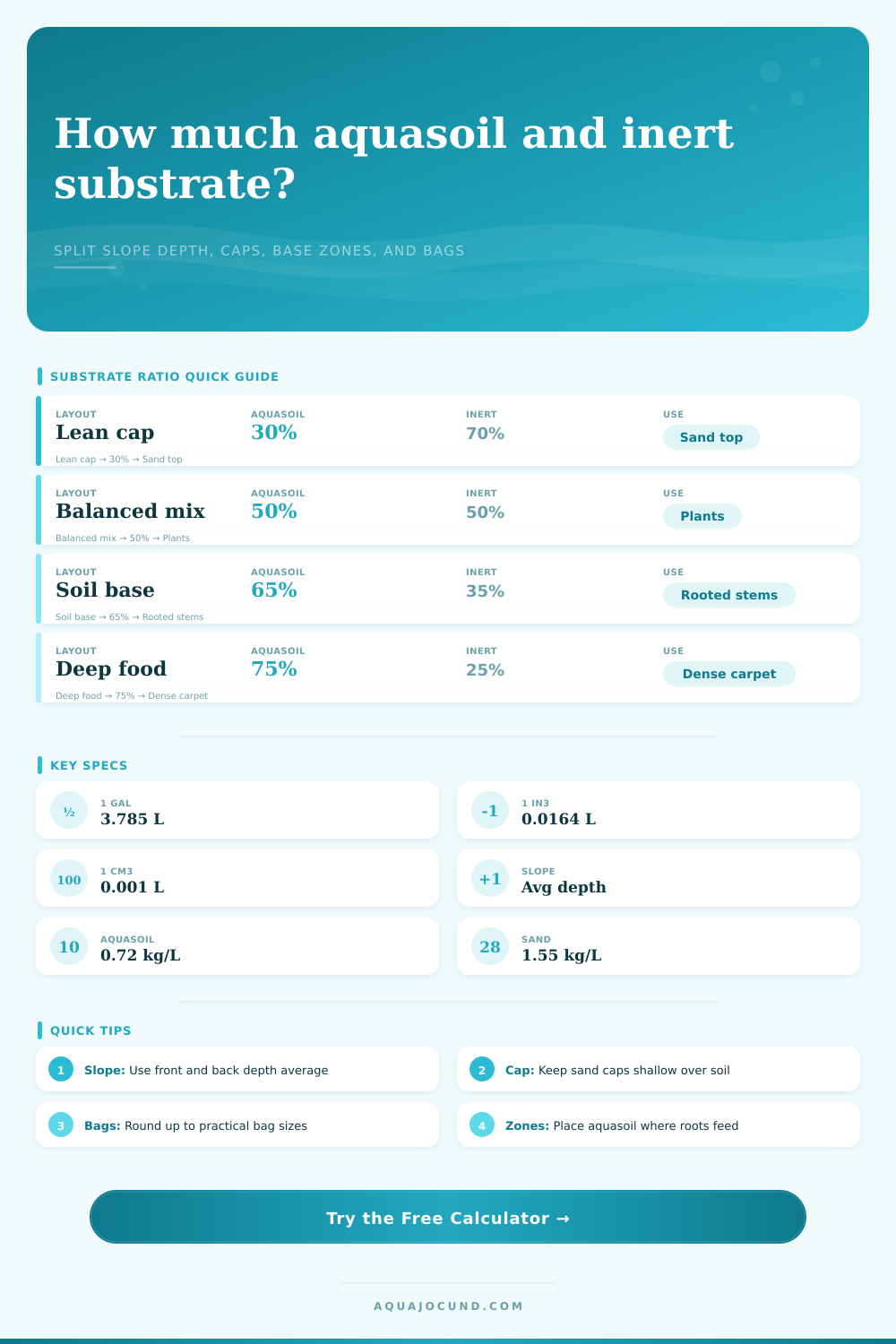
Once the volume is set, then you decide how much goes into each half: the aquasoil share vs. Base share. Base refers to soil that’s not seen but is buried under inert material or hidden by hardscape. Cap refers to the visible surface portion of the bed. More aquasoil share mean more immediate nutrient availability for roots (e.g., when carpeting densely with something like hemianthus). Higher inert percent means you want an open lane of sand and such in your shrimp tank. The calculator will make sure all these percentages sum to 100% (i.e., a full bed) and will adjust them to match.
It also supports a nutrient zone, you specify where certain heavy feeders such as swords or crypts will be planted. That way, it let you focus additional depth in those spots instead of wasting money and releasing nutrients unnecesarily elsewhere.
A second complication for newbie fish keeper is weight. While aquasoil weighs less than sand, a deep bed of soil in a large tank still add significant mass. Knowing how much each bag weigh also lets you know how strong your shelves are going to need to be or if you need to figure out how to get your tank up there. Nobody wants to load a hundred pounds of gravel into a packed car already containing all that glass and water.
Because the tool use the density of materials as input, it can give an estimated weight which you can use to plan your transportation and shelf strength. It will also tell you how many bags to purchase so you don’t go overboard. You will still have more than enough to cover what you’re trying to do, with some extra for rinsing and settling. Yes, losing a cup here or there when you rinse is normal, but it’s nice to know ahead of time instead of panicking because you ran out half way through laying things down.
So which ratio should you choose? It’s not so much a chemical question as it is one of landscaping design. What sort of look do you want? Are you going for a community of balanced fish, perhaps a sixty-fifty mix? Or maybe you want a simple setup with mostly air plants; in that case, a thirty-seventy mix might work for you. How many bags are in each ratio? That is where the flexibility come in. Play around with those numbers and see how the number of bags adjusts. Instantly.
This flexibility turns a stressful shopping trip into a confident execution plan. You’ll walk out of the store with just what you need. Nothing less or more.
Your substrate is the stage for your whole aquarium ecosystem., Your plants will stay vibrant without regular root tabs., Your water will be clear without regular vacuuming. This is a little upfront work, it’s not much time to plan, but it pays off big for years. It should of been easier if you didn’t have to guess. Measure twice. Calculate the split. Build the bed so your plants has the support they need and so does your vision.
You’re armed with the right mix. And now you’re ready to watch your underwater garden take root in a foundation that lasts.