Inches Per Gallon Stocking Calculator
Adjust the classic adult inches rule for fish depth, activity, waste, filtration, water changes, and tank surface area.
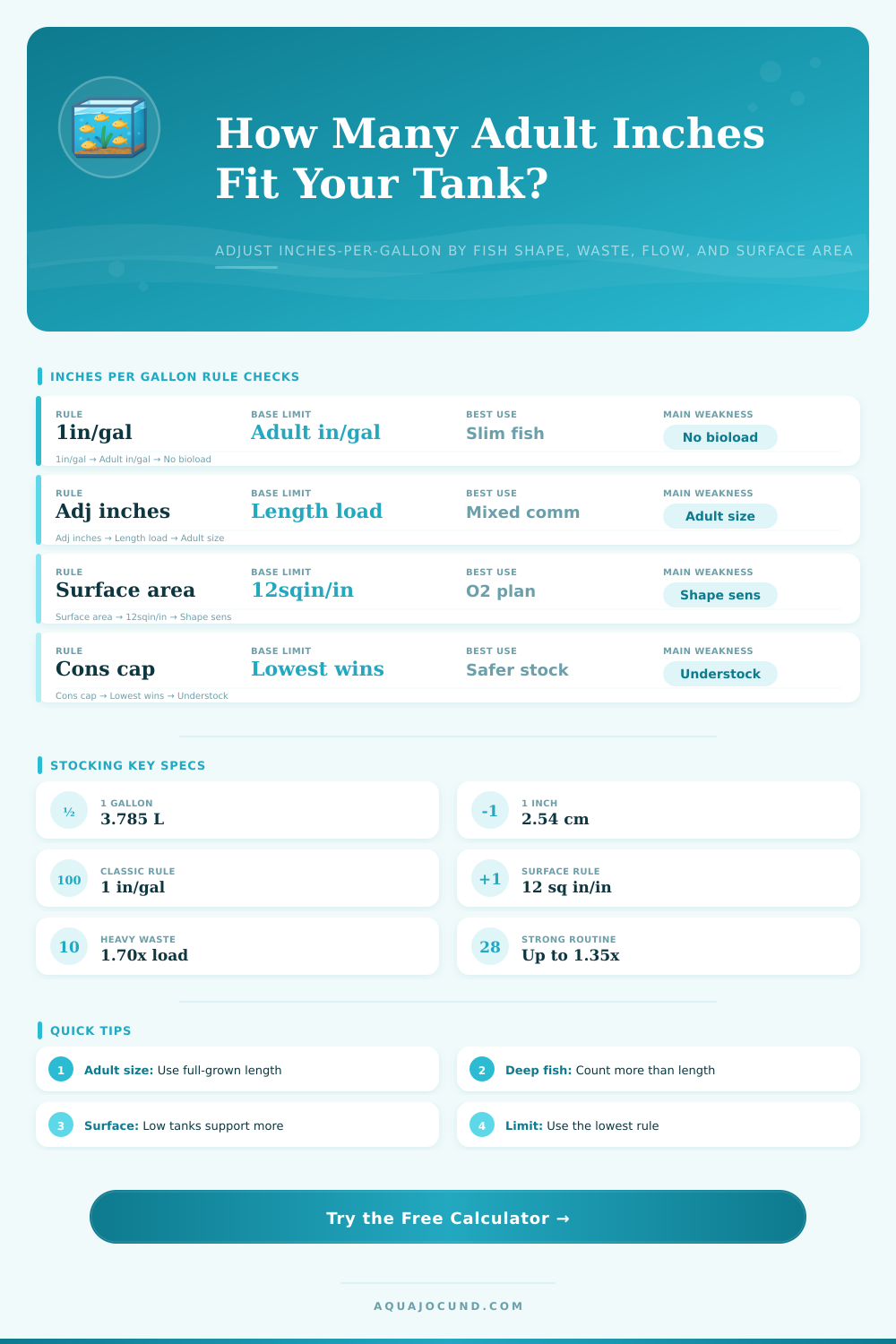
| Rule limit | Formula used | What it protects | When it usually governs |
|---|---|---|---|
| Classic inches per gallon | Tank gallons / adult length | Simple volume capacity | Small slim community fish |
| Adjusted bioload inches | Gallons x husbandry / adjusted fish load | Waste, activity, and body mass | Deep-bodied or messy species |
| Surface area rule | Open surface / adjusted surface demand | Gas exchange and oxygen reserve | Tall tanks, covered tanks, high activity |
| Conservative recommendation | Lowest rule after safety margin | Planning buffer | Most mixed community estimates |
| Category | Setting | Factor | Calculator effect |
|---|---|---|---|
| Body ratio | Slim, depth under 18% of length | 0.85x | Lower adjusted inches per fish |
| Body ratio | Standard, 18-28% | 1.00x | Classic-length baseline |
| Body ratio | Deep, 28-40% | 1.25x | Higher adjusted inches per fish |
| Body ratio | Bulky, over 40% | 1.50x | Strongly reduces count |
| Activity | Sedentary / calm / active / very active | 0.85 / 1.00 / 1.20 / 1.40 | Raises oxygen and space demand |
| Waste | Low / moderate / high / heavy | 0.85 / 1.00 / 1.35 / 1.70 | Raises bioload inches |
| Filtration | Basic / standard / strong / heavy | 0.85 / 1.00 / 1.18 / 1.35 | Adjusts volume capacity |
| Water changes | Light / normal / strong / intense | 0.85 / 1.00 / 1.12 / 1.20 | Adjusts volume capacity |
| Tank size | Typical footprint | Volume | Classic inches | Surface-rule slim inches |
|---|---|---|---|---|
| 10 gallon | 20 x 10 in / 51 x 25 cm | 10 gal / 38 L | 10 in / 25 cm | 17 in / 42 cm |
| 20 long | 30 x 12 in / 76 x 30 cm | 20 gal / 76 L | 20 in / 51 cm | 30 in / 76 cm |
| 29 gallon | 30 x 12 in / 76 x 30 cm | 29 gal / 110 L | 29 in / 74 cm | 30 in / 76 cm |
| 40 breeder | 36 x 18 in / 91 x 46 cm | 40 gal / 151 L | 40 in / 102 cm | 54 in / 137 cm |
| 55 gallon | 48 x 13 in / 122 x 33 cm | 55 gal / 208 L | 55 in / 140 cm | 52 in / 132 cm |
| 75 gallon | 48 x 18 in / 122 x 46 cm | 75 gal / 284 L | 75 in / 191 cm | 72 in / 183 cm |
| 125 gallon | 72 x 18 in / 183 x 46 cm | 125 gal / 473 L | 125 in / 318 cm | 108 in / 274 cm |
| Example profile | Adult length | Body depth | Activity | Waste class |
|---|---|---|---|---|
| Neon tetra | 1.5 in / 3.8 cm | 0.35 in / 0.9 cm | Active schooling | Low |
| Guppy | 2.0 in / 5.1 cm | 0.45 in / 1.1 cm | Calm community | Moderate |
| Cory catfish | 2.5 in / 6.4 cm | 0.60 in / 1.5 cm | Active schooling | Moderate |
| Platy | 2.5 in / 6.4 cm | 0.75 in / 1.9 cm | Calm community | Moderate |
| Angelfish | 6.0 in / 15.2 cm | 3.0 in / 7.6 cm | Calm community | High |
| Fancy goldfish | 6.0 in / 15.2 cm | 3.0 in / 7.6 cm | Calm community | Heavy |
| Rainbowfish | 4.0 in / 10.2 cm | 1.0 in / 2.5 cm | Very active | Moderate |
| Medium cichlid | 5.0 in / 12.7 cm | 1.6 in / 4.1 cm | Very active | High |
Many people use the “one inch of fish for every gallon” rule. This is an approximation at best, it’s typically treated as a rule of nature.
For example, you purchase two two-inch fish, a goldfish and a neon tetra. One is barrel shaped (goldfish) and the other slim down to nothing but a tail (neon tetra). When figuring out stocking density by length alone, you neglect volume of each fish. You also neglect the waste load of each and whether or not your filter can absorbs it.
Why Length Is Not the Only Thing That Matters
Too heavy of a bio-load can result in ammonia spikes which will kill community before the tank can keep up. The number of gallons stated on label isn’t everything; it’s also important to consider the surface area. Your oxygen doesn’t come in through water, but rather through air over the water.
For example, a tall narrow twenty-gallon tank may have a small footprint. It has lots of water by volume, but it do not have many square inches of exposed surface to exchange gas with the atmosphere quickly. Remember, a shallow and wide tank can breathe better different than a deep and narrow tank (assuming same total capacity).
Measure the open top space using width x length of water surface.
Body Depth; How much do they weigh? Why? Weight and mass create waste, so most stocking calculators accounts for it. Cichlids and other deep bodied fish produce more solid waste then slender species (e.g., an angelfish). You cannot treat a round fish like a long one; you need to multiply by a factor based off the profile. The calculator above accounts for that automatically.
For example, if your fish are rounded more than a pencil, the calculator knows it is not as light a load on system. It will reduce how many you should of stock so you do not overdo it. I mean, who wants to buy ten fancy goldfish only to find that they’re all sluggish within two weeks?
The number of fish also depends on how often you maintain the tank. Yes, filtration should cleans water. However, its main function is to provide space for good bacteria to consume toxic ammonia and convert it to less harmful nitrate. By doing regular water changes (weekly), and having a lot of filtration, you’re essentially exporting waste from the tank.
You can then take advantage of that room and fill out the tank slightly heavier than someone who only does minor top-offs every month or so. Your routine and the amount of waste from your fish both matters. A peaceful tank requires less mechanical support than a messy community. That’s how it works in reality.
Oxygen consumption is also affected by activity level. Sedentary bottom dwelling fish consume less oxygen than active schooling fish. The former breathe slower and produce fewer waste product (by volume). Tetra or rainbowfish that swim incessantly require a higher rate of oxygen turnover in the system. Even though they’re easier on the gas exchange, slower-moving fish such as plecos or corydoras will still affects the waste load via feeding habits.
Balance the physical constraints of the glass box against its energy budget. When in doubt, go with what’s safe. Go with the lower limit when two sets of guidelines differ. So if one says you can have twenty inches on a given surface area, yet another says you’re limited to twelve, go with twelve. Better to have a tank with some open space than an algae-clouded tank stinking to high heaven.
A lot of new keepers get anxious to fill their tanks as fast as possible because it seems “unfinished” without anything in it. The truth is; an over stocked tank feel cramped and stresses the fish. Go easy, monitor your tank’s water clarity over time (a month), and if things are stable then consider adding more, gradually.
Stocking isn’t so much about filling up space, it’s more about controlling the invisible chemistry. You don’t see the ammonia. You don’t see the oxygen level going down. But you do feel it in the animals’ behavior. When the environment gets tight, they gets aggressive or lethargic. It becomes tense.
What you want to do is establish a buffer zone… Somewhere between too loose and too tight; where life thrives without you constantly having to manage crisis situations. Follow the numbers, but don’t take them as a commandment. Adjust to fit your set-up. Respect the limitations of gas exchange. And realize that one inch of fish does not always equal one gallon of water.
Begin conservatively. Leave the ecosystem some breathing room. Peace and quiet in a balanced tank is worth far more than a few extra inhabitants.