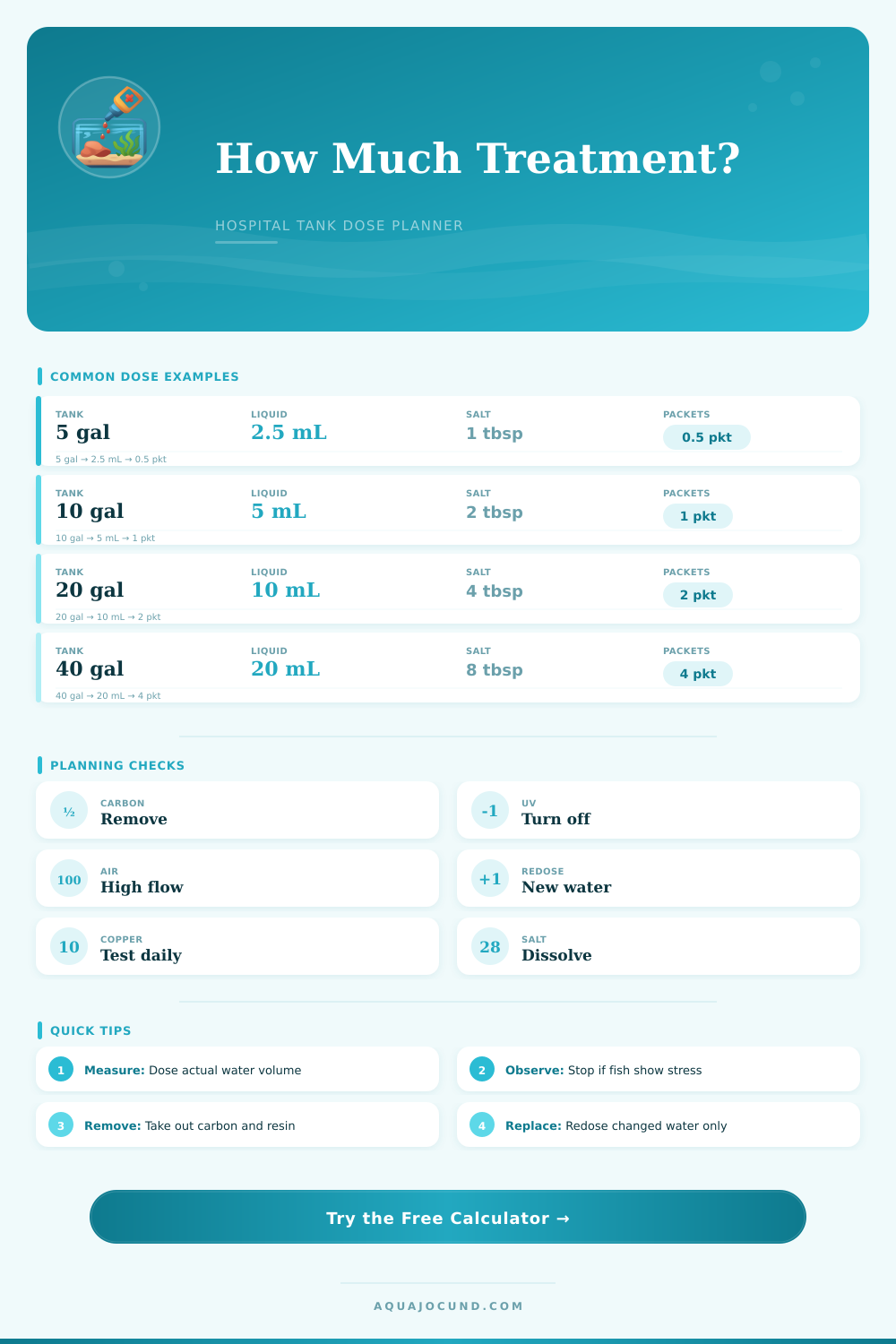
Hospital Tank Dosing Calculator
Plan aquarium treatment doses by true water volume, product label rate, water changes, and species sensitivity.
| Treatment | Label Math Used | Typical Interval | Main Planning Note |
|---|---|---|---|
| Seachem ParaGuard | 5 mL per 10 gal or 40 L | Daily as required | Remove invertebrates and chemical filtration; repeat only while fish show no stress. |
| Aquarium Solutions Ich-X | 5 mL per 10 gal | At least 8-24 hr apart | Works best with substantial pretreatment water changes and strong aeration. |
| Fritz Coppersafe | 5 mL per 4 gal | One month coverage | Use a copper kit that reads chelated or total copper; never use with invertebrates. |
| API General Cure | 1 packet per 10 gal | Repeat after 48 hr | Two-dose course, then water change and replace carbon according to label. |
| Aquarium Salt | 1 rounded tbsp per 5 gal | With new water | Salt remains until water is removed; redose only replacement water. |
| Seachem KanaPlex | 1 measure per 5 gal | Every 48 hr, max 3 doses | Remove chemical filtration, UV, ozone, and invertebrates during the course. |
| Seachem MetroPlex | 1-2 measures per 10 gal | Every 48 hr | Use 2.00x only when matching the high end of the product label range. |
| Praziquantel Liquid | 1 tsp or 5 mL per 20 gal | Often 5-7 day rounds | Protein skimmers and carbon can remove medication; maintain oxygen. |
| Item | During Treatment | Why It Matters | Return Timing |
|---|---|---|---|
| Activated carbon | Remove | Adsorbs many dyes, antibiotics, and organics before they can work. | Use after the course to clear residual medication. |
| Purigen or resin | Remove | Can strip medications unpredictably from small hospital systems. | Return only after water changes and label clearance. |
| UV sterilizer | Turn off | Light exposure can break down some active ingredients. | Restart after final redose window has passed. |
| Protein skimmer | Usually off or cup removed | Can remove organics and overflow with some treatments. | Restart gradually after treatment water change. |
| Sponge filter | Keep running | Provides oxygen and biofiltration without adsorbing medication. | Seed a spare sponge for future quarantine. |
| Air stone | Increase flow | Many medications and warmer water reduce oxygen margin. | Keep extra aeration until fish breathe normally. |
| Group | Risk Pattern | Planning Adjustment | Watch Closely For |
|---|---|---|---|
| Tetras, rasboras, danios | Generally standard tolerance | Use label dose if water quality is stable. | Clamped fins, flashing, surface gasping. |
| Bettas and gouramis | Labyrinth fish dislike low oxygen | Keep warm, gentle, well-aerated water. | Lethargy, rapid breathing, refusal to surface. |
| Loaches, catfish, eels | Often sensitive to dyes, copper, salt | Consider 0.50x to 0.75x first dose if label allows. | Rolling, darting, red skin, heavy slime. |
| Goldfish and koi | High waste load in hospital tanks | Use extra aeration and test ammonia daily. | Bottom sitting, red streaks, ammonia burn. |
| Marine fish | Some require precise copper range | Match salinity and verify copper with the correct kit. | Head twitching, appetite loss, respiration spikes. |
| Shrimp, snails, live rock | Very sensitive to copper and many meds | Remove before treatment or use a fish-only hospital tank. | Immobility, failed molting, rapid losses. |
| Tank | Typical Dimensions | Usable Treated Water | Planning Use |
|---|---|---|---|
| 5 gal | 16 x 8 x 10 in | 4.0-4.6 gal after gear | Single betta, small rasbora group, short observation. |
| 10 gal | 20 x 10 x 12 in | 8.0-9.2 gal after gear | Most small community fish and medication courses. |
| 20 long | 30 x 12 x 12 in | 16-18 gal after gear | Active fish, small marine quarantine, better gas exchange. |
| 29 gal | 30 x 12 x 18 in | 23-26 gal after gear | Taller quarantine for angelfish, gouramis, or groups. |
| 40 breeder | 36 x 18 x 16 in | 32-36 gal after gear | Larger fish, marine QT, copper monitoring stability. |
| 55 gal | 48 x 13 x 21 in | 44-50 gal after gear | Goldfish, cichlids, and larger display-fish treatment. |
If fish in the main display tank become ill, a person must decide whether to treat the fish in the main tank or move the fish to an separate hospital tank. While moving the fish to a hospital tank is a common decision for treating fish with illnesses, moving the fish to a hospital tank can cause stress for those fishes. Furthermore, a person must also decide the amount of medication to add to the hospital tank, as the hospital tank usually contains less water than the main display tank.
A calculator is provided that will allow a person to enter the dimensions and the fill levels of the hospital tank so that the calculator can determine the correct amount of medication. However, the calculator will not determine if the fish is ready for the stress of being moved to the hospital tank, or if the water parameters in the hospital tank will remain stable during the administration of the medication. Hospital tanks are typicaly smaller and simpler than the main display tank, and often dont contain the same substrate and plants as the main display tank.
How to Use the Hospital Tank Medicine Calculator
Hospital tanks often use bare bottoms to the tank, sponge filters, and PVC hides to simulate the same areas in the main display tank for the ill fish. Because hospital tanks have bare bottoms and sponges filters, the actual volume of water in the hospital tank is often less than the size of the hospital tank. This is due to the fact that both the filtration and the fish takes up some of the volume of the hospital tank.
The calculator allows a person to adjust the percentage of the hospital tank that gets filled with water, and to adjust the values for the volume that the fish and filtration equipment occupy in the hospital tank. By adjusting these parameters, the calculator will determine the amount of medication that should be added to the hospital tank to provide for the ill fish. The medication that is added to the tank may have different effect within the hospital tank.
For instance, medications that contain copper last in the hospital tank for many week, and only require one dose of the medication to be administered. Liquid medications, such as liquid remedies for ich, may require many doses of the medication to be added to the tank over a specific period of time. Salt behaves differently than other medications; it does not evaporate from the hospital tank, so the salt only needs to be replaced when a person removes water from the hospital tank.
Both of these variables can be accounted for in the calculator; the person can select the medication type, the person can select the number of doses, and the person can reference the medication schedule on the product label. Some medications account for the sensitivity of the fish to the medication, but often does not include a factor for this in its dosing charts. For instance, scaleless fish and loaches is often more sensitive to the ingredients in medications than fish like goldfish or tetras.
Invertebrates are also very sensitive to some ingredients. A strength multiplier is included in the calculator so that the amount of medication is reduced in the first dose to account for the sensitivity of the fish to the medication. Another factor that is included in the calculator is a dropdown menu that allows the person to select the species of fish in the hospital tank.
This dropdown menu will flag medications that require more aeration in the hospital tank, or that require a lower starting amount of medication. These factors will prevent the medication from becoming stressed for the fish, but will require the person to read the label of the medication to ensure that it is safe for the fish. Another factor in the consideration of adding medication to the hospital tank is water changes.
For instance, if a person decides to change twenty-five percent of the water in the hospital tank, twenty-five percent of the active medication will also be removed from the hospital tank. The calculator will determine the amount of medication that must be added to the hospital tank to account for this water change, but will not determine if the fish in the hospital tank can handle the stress of a water change. Some medications will dissapears from the hospital tank quick when new water is added, while medications like salt or copper will remain in the hospital tank until the water is physically removed.
Thus, the calculator will determine the amount of medication that will be replaced when new water is added to the hospital tank, but will not factor in the possibility of changing the water. Aeration and chemical filtration of the hospital tank can also impact the efficiency of the medication that is added to the hospital tank. For instance, many medications require high levels of aeration of the hospital tank, as some of the ingredients in the medications can reduce the amount of dissolved oxygen in the hospital tank.
Chemical filtration, such as the addition of carbon or other resins can remove the medication from the hospital tank prior to the completion of the medication course. Both of these factors are indicated in the dropdown menu for the medication in the hospital tank; to ensure that the person is aware of the need to physically remove the carbon or the UV sterilizer prior to the addition of the first dose of the medication. The goal of the hospital tank is to provide the fish with a stable and medicated environment.
Accurate dosing of the medication is one component of providing for the stability of the hospital tank, as well as the maintenance of the medicated environment. In addition to adding the proper amount of medication to the hospital tank, the person must also observe the hospital tank daily to ensure that the fish are stable and well. Additionally, regular testing for the amount of ammonia in the hospital tank will ensure that the hospital tank remains stable.
If the fish in the hospital tank begin to display signs of stress, the person may have to take the option of discontinuing the medication. Thus, while the calculator includes all of the mathematical numbers necessary for the medication, the person will perform the physical work of managing the hospital tank.