Herbie Overflow Size Calculator
Size a full siphon, emergency standpipe, return flow, valve reserve, and sump turnover for a quiet Herbie drain layout.
⚙Preset Herbie Scenarios
Most reef sumps run quietly around 3x to 7x display volume per hour.
The style changes practical tuning margin because air entry, weir stability, and standpipe spacing affect Herbie behavior.
📏Drain Size Comparison Grid
📊Estimated Drain Capacities
| Pipe Size | Full Siphon Range | Emergency Range | Typical Use |
|---|---|---|---|
| 3/4 in | 350-650 gph | 180-330 gph | Nano, shallow return |
| 1 in | 650-1,200 gph | 325-600 gph | 40-90 gallon systems |
| 1-1/4 in | 1,000-1,900 gph | 500-950 gph | Medium high turnover |
| 1-1/2 in | 1,500-3,000 gph | 750-1,500 gph | Large reefs |
| 2 in | 2,600-5,200 gph | 1,300-2,600 gph | Large or remote sumps |
🔄Common Tank Turnover Targets
| System Type | Sump Turnover | Noise Goal | Herbie Note |
|---|---|---|---|
| Soft coral reef | 3x-5x/hr | Very quiet | Easy valve tuning |
| Mixed reef | 4x-7x/hr | Quiet | Most common range |
| SPS display | 5x-8x/hr | Moderate | Prefer larger backup |
| Frag system | 6x-10x/hr | Functional | Watch emergency flow |
| Basement sump | 3x-6x/hr | Head limited | Return head dominates |
🛠Herbie Tuning Reference
| Measurement | Preferred Range | Warning Range | Adjustment |
|---|---|---|---|
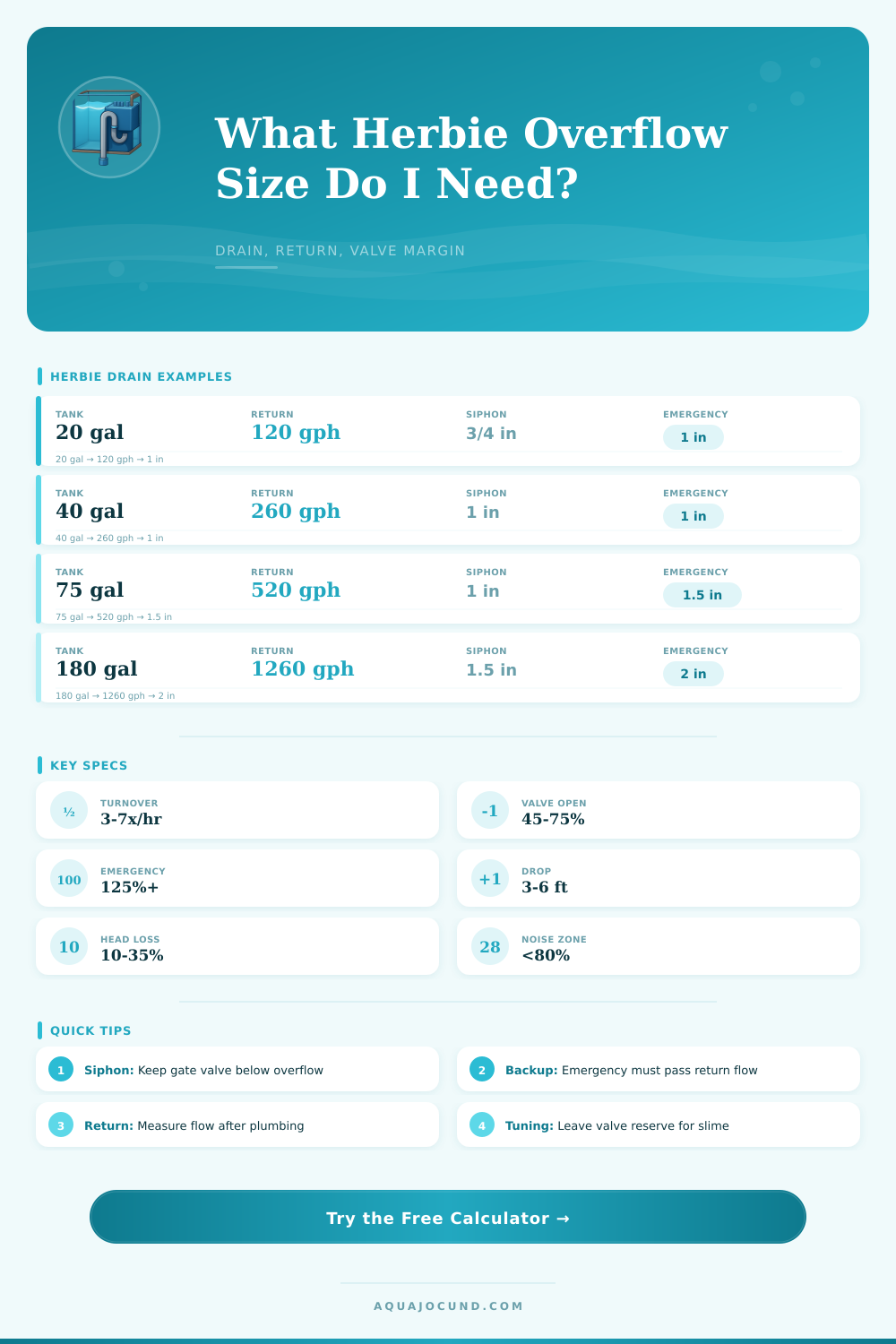
| Gate valve open | 45%-75% | 80%+ | Increase pipe size or reduce return |
| Siphon load | 35%-70% | 85%+ | Lower return flow or upsize siphon |
| Emergency margin | 125%+ | Under 110% | Upsize emergency drain |
| Drain drop | 3-6 ft | Under 2 ft | Expect lower siphon capacity |
| Sump turnover | 3x-7x/hr | 10x+ | Use display flow pumps for tank flow |
💧Example Tank Sizes
| Display | Quiet Return | Suggested Siphon | Suggested Emergency |
|---|---|---|---|
| 20 gal / 76 L | 80-140 gph | 3/4 in | 1 in |
| 40 gal / 151 L | 160-280 gph | 3/4-1 in | 1 in |
| 75 gal / 284 L | 300-525 gph | 1 in | 1-1/2 in |
| 120 gal / 454 L | 480-840 gph | 1-1/4 in | 1-1/2 in |
| 180 gal / 681 L | 720-1,260 gph | 1-1/2 in | 2 in |
If you’re a reef keeper, then you know what I’m talking about: the dreaded “clogged drain.” The one where all of a sudden there’s this hollow gurgling sound from somewhere in the tank, and water spills over your emergency standpipe because main siphon has clogged.
What’s wrong? The actual conditions don’t match the system’s design. The problem isn’t generally that Herbie drains fails. They is generally undersized. Builders tend to select their pipe diameter according to peak pump ratings, which assume no head pressure. In reality, sumps will have some sort of resistance, meaning the pump doesn’t move as much water as the box say it does.
How to Choose the Right Pipe Size
The calculator (above) takes these movements into account. It’s worth knowing what it does since it impacts the design of your system. The biggest variable to know isn’t the display volume. It’s the head loss calculation. Each inch of vertical rise, each elbow, and each union will reduce output of pump. An eight hundred gallon per hour pump may only produce four hundred gallons once it has to battle past some fittings and three feet of lift. Size your drain for eight hundred gallons? You’ve built for a number that doesn’t exist.
Your plumbing layout determines how much your return flow is reduced, that prevents oversizing the siphon because you believed the sticker on the pump box. To calculate valve reserve you use the above number. The goal is to leave the valve between forty-five and seventy-five percent open. Running a gate valve wide open accomplishes nothing. What’s the point of having a valve if you have to turn it all the way counter-clockwise just to maintain your regular flow? Why would you ever want to change the flow during an algae buildup, or when replacing your return pump with one more efficient different than what you’re using now?
Your goal should of be to leave your valve somewhere between forty-five and seventy-five percent open. That’s where you have mechanical leverage. That way you can gradually trim down the flow smoothly without any noise or turbulence. When you see what your siphon load is, it will tell you how close you are from reaching the physical limit of the drain.
Now about the emergency drain. You know, the dry pipe that is only used if the main siphon fails? It has to suck down all that return flow on its own. No, it can’t take half of it. And it can’t take eighty percent of it. It’s gotta be big enough to handle the entire amount your pump are pushing back at it. Because if the main drain clogs and the emergency standpipe doesn’t hold enough in there, you’ve got precious little time to address the issue before water floods the floor. So the safety factor numbers help make sure that backup line is oversized just enough for that worst-case scenario. It’ll cost more to put in a bigger pipe today, but you won’t need to replace any drywall later.
There’s also a hidden variable in plumbing design: noise. Water striking water makes noise, and the higher the speed, the more it sound. If you let your drain run at ninety percent capacity, it will probably be roaring or even chattering because of air being trapped in the stream. Keeping the load lower ensures silence for free.
To get some quick guidelines on common tank sizes, check the reference tables associated with the calculator. A one-inch siphon can comfortabley handle a seventy-five-gallon reef whereas a minimum inch-and-a-half would serve a hundred-eighty-gallon better. Remember these are starting points; there are no hard rules here. Your own fitting count and head height will change numbers.
The size of the Herbie drain is too big for its capacity. Big pipes is good because big pipes mean margin for error. That’s the basic philosophy. And the math comes from the calculator. But the math also tells you how much pipe to install and how much pipe to fine-tune away. You will also learn how to never assume a pump rating at face value.
If you do all this, the most noise you’ll ever hear is the soft whoosh of water running where water should run. Quietly. There is no drama.