🌡 Heater Wattage By Temperature Rise Calculator
Estimate aquarium heater watts from water volume, desired temperature rise, room temperature, lid and insulation, surface heat loss, safety margin, and redundant heater splitting.
Calculation Breakdown
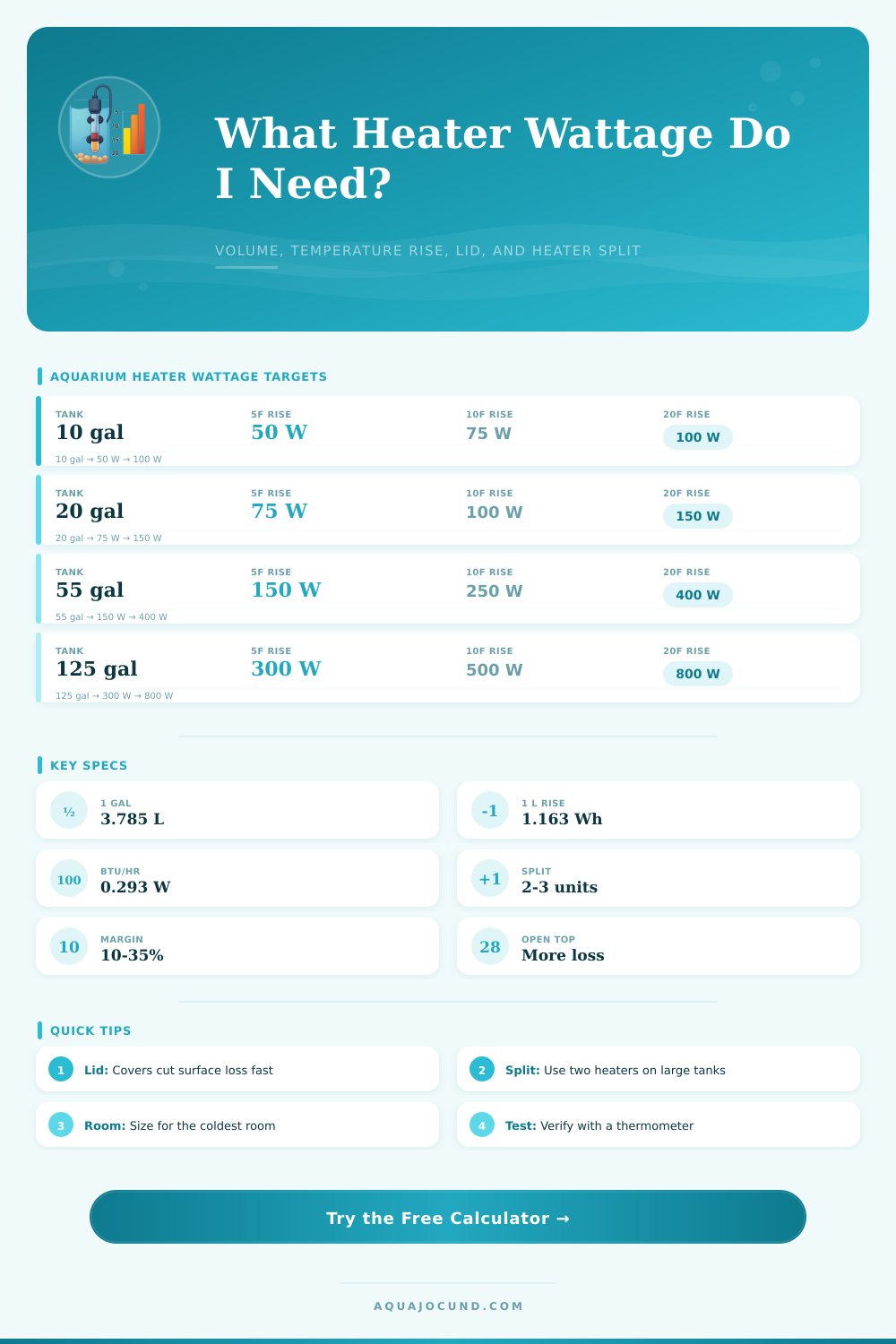
| Net Volume | 5°F / 3°C Rise | 10°F / 6°C Rise | 15°F / 8°C Rise | 20°F / 11°C Rise |
|---|---|---|---|---|
| 5 gal / 19 L | 25-50 W | 50 W | 50-75 W | 75-100 W |
| 10 gal / 38 L | 50 W | 75 W | 75-100 W | 100 W |
| 20 gal / 76 L | 75 W | 100 W | 150 W | 150-200 W |
| 40 gal / 151 L | 100-150 W | 200 W | 250 W | 300 W |
| 75 gal / 284 L | 200 W | 300 W | 400 W | 500-600 W |
| 125 gal / 473 L | 300 W | 500 W | 650 W | 800-1000 W |
| Profile | Top Loss Factor | Side Loss Factor | Best Use |
|---|---|---|---|
| Open rimless top | 1.35 | 1.00 | Display tanks where evaporation and room drafts matter. |
| Mesh or egg-crate cover | 1.15 | 1.00 | Jump protection with only modest heat-loss reduction. |
| Glass lid or canopy | 0.85 | 0.95 | Common freshwater and planted tanks. |
| Tight lid with low gaps | 0.70 | 0.90 | Warm fish rooms or tanks with low evaporation. |
| Covered top plus foam back | 0.70 | 0.70 | Cold walls, basement tanks, and racks. |
| Insulated holding tub | 0.55 | 0.55 | Quarantine, grow-out, and temporary vats. |
| Tank | Dimensions | Volume | Typical Split For 10°F Rise |
|---|---|---|---|
| 10 gallon | 20 x 10 x 12 in / 51 x 25 x 30 cm | 38 L | 1 x 75 W or 2 x 50 W |
| 20 long | 30 x 12 x 12 in / 76 x 30 x 30 cm | 76 L | 1 x 100 W or 2 x 75 W |
| 40 breeder | 36 x 18 x 16 in / 91 x 46 x 41 cm | 151 L | 2 x 100 W or 2 x 150 W |
| 55 gallon | 48 x 13 x 21 in / 122 x 33 x 53 cm | 208 L | 2 x 150 W |
| 75 gallon | 48 x 18 x 21 in / 122 x 46 x 53 cm | 284 L | 2 x 200 W |
| 125 gallon | 72 x 18 x 21 in / 183 x 46 x 53 cm | 473 L | 2 x 300 W or 3 x 250 W |
| Temperature Rise | Room Example | Planning Meaning | Adjustment |
|---|---|---|---|
| 3-5°F / 2-3°C | Warm fish room | Low heater demand once stable. | Prioritize controller accuracy. |
| 6-10°F / 3-6°C | Normal living room | Most common tropical aquarium range. | Use 10-25% safety margin. |
| 11-15°F / 6-8°C | Cool bedroom | Heat loss becomes a major part of sizing. | Add a lid or split heaters. |
| 16-20°F / 9-11°C | Basement or garage | Open tops and drafts can overwhelm small heaters. | Insulate sides and size conservatively. |
| Above 20°F / 11°C | Very cold room | Requires careful redundancy and testing. | Use multiple heaters and alarms. |
Or maybe you had a seemingly healthy fish in January when all the heating oil ran out and now it won’t eat or floats at the top of tank. The heater says it’s seventy-two degrees but you’re cold in the room, and sticking your hand on the glass tells you the water is lukewarm. What happened? Sizing heaters only by their wattage are a recipe for disaster. Wattage is potential energy; you actualy need a temperature rise so the energy stays in the tank rather then warming up your living room.
Let’s use that 100 gallon tank as our example again. I’m going to let the calculator do the math for you, but knowing how it works will make those numbers more believable. Water has a specific heat capacity, so it doesn’t like being heated or cooled very quickly. It retain heat well and takes a lot of energy to change its temperature. This makes a small tank, like a ten-gallon betta bowl, easy to warm because it don’t hold much heat. Conversely, a large tank like a hundred twenty-five gallon display tank is a thermal heavyweight that require some serious wattage to simply stay at the same temperature.
How to Choose the Right Heater Size
While most hobbyists concern themselves solely with volume they forget about the surrounding environment. Evaporation robs energy much faster than conduction. Because of this, having an open rimless top instead of a tight lid with small gaps can result in almost half the amount of heat loss. What about your room temp? You’re not trying to heat the water only. Try to think of room temp as the base temperature and what you add on top of that.
In other words, if I have 75g tank and my bedroom gets down to 60 degs in winter and I set the heater to maintain 78, you’re asking the heater to close an 18 degree gap. It’s there all hours of the night. And that is where people miss the boat. They read that a heater will do x amount because it’s rated for y gallons under normal conditions. Then when it’s a bit chilly outside, they ask why the heater can’t keep up.
The tool takes that into account and lets you enter your real world conditions (room temp) and how much you need to bump the temp up. That’s a realistic load instead of an overly optimistic one. Having a backup will save your fish if a heater sticks off, but it also eliminates a potential hot spot which can cause stress on cichlids, shrimp and other sensitive livestocks. When you have one 300 watt heater cranked up in a corner, it’s going to create a difference in temperature that the circulating water might never completely even out. Using two smaller heaters on opposite ends will spread the heat more evenly and provide two points of failure rather than one. That’s what having a safety margin is all about.
This page clearly lays it out in their reference table, you’ll see the requirements scale rapidly as volume increases. The bigger your tank, the more wattage you need for the same temperature increase. A ten degree change only requires fifty watts in a five gallon tank, but it can be upwards of three hundred or more in a seventy-five gallon tank if insulated. You’ll notice the jump from twenty to fifty-five gallons is steep. Why? Volume does not directly connect to surface area when talking about retaining heat.
Reducing evaporative loss is often half the battle. You can drastically reduce that coefficient by adding something like an egg crate cover or even a glass lid. Don’t trade reliability for perfect efficiency. If your heater dies, replacing dead livestock is more expensive than buying a slightly larger heater then you need. You can also include an extra buffer in the controller settings. This helps if you’re worried about drafty rooms with windows close by or if your older unit has wore down over time. When the winter storm comes in and the power flickers, there’s no room for error with a tight margin.
To conclude. Heating an aquarium isn’t about watts but it’s certainly about loss. You’re attempting to create a stable microclimate within a larger environment that is trying to balance its temperature. Knowing that wattage isn’t determined by volume but instead depends on heat loss will help you stop guessing and begin to plan. Consistency is all your fish care about (they don’t give a hoot about the specs on the box) so don’t size for the average day but instead for the worst day.
That small change in thought pattern will keep everyone comfortabley during the coldest days of the year and prevent the floaty fish scenario. You should of planned ahead.