Heat Treatment Duration Calculator
Estimate an aquarium warming schedule from starting temperature, target temperature, ramp rate, hold duration, tank volume, heater wattage, aeration, and tolerance class. Scheduling estimate only.
🔧Schedule presets
⚙Tank, heat, and schedule inputs
Schedule breakdown
Heat and ramp comparison grid
📊Core heat constants
🐟Species tolerance reference
| Class | Planning examples | Suggested max ramp | Check rhythm |
|---|---|---|---|
| Sensitive | Shrimp, delicate fry, cool-water species | 0.25°F/hr / 0.14°C/hr | Short and frequent |
| Cautious | Mixed community or uncertain tolerance | 0.50°F/hr / 0.28°C/hr | Every 30-45 min |
| Standard tropical | Common tropical community fish | 1.00°F/hr / 0.56°C/hr | Hourly or better |
| Warm-water tropical | Species normally kept warm | 1.50°F/hr / 0.83°C/hr | Hourly or better |
| Hardy broad-range | Robust species with broad range | 2.00°F/hr / 1.11°C/hr | At each step |
| Empty tank test | No livestock, equipment-only test | Heater-limited | Equipment checks |
🌬Aeration and heat-loss adjustments
| Aeration setting | Use case | Heat-loss effect | Schedule note |
|---|---|---|---|
| Minimal movement | Quiet tank, little surface ripple | 0.95x | Do not assume water is evenly mixed |
| Gentle ripple | Small air stone or return ripple | 1.00x | Balanced default for many tanks |
| Moderate air stone | Visible bubbles and surface break | 1.05x | Adds mixing and slight heat loss |
| Sponge filter air lift | Air-driven quarantine or holding tank | 1.08x | Good mixing around heater |
| Powerhead agitation | Strong surface movement | 1.12x | Watch evaporation and top-off |
| Heavy aeration | Extra diffuser or multiple air points | 1.18x | Plan for faster heat loss |
📏Common tank ramp examples
| Tank size | Typical water volume | Example heater | 6°F ramp at 0.5°F/hr | Hold add-on |
|---|---|---|---|---|
| 5 gal nano | 4.5 gal / 17 L | 25 W | 12 hr | Add selected hold hours |
| 10 gal | 9 gal / 34 L | 50 W | 12 hr | Add selected hold hours |
| 20 long | 18 gal / 68 L | 100 W | 12 hr | Add selected hold hours |
| 40 breeder | 36 gal / 136 L | 200 W | 12 hr | Add selected hold hours |
| 55 gal | 48 gal / 182 L | 250 W | 12 hr | Add selected hold hours |
| 75 gal | 68 gal / 257 L | 300 W | 12 hr | Add selected hold hours |
| 125 gal | 110 gal / 416 L | 500 W | 12 hr | Add selected hold hours |
⏱Ramp rate planning table
| Temperature increase | 0.25°F/hr | 0.50°F/hr | 1.00°F/hr | 1.50°F/hr |
|---|---|---|---|---|
| 2°F / 1.1°C | 8 hr | 4 hr | 2 hr | 1.3 hr |
| 4°F / 2.2°C | 16 hr | 8 hr | 4 hr | 2.7 hr |
| 6°F / 3.3°C | 24 hr | 12 hr | 6 hr | 4 hr |
| 8°F / 4.4°C | 32 hr | 16 hr | 8 hr | 5.3 hr |
| 10°F / 5.6°C | 40 hr | 20 hr | 10 hr | 6.7 hr |
💡Planning tips
The thermometer says it’s three degrees cooler then normal and you realize that your tropical fish is behaving sluggishly. Now what? You know you have to correct the water temperature… but if you crank up the air conditioner/heat immediately, you risk not only killing off any sensitive species but also stressing all of them and harming your filtration biology. You need to both get the problem fixed fast AND give the eco-system time to adjust to the change. That’s where the balance lies: how do you achieve a slow increase so as not to harm the ecosystem while still moving fast enough to resolve the issue? That’s where the calculator comes in handy.
Guessing heating time is something most hobbyist do, resulting in either slow heating or thermal shock. After you input the target temperature(s) and your tank volume, the tool takes over the math for you. No more guessing. It also makes you think about what’s actualy in the tank (e.g., heater) and not just the nominal size of the glass box. For example, that 20 gallon tank seldom contain 20 gallons of water due to decorations, substrate, etc. Getting the true liquid volume will make realistic energy calculations necessary. Underestimating the mass could cause you to expect a quicker ramp than your equipment provides.
Why You Should Use a Heating Calculator
Two things determine how quickly you can raise the heaters, the capacity of the heaters and the temperature tolerance of the biota. Some living thing, such as shrimp, require very gradual adjustments, measured in fractions of degrees per hour. Other life (e.g., hardy cichlids) tolerate rapid transitions. The rate you select is compared with the selected species class and alerts you when you’re overdoing it. Think of it as a safety net. Maybe you’d prefer to get to the target temperature in four hours, but the algorithm may say that’s unsafe for shrimp, so it extends the timeline. It isn’t all physics; it’s also biology.
Wattage of heaters make more difference than most people think. Sometimes we use a little heater on a big tank. It doesn’t have enough heat to get to the speed you want. The calculator will check if your wattage is enough to raise the temperature despite the heat loss at the current room temp. If the heater isn’t rated for it, the schedule gets adjusted accordingly. Water won’t heat up any faster than the energy input provides. No point in getting frustrated that it’s not warming as fast as expected.
Another variable that people often overlook is aeration. Yes, air stones do make mixing better and oxygenation higher but they also cause more heat loss (and evaporation). A heavily aerated tank will lose heat faster than a non-aerated tank and therefore needs more energy to stay warm. This is accounted for in the tool which adjusts efficiency based off surface movement settings. Small tradeoff, but important when you’re targeting specific timing goals.
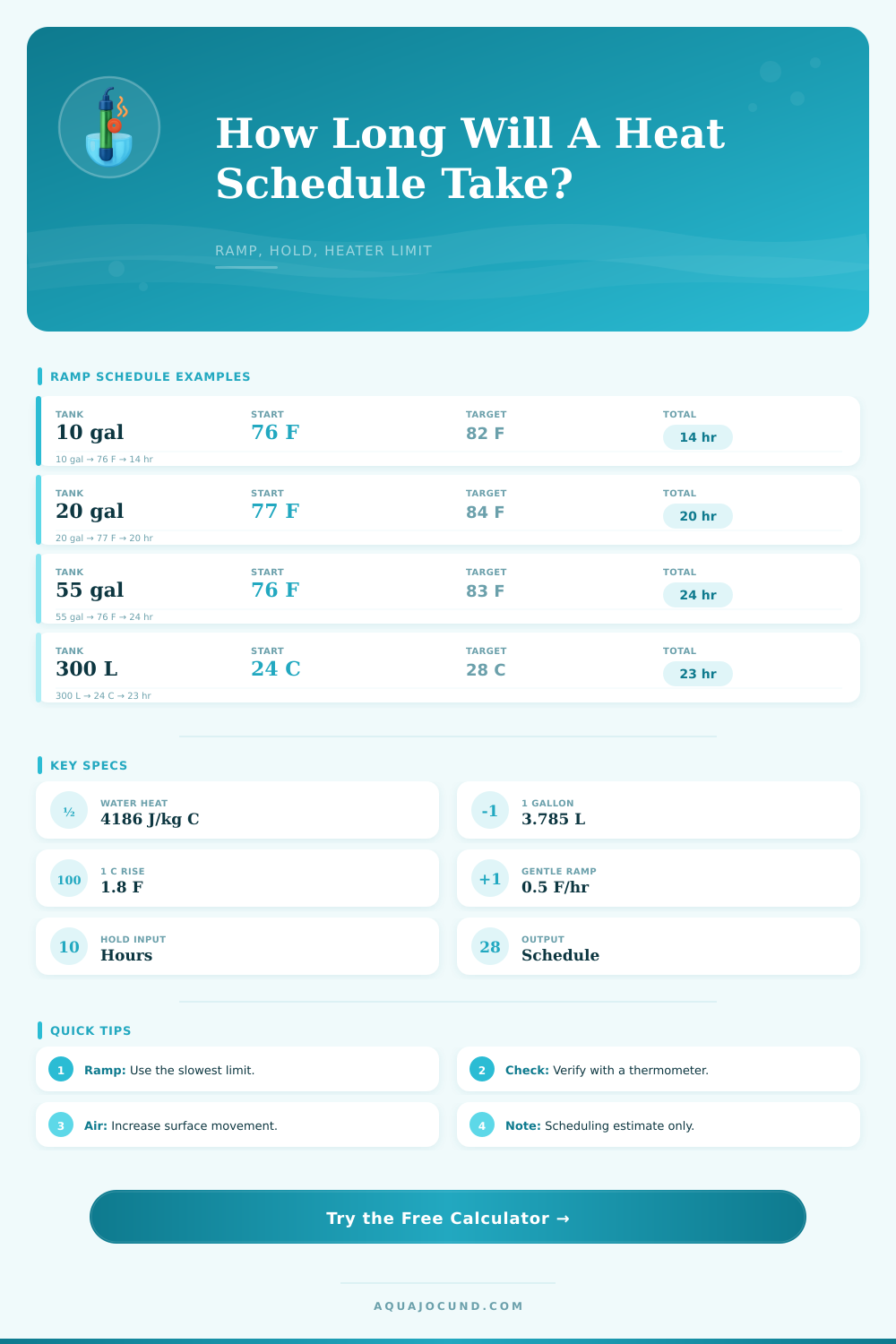
After the ramp is done you typically want to maintain the temperature for a treatment period (either for medication effectiveness or just to stabilize things until it warms up from a sudden cold). That means adding that holding period to the end of the ramp and showing you how long your overall project will take. Plan accordingly knowing how long the project will take. Monitor the temperature every half hour as it’s climbing and then back off to less often once stabilized. On the page are reference tables that put your tank size and species class into perspective. These offer a guideline of suggested maximum ramp rates for you to use as a standard when making your decisions.
Aquarium management is nearly always best with a gradual approach rather than a rush job. Slow makes it possible for ammonia cycling bacteria to adjust and gives the fish time to regulate their own salt and water balance. It is boring but lifesaving work. Make your plans conservatively to account for real-world inefficiencies like badly positioned heaters or drafty rooms. Build yourself a bit of a buffer by adding 10-20% more than expected time. No one wants to be caught off guard as the heater is struggling half way up.
While the calculator will give you an estimate for the total schedule, you’ll also need to check with a physical thermometer. Digital controllers can drift and lag which means you absolutely must have independent confirmation. Patience is as much a part of heat treatment as temperature. You have to understand you are dealing with a livig system that reacts to consistency and stability. Running the numbers takes the anxiety out of the equation.
You’ll know when to start the ramp, how long it will last, when the hold period starts, and when to check things. Once you have your plan in place, there’s no rush. Kick back and let the heater do the work while you wait for the steady rise to finish.