🌡 Heat Loss From Tank Calculator
Estimate aquarium heat loss through glass, open water evaporation, lid coverage, airflow, and water-air temperature difference.
| Material Type | U Value W/m²K | Relative Heat Loss | Typical Use |
|---|---|---|---|
| Standard glass | 5.8 | Baseline | Most framed aquariums |
| Thick glass | 5.2 | About 10% lower | Large or tall tanks |
| Low iron glass | 5.7 | Near baseline | Display panels |
| Acrylic | 3.6 | About 38% lower | Lightweight and custom tanks |
| Insulated back | 2.4 effective | Lower back-panel loss | Tanks against a wall |
| Double pane | 2.8 | About 52% lower | Cold rooms and viewing panels |
| Open rimless | 6.1 effective | Slightly higher | High exchange display tanks |
| Tank | Dimensions | Volume | Typical Heater Need |
|---|---|---|---|
| 10 Gallon | 20 x 10 x 12 in / 51 x 25 x 30 cm | 10 gal / 38 L | 25-75 W |
| 20 Long | 30 x 12 x 12 in / 76 x 30 x 30 cm | 20 gal / 76 L | 75-150 W |
| 29 Gallon | 30 x 12 x 18 in / 76 x 30 x 46 cm | 29 gal / 110 L | 100-200 W |
| 40 Breeder | 36 x 18 x 16 in / 91 x 46 x 41 cm | 40 gal / 151 L | 125-250 W |
| 55 Gallon | 48 x 13 x 21 in / 122 x 33 x 53 cm | 55 gal / 208 L | 150-300 W |
| 75 Gallon | 48 x 18 x 21 in / 122 x 46 x 53 cm | 75 gal / 284 L | 200-400 W |
| 125 Gallon | 72 x 18 x 22 in / 183 x 46 x 56 cm | 125 gal / 473 L | 300-600 W |
| Condition | Factor Used | Main Effect | Calculation Impact |
|---|---|---|---|
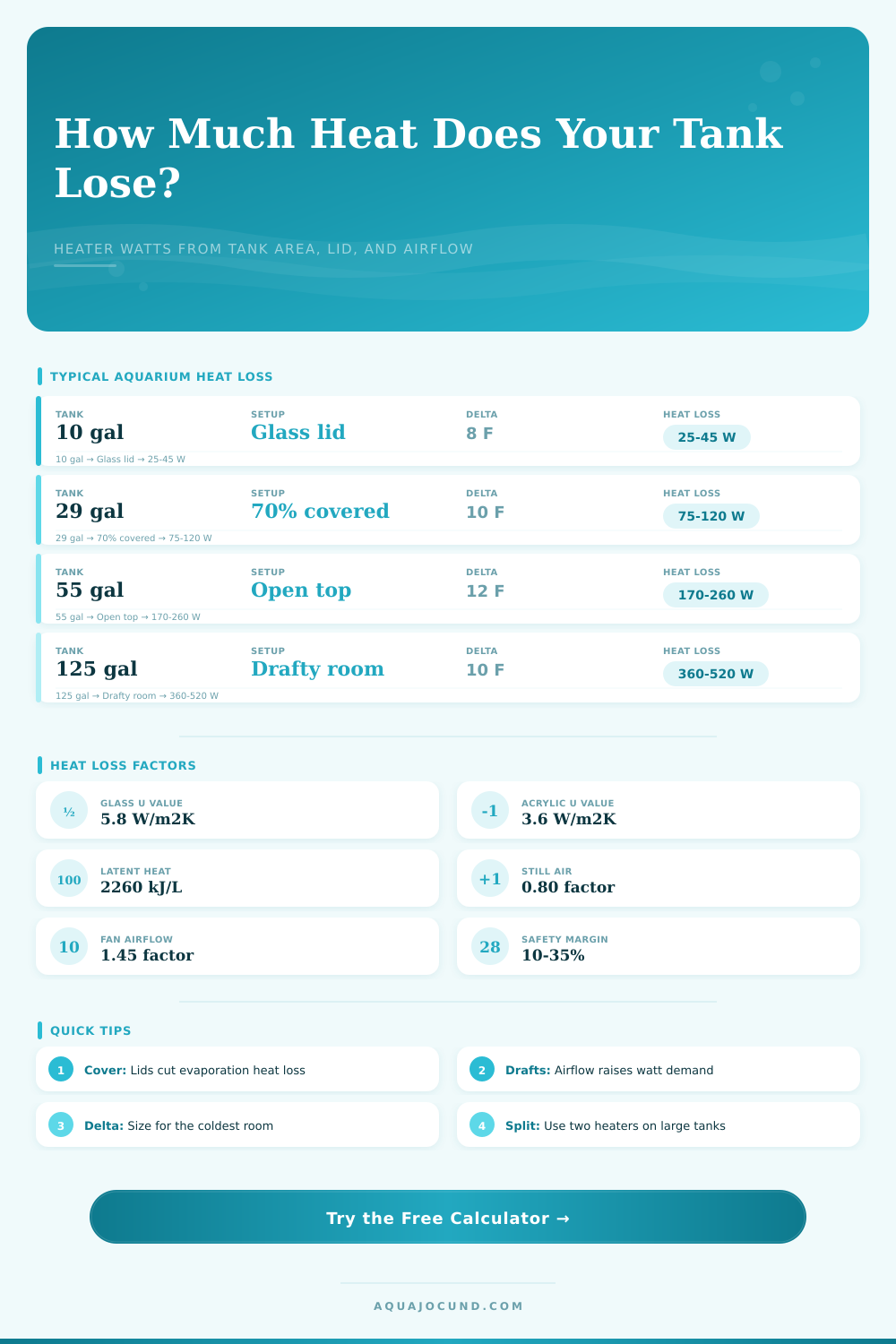
| Still air | 0.80 | Lower convection | Reduces glass and evaporation losses |
| Normal room | 1.00 | Baseline exchange | Standard estimate |
| Drafty room | 1.25 | Higher convection | Raises heat loss through glass and water |
| Fan airflow | 1.45 | High evaporative cooling | Largest increase in evaporation load |
| Closed canopy | 0.70 | Traps humid warm air | Reduces open-water heat loss |
| Step | Formula | What It Measures | Output |
|---|---|---|---|
| Glass area | Sides + bottom, or custom area | Panel area exposed to room | m² and ft² |
| Conductive loss | U x glass area x water-air delta | Heat moving through tank walls | Watts |
| Evaporation rate | Open top area x adjusted mm/day | Water lost from uncovered surface | L/day |
| Evaporation load | L/day x 2260 kJ/L / 86400 | Latent heat carried away | Watts |
| Heater watts | Total loss x safety margin | Installed heater target | Watts |
Fish purchases are how most people get started in aquarium hobby and electric bills is what ends it. You purchase a tank, fill it up with water, and load it with livestock. Next thing you know, you need to maintain a constant temperature of that water. That’s not easy because the glass is thin and the room air isn’t warm. Water escapes through the surface and out of the walls.
Beginners typically rely on rule-of-thumb charts (which don’t even account for their own set-up) when figuring out how much heating power their heater require. As a result, they end up freezing there fish or burning out their heaters. Plug-in the room conditions and dimensions into the calculator above and let it do math for you. It will save you from rule-of-thumb charts which rarely apply to your set-up.
How to Size Your Aquarium Heater
There are two ways heat escapes from your tank. You need to understand difference when it comes to properly sizing your tank. One way is conduction, or heat traveling through the tank’s walls into surrounding cool room air. Factors includes tank material and surface area. Generally speaking, the higher thermal conductivity, the less heat retention. In other words, acrylic hold more heat than regular glass. For big display tanks, that makes a difference. Acrylic has a U-value of three-point-six versus glass at five-point-eight. That translates directly into your power bill, which is an efficiency issue with the meter. And it is a comfort issue for fish.
Which brings us to evaporation, the other pathway. Here’s what happens: water goes into air. That process sucks up energy. We call it latent heat. As each water molecule evaporates, it carry heat with it. You lose heat every time an open-top tank “breathes” water vapor. You lose heat even when the surrounding air isn’t warmer then usual. Covering the top of the tank prevents splash-outs and retains humidity. Less energy is lost. How much? See chart on the page. It’ll show you that a wind blowing through your room will double the load on your heater. Why? It removes humid air before it settle down.
So, sizing your heater isn’t about average loss. It’s about planning for the coldest night. In winter, if the room temperature fall to sixty-five degrees, you’ll want to size for that. Don’t size for seventy-two degrees in the summer. That’s where people go wrong. They buy a heater for what it will do in October and then they ask why the fish are sluggish in January.
Standard practice is adding a safety margin of twenty to thirty-five percent. This means the heater won’t be running at full capacity. It prolongs the life of heater. It avoids having a single point of failure. It’s not only what you use but where you put it. Corner tanks with insulated walls lose less heat than ones in center of a room. This is because air flows around tank. Airflow multipliers factor into the calculator. Insulated walls trap still air. Moving air act as a conductor. If you have a cold climate, insulate the back panel. Or pull the tank off exterior walls. These are inexpensive fixes that reduce heat loss to the cold.
A heater is a combination of power, insulation, and coverage. What’s the right mix? That’s where the tool come in (it gives you the base). Then your real-world adjustments makes the details more accurate.
Cover the tank. Seal out drafts. Choose the wattage to fit the worst case. Stop guessing when you understand how heat escapes. Manage the system instead. Enjoy comfortabley fish. Extend the life of the equipment. Reduce the energy waste. End up with a system that runs quietly and stays stable.