Head Loss From Elbow Fittings Calculator
Estimate elbow fitting head loss, pressure drop, equivalent pipe length, and pump head impact for aquarium, sump, reef, and pond plumbing.
⚙Unit System
📌Real Plumbing Presets
💧Flow, Pipe, and Elbow Inputs
📊Current Layout Snapshot
🔁Fitting Comparison Grid
🔧Elbow K-Value Reference
| Fitting Style | Typical K | Equivalent Diameters | Best Aquarium Use |
|---|---|---|---|
| Standard 90° elbow | 0.75 to 1.10 | 30D to 45D | Compact cabinet turns |
| Long sweep 90° elbow | 0.25 to 0.45 | 12D to 20D | Quiet return plumbing |
| 45° elbow | 0.25 to 0.45 | 12D to 20D | Offset runs and gentle rises |
| Barbed hose bend | 0.90 to 1.50 | 35D to 60D | Soft tubing behind tanks |
| Threaded street elbow | 1.20 to 1.80 | 45D to 75D | Tight pump outlet only |
📏Common Pipe Size Guide
| Nominal Size | Inside Diameter | Comfort Flow Range | Typical Use |
|---|---|---|---|
| 1/2 in PVC | 0.602 in / 15.3 mm | 80 to 250 gph | Nano returns and reactors |
| 3/4 in PVC | 0.824 in / 20.9 mm | 180 to 550 gph | Canister and small sump lines |
| 1 in PVC | 1.049 in / 26.6 mm | 350 to 950 gph | Medium reef return lines |
| 1-1/2 in PVC | 1.610 in / 40.9 mm | 900 to 2200 gph | Pond and high-flow overflows |
🧪Fluid and Roughness Reference
| Condition | Kinematic Viscosity | Roughness Used | Calculator Effect |
|---|---|---|---|
| Freshwater 68°F | 1.08 cSt | Pipe selection | Baseline for most aquariums |
| Freshwater 78°F | 0.86 cSt | Pipe selection | Slightly lower friction |
| Saltwater reef 78°F | 0.92 cSt | Pipe selection | Small viscosity increase |
| Cool pond water 50°F | 1.31 cSt | Pipe selection | More friction at low temperature |
💡Practical Calculation Notes
After installing your new pump, you’re happy to see the water gushing back into the tank. Then you realize it’s not flowing as stronger as stated in the spec sheet. Most of the time, it’s not the pump’s fault. More often than not, it’s the plumbing (particularly elbows).
Each time the water turn a corner, it resists the pipe. This creates friction that accumulate rapidly. Elbow fittings cause head loss. It’s the price we pay for nice-looking cabinets.
How Bends Stop Water Flow
Knowing this help you avoid overbuying equipment and having poor water movement. When you plug in your number of fitting and pipe size, the calculator above do the math for you.
This eliminates all the conversion and coefficient guessing, but what’s really valuable is knowing what all these numbers represent. What it essentially does is look at how much resistance each bend create and then factors in the speed of the water flowing through it. Then it spits out an estimate of head loss and the pressure drop in psi. But more importantly, it gives you an equivalent length of straight pipe.
Why? Because that allows you to compare the resistance of straight runs versus the resistance of your fittings. So if your elbows adds up to be the equivalent of ten feet of pipe, that’s significant. It means your pump should of work harder just to overcome those turns.
The missing factor here is velocity. People think about head loss in vertical height and while that’s part of it, the other part is velocity. The higher the velocity, the more energy the water lose with each bend. 9. So that’s your kinetic energy wastage from turbulence. 35. It is huge. This means the water doesn’t hit the wall of the pipe, but rather glides around it.
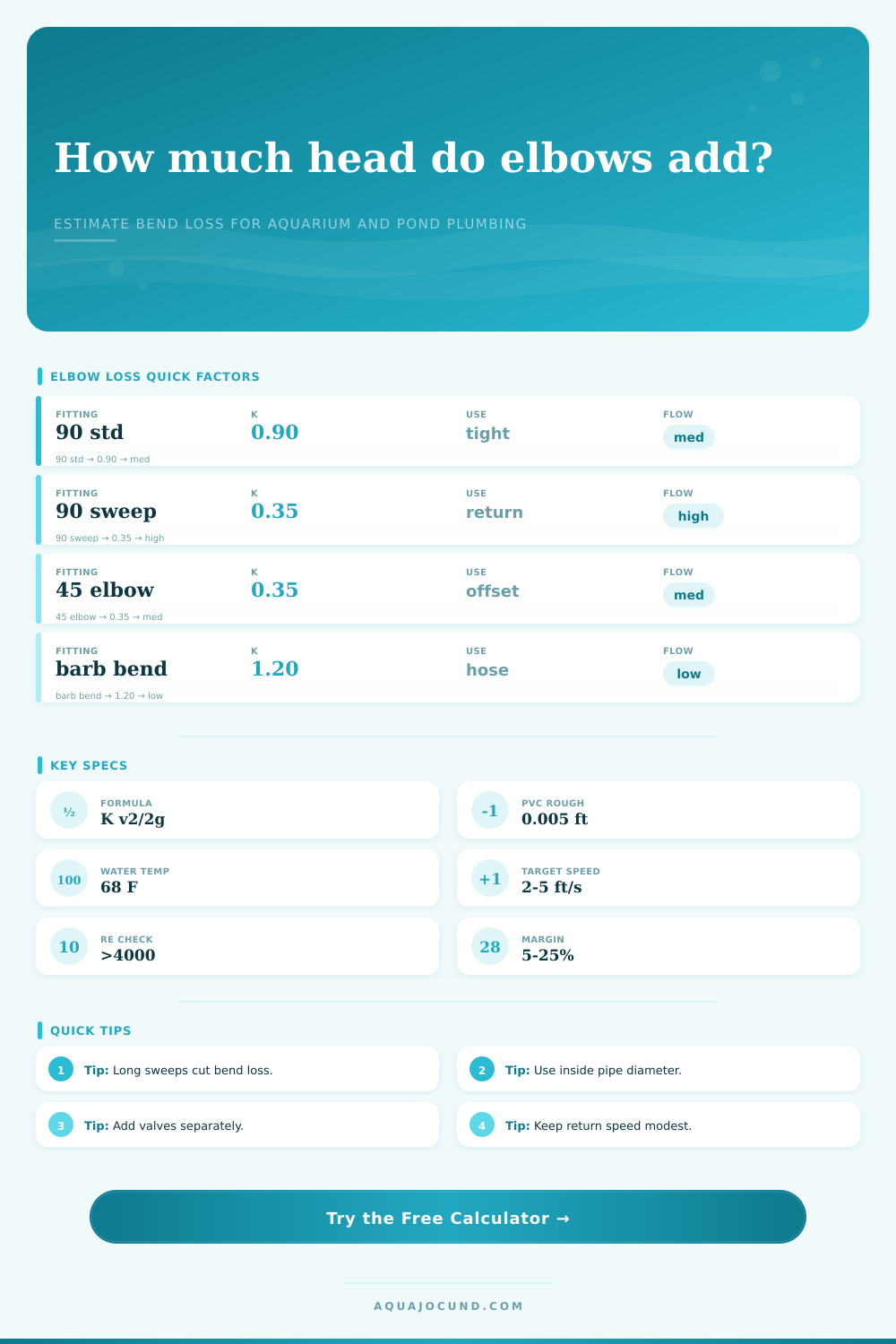
You don’t have to do all this math for each individual bend. It’s nicely spelled out in the reference table on the page which show that tight barbed bends can be even worse than standard elbows. And again, there is little change in hardware but a big difference in flow.
The diameter of the pipe also play a role. A half-inch line with high flow will have terribel velocity losses. That’s why the calculator adjust the results based off the inside diameter you choose. Keep in mind, though, that the inside diameter of soft vinyl tubing is smaller than the nominal size. Soft vinyl tubing has a lower interior diameter. Inputting the correct number ensure the calculations reflect what’s actualy happening.
Whether you’re setting up a large pond system or a nano tank, the presets within the tool allow you to get going fast and provide you with a starting point. From there, adjust the inputs according to your own set-up so you can see where things stand.
Don’t neglect the safety margin. The real world plumbing sucks. Pumps gets old. Joints aren’t perfect. There’s dirt everywhere. You’re smart to add a ten percent safety margin to your calculation. That way even in less than ideal conditions, there will still be enough head for your pump to push water. This allow you to design confidently knowing the calculator offers this option. And it shields you from those unexpected variables that make your system underperform.
Water temperature is an additional factor. Warm water flow easier than cold water. Cold water has a greater resistance and is thicker. So if you’re operating a pond system in the middle of winter, expect the head loss to be higher then during the heat of summer. The tool accounts for this by considering how different types of water affect its viscosity. When you choose whether it’s saltwater, freshwater, or cool pond water, it factors all this in. This way you don’t mistakenly think that because you were getting great summer performance, your winter performance will match.
Resistance is bad. A good plumber minimize that. Each elbow cost you in flow. Elbows mean turbulence, not smooth flow. Make the pipe diameter big enough so your pump doesn’t have to work hard. Long sweeps make life easier on the plumbing. Big diameter and long sweeps reduces the burden on your pump.
The calculator lets you see what each elbow costs. It brings abstraction down to real-world decision making. Use it to design your layout BEFORE you cut any pipe. After you’ve got water running, changing out elbows won’t do much good. Plan first, then watch your system run right from day one. What you put in up front makes your system run quietly and reliablly. Get the flow you want without the fight. It’s all about working WITH the water rather than against it.