Hardscape Rock Quantity Calculator
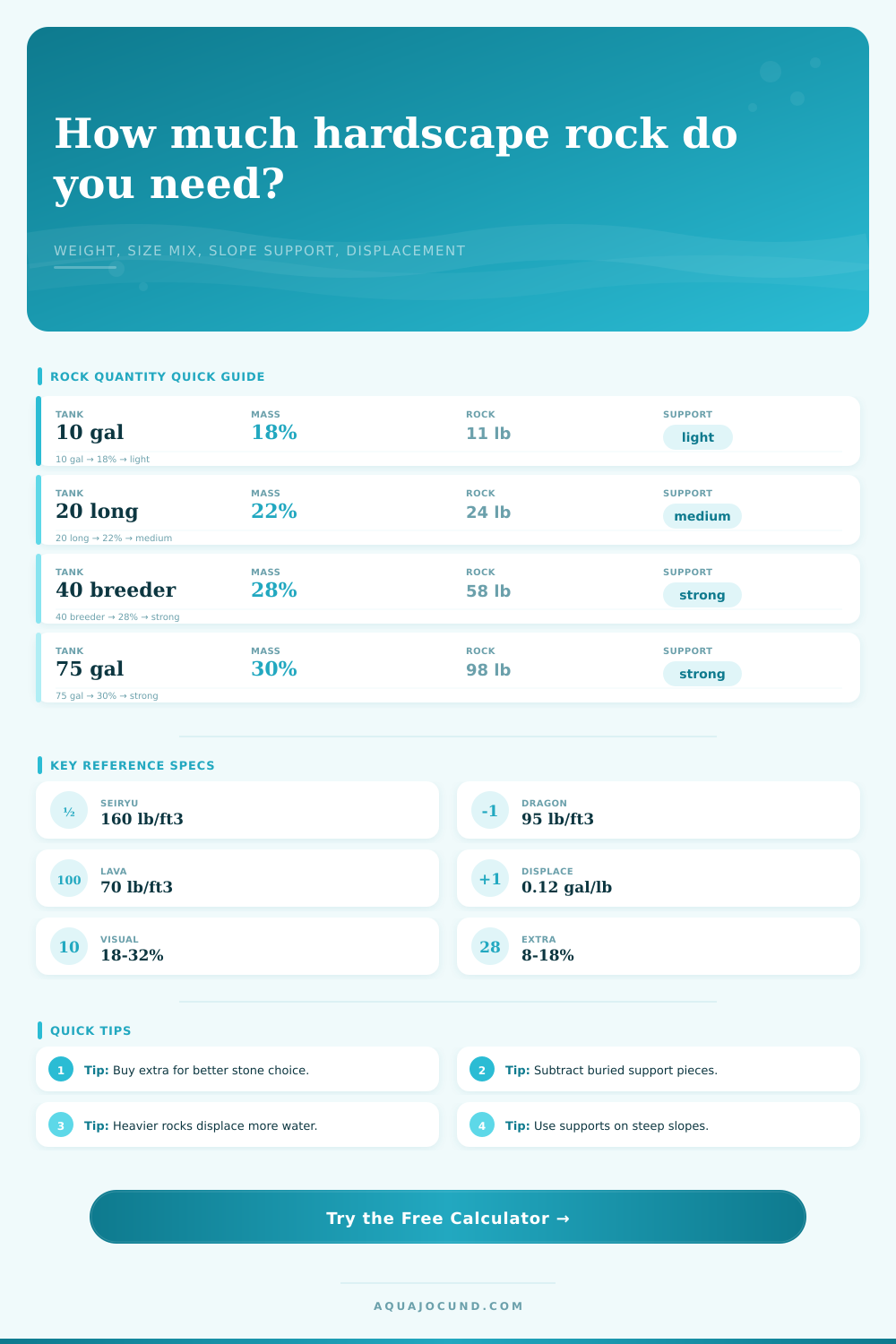
Estimate aquarium rock weight, displacement, visible mass, size mix, and slope support from the tank footprint and planned scape height.
📌Quick Presets
⚙Calculator Inputs
Calculation Breakdown
🧱Rock Density Grid
🗂Hardscape Comparison Grid
📊Rock Type Density Reference
| Rock type | Typical dry density | Volume behavior | Best quantity note |
|---|---|---|---|
| Seiryu / Ryuoh stone | 150 to 170 lb/ft³ / 2.40 to 2.72 kg/L | Dense, sharp, low voids | High weight from small visual mass |
| Ohko / dragon stone | 85 to 105 lb/ft³ / 1.36 to 1.68 kg/L | Porous, craggy, many gaps | Buy more volume, less weight |
| Lava rock | 55 to 85 lb/ft³ / 0.88 to 1.36 kg/L | Very porous, lightweight | Large piles need less weight |
| Slate ledge rock | 160 to 175 lb/ft³ / 2.56 to 2.80 kg/L | Flat plates, stackable | Add support pieces for terraces |
| Granite boulder | 155 to 170 lb/ft³ / 2.48 to 2.72 kg/L | Dense rounded blocks | Fewer pieces create high weight |
| Rounded river stone | 145 to 165 lb/ft³ / 2.32 to 2.64 kg/L | Smooth, low interlock | Needs stable contact and support |
| Limestone / Texas holey | 115 to 145 lb/ft³ / 1.84 to 2.32 kg/L | Holes and pitted faces | Displaces less than solid stone |
| Petrified wood stone | 150 to 170 lb/ft³ / 2.40 to 2.72 kg/L | Dense, directional grain | Plan extra for matching grain |
📐Common Tank Rock Estimates
| Tank | Footprint | Water volume | Moderate rock estimate |
|---|---|---|---|
| 5 gallon cube | 16 x 8 in / 41 x 20 cm | 5 gal / 19 L | 5 to 10 lb / 2 to 5 kg |
| 10 gallon | 20 x 10 in / 51 x 25 cm | 10 gal / 38 L | 10 to 18 lb / 5 to 8 kg |
| 20 long | 30 x 12 in / 76 x 30 cm | 20 gal / 76 L | 20 to 35 lb / 9 to 16 kg |
| 29 gallon | 30 x 12 in / 76 x 30 cm | 29 gal / 110 L | 25 to 45 lb / 11 to 20 kg |
| 40 breeder | 36 x 18 in / 91 x 46 cm | 40 gal / 151 L | 45 to 75 lb / 20 to 34 kg |
| 55 gallon | 48 x 13 in / 122 x 33 cm | 55 gal / 208 L | 55 to 90 lb / 25 to 41 kg |
| 75 gallon | 48 x 18 in / 122 x 46 cm | 75 gal / 284 L | 75 to 125 lb / 34 to 57 kg |
| 125 gallon | 72 x 18 in / 183 x 46 cm | 125 gal / 473 L | 120 to 210 lb / 54 to 95 kg |
🧮Size Mix Allocation Table
| Size mix | Feature stones | Medium stones | Small support and fill |
|---|---|---|---|
| Nano small fragments | 25% of weight | 45% of weight | 30% of weight |
| Balanced feature mix | 45% of weight | 35% of weight | 20% of weight |
| Iwagumi dominant stones | 60% of weight | 28% of weight | 12% of weight |
| Terrace retaining mix | 35% of weight | 38% of weight | 27% of weight |
| Large boulder layout | 70% of weight | 22% of weight | 8% of weight |
| Rubble gap filling mix | 20% of weight | 35% of weight | 45% of weight |
⛰Slope Support Reference
| Slope support | Hidden rock factor | Stability role | Quantity effect |
|---|---|---|---|
| Flat or low slope | 0% extra | Visual stones sit on the substrate surface | Lowest support weight |
| Gentle 1 to 2 in rise | 4% extra | Small stones lock the rear edge | Slight support bump |
| Moderate 2 to 4 in rise | 10% extra | Buried stones brace the bank face | Noticeable hidden volume |
| Steep mountain or terrace | 18% extra | Support pieces hold upper stones and soil | High support requirement |
| Rock-retained back bank | 25% extra | Rock acts as retaining wall and anchor | Highest hidden support |
💡Practical Quantity Tips
The blank aquarium stands there before you. A canvas? Yes, except that it’s also a container. Maybe you envision a dramatic mountain ridge or perhaps a Japanese forest scape. More likely, it will be a pile of heavy stones. Most people who aquascape purchases their rocks based off instinct. They grab a bag here and a sack there until they feels like they have enough. This strategy would of worked well if you weren’t three hours into set up with nowhere to put a large boulder. Or if you didn’t buy so much heavy Seiryu stone that your stand groan under its weight.
Before you begin, figure out how much hardscape you need. It will save money. It will save time and it will protect your back. The calculator does all that math for you (see above). Simply enter your tank size(s) along with how you intend to use it and let the calculator do the rest. Gone are the days of guessing volumes and then converting those guesses into densities.
How Much Rock Do You Need?
Enter the type of rock you’re going to use. Sharp, dense Seiryu stone doesn’t weigh the same as lightweight Lava rock. And neither one weigh the same as porous Dragon stone. Don’t assume lava rock is light when planning a landscape made up mostly of heavy granite. You’ll massively under-estimate what your tank stand can handle. These types of densities is built into the tool. What you get back are a representation of the real-world mass of the materials. Aside from looks, structural strength matter.
Another tricky idea is visual mass. The calculator quantifies this too. Fill up the whole tank with rock? No. That’s not how it works. How much of the scape envelope are filled with what you can see? What if it’s only fifteen percent visual mass? The look changes dramaticly. Fifteen percent might be all there is in an Iwagumi layout that is minimalist. Most of the floor space become available for carpet plants and moss.
At the other extreme, maybe it’s thirty percent or more in a busy mountain scape. The calculator allows for adjustment of this percentage. It makes the visual goal real by turning it into a specific weight. It’s the difference between a heavy, cluttered fortress vs. It is a sparse, elegant arrangement. If you get the ratio right, your hardscape will feel like it was meant to be that way.
The other thing it has is the secret labor. Every landscape need something under it to hold it in place. A slight incline requires rocks to hide under it or else slide. Something like a terrace needs something hidden to hold its form. There’s a factor built into the calculator for slope support. For every percentage rise above level ground, it will add some additional weight for this secret support. So if you’re making a terraced mountain with a pretty high incline, you’ll need about an additional 18% of rock just to hold it all together. The vast majority of hobbyists don’t even think about this aspect. They’ll purchase enough rock to cover the face of the mountain but not the foundation. The tool helps remind you, invisible rock matter too.
Water displacement is a useful secondary output. Rocks occupy space in the aquarium. That pushes water higher up or makes available volume less for filtration turnover. This is not necessarily a deal breaker for most tanks, but useful if you want to be accurate about flow rates and dosing. The calculator provides the water displacement figure. Now you can dose chemicals and make water changes with more precision. It is a little thing. It is a big thing if you’re growing delicate plants or keeping sensitive fish that require stable parameters.
Lastly, purchase more. Weight isn’t everything, angle and face are also deciding factors in selecting stone. You’ll cull out ones that don’t fit your needs. You may find some that break when you handle them. Some won’t even appear to work well for you in your composition. The calculator selects more than you actualy need. That way there’s plenty of options to choose from. You do not need to force awkward pieces into position.
When you plan how much rock to buy down to the pound, you’re free to concentrate on creating the artistic scape you desire. It’s not a rock pile anymore… It’s a landscape. And you did the math first.