🌕 Half-Moon Aquarium Volume Calculator
Estimate curved-front tank capacity from chord width, front bulge depth, fill height, displacement, water weight, and dosing volume.
| Preset | Chord x Bulge | Fill Height | Expected Use |
|---|---|---|---|
| 5 Gal Shrimp Crescent | 12 x 6 in | 10.5 in | Shrimp, snails, moss |
| 6 Gal Betta Desk | 13 x 6.5 in | 11.8 in | Betta and floating plants |
| 10 Gal Nano Half-Moon | 16 x 8 in | 13.5 in | Nano community or plants |
| 20 Gal Community Moon | 22 x 10.5 in | 17.2 in | Small schooling fish |
| 40 Gal Wide Moon | 30 x 14 in | 21.5 in | Display aquascape |
| Measurement | Formula | What It Means | Use In Calculator |
|---|---|---|---|
| Radius | (s² + (c/2)²) / 2s | Estimated circle radius from chord and bulge | Curve card |
| Segment area | R² acos((R-s)/R) - (R-s) sqrt(2Rs - s²) | Half-moon footprint under the waterline | Gross volume |
| Gross volume | Footprint x fill height | Water before substrate and decor | Breakdown |
| Net volume | Gross - substrate - decor | Dosing volume for additives | Result card |
| Item | Typical Range | Volume Effect | Calculator Handling |
|---|---|---|---|
| Fine sand bed | 1 to 2 in | About 5% to 10% | Substrate depth x footprint |
| Planted soil cap | 2 to 3 in | About 10% to 18% | Increase substrate depth |
| Rock-heavy scape | 1 to 4 gal | Direct displacement | Enter decor volume |
| Sponge/filter media | 0.1 to 0.8 gal | Small but dose-relevant | Add to decor field |
| Reference | US Value | Metric Value | Why It Matters |
|---|---|---|---|
| Volume conversion | 1 gal = 231 cu in | 1 L = 1000 cu cm | Converts curved footprint into tank volume |
| Freshwater weight | 8.34 lb/gal | 1.00 kg/L | Estimates stand and floor load |
| Marine water weight | 8.55 lb/gal | 1.025 kg/L | Saltwater weighs slightly more |
| Medication dosing | mL per 10 gal | mL per 38 L | Use net water after displacement |
For the most accurate half-moon volume, measure the inside chord and the inside front bulge at the waterline. Outer glass dimensions can overstate volume.
Conditioner, fertilizer, and medication should be based on net water volume after substrate, rocks, driftwood, filter media, and the lower fill line are subtracted.
Half-moon tanks is shaped like aquariums with curved fronts and are often used in living rooms and offices because the curved front allow for a visual presence in the room without taking up alot of space. However, it is difficult to judge the volume of water in a half moon tank by looking at the tank. When people look at half-moon tanks, they usually assume it takes in more water than the tank hold.
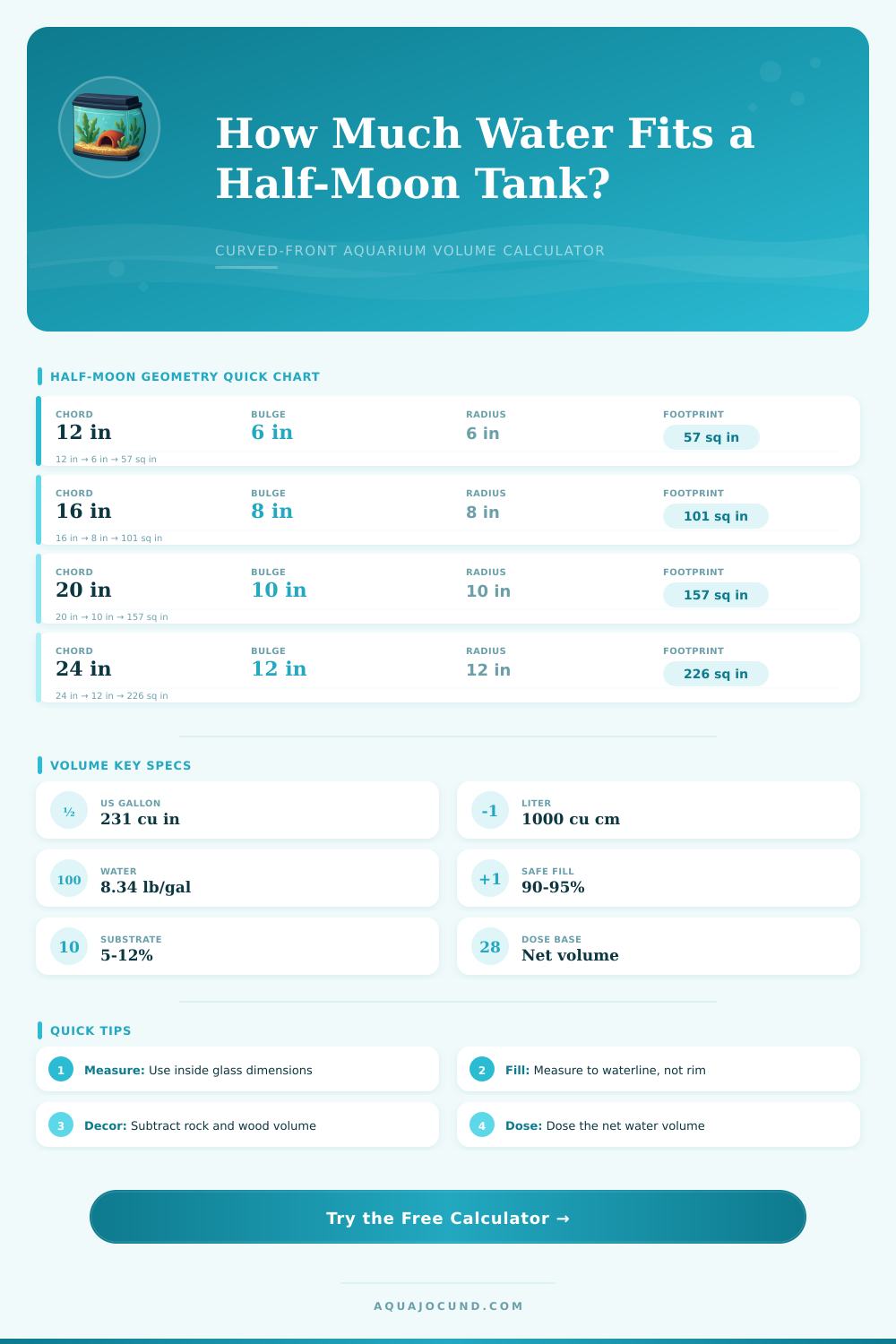
To calculate the correct volume of a half-moon tank, you have to use a calculator and enter the chord width, bulge depth, and the height of the water in the tank. The chord of a half-moon tank is the distance in inches between the two corner at the rear of the tank. The bulge is the distance in inches from the chord to the front of the tank.
How to Measure Water Volume in a Half-Moon Tank
Half-moon tank calculators use these two measurements to figure out the footprint of the tank. The footprint of the tank is the area that the tank would take up if it were a perfect rectangle instead of a half-moon tank. By calculating the footprint of the tank and multiplying that by the height of the water, the calculator can tell you the gross volume of the tank.
The gross volume is the total amount of water that the tank can hold. However, that number dont account for items that take up space within the tank. Items that take up space in the tank include substrate items like sand at the bottom of the tank and hardscape items like rocks and driftwood.
Each of these item reduces the amount of water that the tank can hold. The calculator asks for the volume of the substrate and hardscape items to calculate the net volume for the tank. The net volume is the amount of water that the tank can hold once the calculator subtracts the volume of the substrate and hardscape items from the gross volume.
The net volume is the actual amount of water that will be in the tank. When dosing medications or water conditioners into the tank, people should use the net volume to ensure that the proper amount of product is added to the water. Many people make the mistake of using the gross volume when dosing products, which can result in incorrect dosing of those medications or water conditioners.
The weight of the water in the tank depend on the net volume of the tank. When calculating the weight of the water, you have to use the net volume to determine how much the water will weigh. The weight of the water is important to know because the furniture on which the tank will stand may have a limit to the weight that it can support.
When using the calculator, the calculator will estimate the weight of the water. The estimated weight allows the person to determine whether the stand for the half-moon tank can support the weight of the water. Additionally, the calculator will provide the estimated radius of the curve of the front of the tank.
This measurement is helpful in determining how the tank will sit against a wall. The height of the water isnt the same as the height of the glass. People typically allow an inch or two at the top of the tank to allow room for movement of the water without splashing it against the tank.
The calculator allows the user to choose a safety margin for the water height. Using the total height of the glass will result in an underestimation of the volume of the water in the tank. The substrate that covers the bottom of the tank can be laid in a variety of ways.
The net volume of the tank can change based off the substrate layout. For example, a sloped substrate layout will displace a different amount of water than a flat substrate layout. The calculator allows a user to select the coverage of the substrate to account for the different ways that people can lay substrate in their tanks.
Small changes in the substrate layout can significantly change the net volume of the tank, especially if the capacity of the tank is 20 gallon or more. Because it is a half-moon tank, the extra volume is located near the front curve of the tank. Therefore, it is important to measure the bulge near the waterline to gain an accurate measurement of that dimension of the tank.
Measuring the bulge at the rim of the tank may not provide an accurate measurement of the bulge. Using the bulge measurement allows the calculator to compute the footprint of the tank properly. Once you know the correct measurements of the half-moon tank, you can make a variety of decisions about the tank.
You can determine whether the tank can support the number of fish that you want to keep in the tank. You can also determine whether the stand upon which the tank will rest can support the weight of the water that the tank will contain. Additionally, you can also determine the amount of water conditioner that will be needed for water changes in the tank.
The geometry reference table located on the calculator provides a visual representation of the relationship between the chord, the bulge, and a variety of half-moon tank sizes. In most cases, you will need to use the calculator again after several months when the tank is established and running. Over time, the substrate settles into the tank and plants may grow into the substrate.
Both of these scenario will change the net volume of the tank. Additionally, if the water level is changed within the tank, the volume of the water will change as well. The calculator makes it easy to adjust for these changes, which ensures that dosing is consistent over time.
Consistency in dosing of medications and water conditioners is important for the health of the fish in the tank. Consistency in dosing is achieved by using the net volume of the tank to dose the medications and water conditioners.