
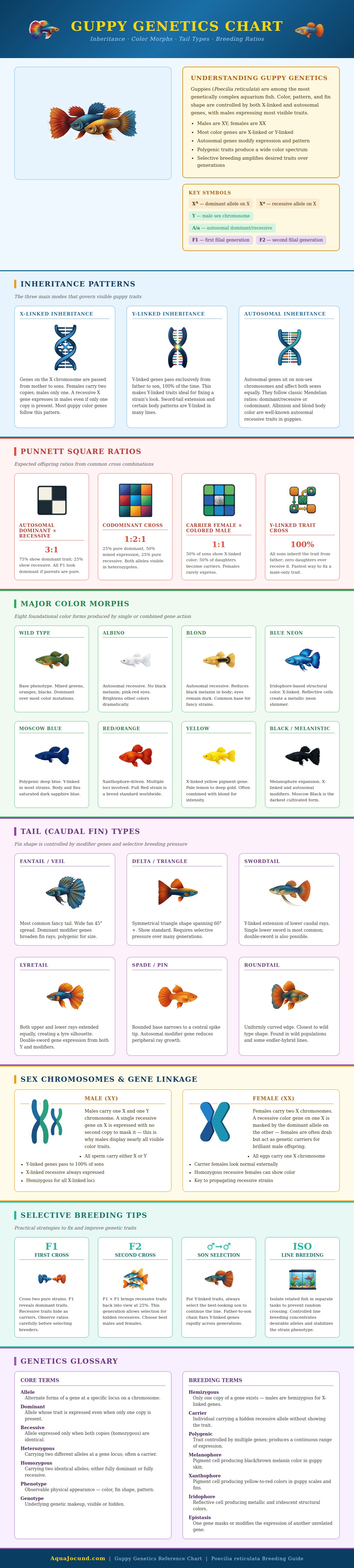
You purchase a male guppy with a sword-like tail and a bright blue body, thinking all your sons will be just like him. But what you recieve is a combination of some fry matching the photo, some that dont, and other plain fry. If this sounds familiar, it’s happened to nearly all first-time guppy breeders. Why? Because genetic makeup of guppies are complicated. They have recessive and dominant traits, sex-linked genes, and polygenic modifiers which mix chaotically without understanding the rules.
Most hobbyists stop here because they lump inheritance patterns into these three groups as shown by above infographic. Guppy color genes is largely passed down the female line (X-linked). Males possess only one X chromosome. Because of this, whatever traits they have show up and can’t be masked by another X chromosome copy. So males is generally the brightest members of the family and the females are simply drab carriers of same traits. Once you grasp this fact (i.e., mom has the keys to your son’s genetic makeup), you can stop random guessing at who fathered whom and begin making crosses with purpose.
Simple Rules for Guppy Genetics
Traits linked to the sex chromosomes (X or Y) acts differently. The Y-chromosome does not hide itself inside daughters or skip generations. It’s direct father-son inheritance. This is good for things you wish to pin down fast, such as swords or certain body markings. If you spot a male with some cool trait you’d like to lock down on, try mating him to his own daughters to quicky stabilize that Y-linked marker.
Autosomal genes follow traditional Mendel patterns and affect both males and females. Blond hair and albinism are examples of autosomal recessive traits where both parents must carry the gene in order for their offspring exhibit the trait. Even though both parents appear normal, one or both may be silent carriers. Recessive doesn’t mean it leaves the population; it just vanishes from sight. People often misunderstand this aspect of recessive traits.
When you combine various genetic types, resulting color can be more intense. Polygenetic combinations (polygenic) such as Moscow Blues (Y-linked in most strains), shown below, must be selectively bred across multiple generations to increase their saturation. These major morphs is noted in the chart. Other structural colors, including the metallic shimmer of blue neon, do not come from pigment alone. Instead, they comes from light reflecting off specialized cells called iridophores. You cannot get these colors from pigment by itself.
Knowing what you’re selecting for; pigment or structure… Changes how you assess your fish. Even though they may both be vivid, a fish loaded with melanosomes will appear more differently than another whose xanthophores are all brightly red. Then there’s the additional wrinkle of tail shape. A few genes controls fan- or delta-tailed morphs. Instead of a simple yes-or-no change, the transition is gradual. You don’t just breed two fish together and suddenly all your fry has perfect triangles. Those fin rays won’t spread out on their own. It takes patient and deliberate selective pressure over time. Spade tails and lyretails have different looks but similar needs for strict culling of less-than-great offspring. Like poor water quality, bad fry will dilute your gains.
Practically speaking: If you want to successfully breed guppies, it’s not as much a matter of chance as it is a matter of isolation and record keeping. Don’t randomly cross your lines, because doing so muddles up the genetic pool immediately. Know which male gets what from his children, and know that recessive traits tend to be hidden until the F2 cross when they can reveal themselves. Yes, it may seem hard at first but maintaining separate tanks for each line ensures that your time spent will pay off.
But what is abstract turns concrete when you’re looking into your tank and seeing those fry swimming around with your results. Understanding how autosomal modifiers interact with sex chromosomes explains why those seemingly random fry makes sense. It starts to make sense how there’s a beautiful pattern behind the beauty. A basic red fantail follows same rules as a Moscow Black strain but expressed in another way. Breeding becomes not so much reactive but predictive. That change makes all the difference for someone who want more than just a full tank; they would of wanted to use patience to control their results.
