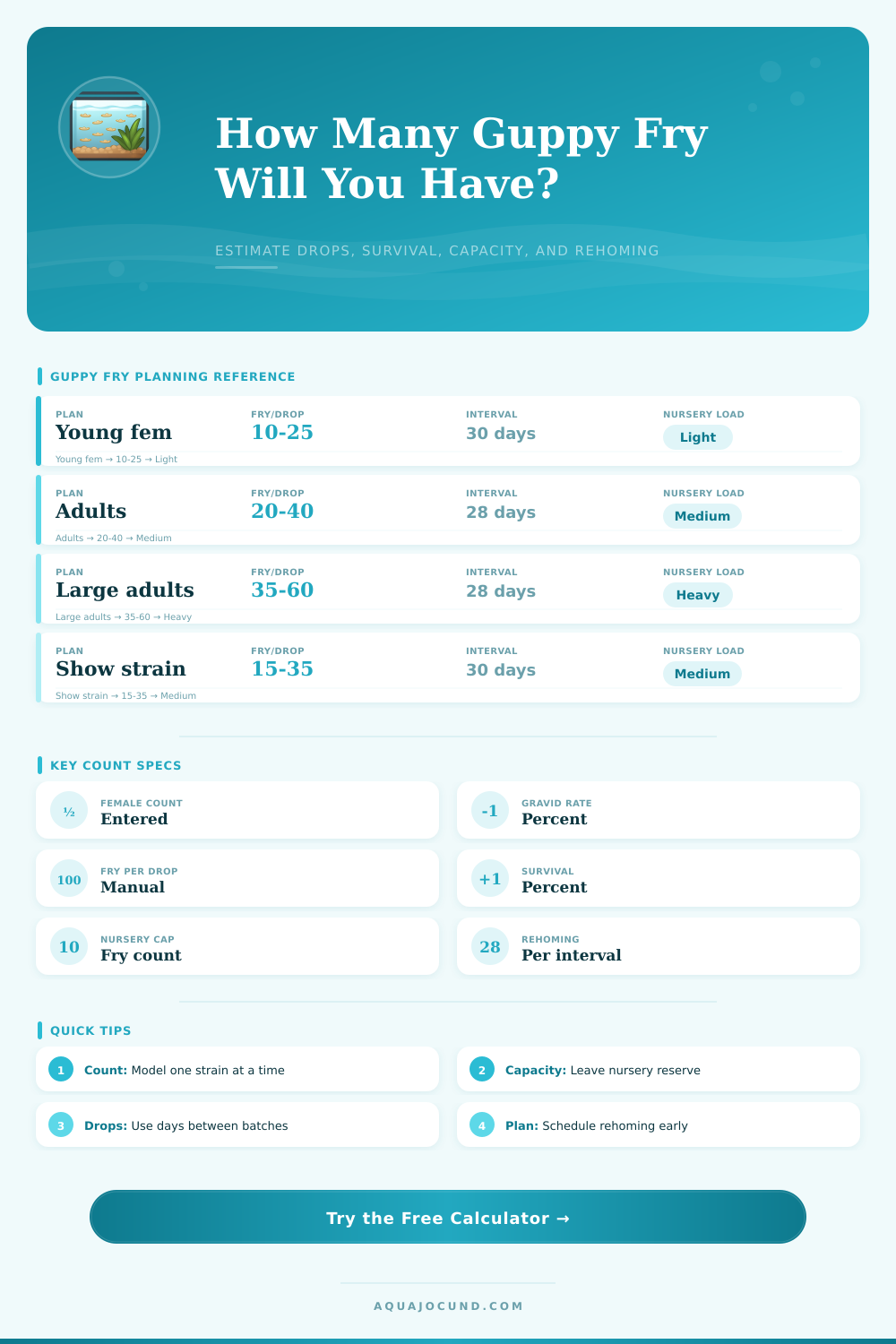
Guppy Fry Count Calculator
Estimate aquarium guppy fry from female count, gravid rate, fry per drop, survival, nursery capacity, generation interval, and rehoming capacity.
Calculation breakdown
| Guppy profile | Default fry/drop | Default interval | Default survival | Nursery density basis |
|---|
| Nursery setup | US volume | Metric volume | Working fry capacity | Planning note |
|---|---|---|---|---|
| Small breeder box | 0.5-1 gal | 1.9-3.8 L | 5-12 fry | Use for short separation, not a full grow-out projection. |
| 5 gal fry tank | 5 gal | 18.9 L | 25-45 fry | Works for small drops if rehoming is scheduled early. |
| 10 gal nursery | 10 gal | 37.9 L | 60-100 fry | Common guppy fry count planning baseline. |
| 20 gal grow-out | 20 gal | 75.7 L | 140-220 fry | Useful for several drops with sorting or rehoming. |
| 40 gal breeder grow-out | 40 gal | 151.4 L | 300-450 fry | Best modeled with routine culls, sexing, and rehome batches. |
| Load band | After-rehoming count | Meaning | Calculation action |
|---|---|---|---|
| Comfortable | 0-80% of usable capacity | Projection fits the nursery reserve. | Keep the entered rehoming schedule. |
| Tight | 81-100% of usable capacity | Little room remains for an early or oversized drop. | Raise reserve or move fry sooner. |
| Over capacity | Above usable capacity | Survivors exceed modeled nursery room. | Add rehoming capacity or shorten the interval. |
| Overflow | 125% or more of capacity | The plan needs a larger nursery or fewer breeding females. | Reduce female count in the model before the next drop. |
| Removal plan | Typical interval | Capacity model | Best calculator use |
|---|---|---|---|
| No planned removal | 0 per interval | All survivors remain in nursery | Stress test whether the nursery can absorb several drops. |
| Small local rehome batch | 15-30 days | 10-30 fry each batch | Good for hobby colony overflow estimates. |
| Line selection cull | 21-45 days | Percent kept depends on project goals | Enter only the number you can actually remove. |
| Store or club batch | 30-60 days | 40-150 juveniles per batch | Use a longer interval if fish must size up first. |
| Grow-out split | 14-30 days | Move fry to another aquarium | Treat moved fry as rehomed for this nursery count. |
If you’re a guppy breeder, you’ve experienced “that” moment, the moment you suddenly discover that the female dropped her fry and your ten-gallon nursery is on its way to becoming a sardine can. Exciting news turns into an unpleasant reality as you count three dozen small fish swimming around in an environment designed for twenty. At the same time, you try to figure out if your filter can handle the biological load before water quality go south. Chaos ensues.
This is not an uncommon occurrence because we tend to underestimate how rapidly livebearers will reproduce. Once you input your breeding parameters, the calculator do the work for you. You no longer have to guess if what you have now can support next generation. That’s because it’s never as simple as “I need more females.”
How to Stop Your Guppy Tank from Getting Too Crowded
This is why I always talk about the chain reaction of female reproductive cycle in guppies. Sure, they’re prolific for a good reason: they evolved to take up space and propagate rapidy. They don’t give two shits if your tanks is small and you’re stressed out. So when you put in number of adult females and projected gravid rate into the tool, what you’re really doing is modeling the biological pressure cooker before it even lights up.
Because remember, the tool doesn’t merely count heads. It models the survivorship over some amount of time, taking into account the natural attrition from birth through to juvenile. That’s where people go astray. They plan for the birth, but fail to plan for growth. Survival rates matter because not everything that hatches will survive to be counted. There’s predation from other adult fish, there’s competition over food, and there’s plain old water quality issues that has an impact on that number. That’s why it’s important to adjust the survival percentage to model what happens in your worst-case scenario (hungry and aggressive parents) versus your best-case scenario (perfect hiding spots). Often times, that’s the difference between “thriving” and “oh crap, I need to get these out NOW.”
Be realistic, not optimistic. Most hobbyists run into capacity planning. We’re used to thinking about our nurseries in terms of liters/gallons. Not how fast fry grow/density. Those fry triple in just three weeks. That little drop of fry looks manageable now, but they will triple in size in three week.
That’s where the page’s reference table comes in. It connects your tank volume to real-world working limits. What can I keep comfortable? If you have a five-gallon tank, you could probably keep twenty-five fry comfortablly for one week. But keeping them for a month would of asking for trouble with spikes, stunted growth, etc.
The calculator plots the load based off your scheduled rehoming intervals so that you get a clear picture of whether you are above (staying under the waterline) or below (taking on floodwater). So, how do I figure out who goes? That’s when the “rehoming” comes into play. Yes, we’re talking rehousing but more importantly, we’re talking managing the quality of our stock.
Yes, you can’t keep them all. Yes, if you’re doing any sort of line breeding, then you have to cull some out in an effort to maintain that color or whatever else you are selecting for. But you must cull based on health and appearance. So you must remove fish from the main system periodically.
With this tool you can set an interval and capacity to be rehomed. In other words, it mimics the rhythm of your own rehoming schedule, so the nursery never gets overcrowded during the time between drops. That means you gotta think about the logistics prior to biology. The fish aren’t going to wait until you get your paperwork processed.
What most folks don’t get is what the heck these outputs mean when they read tight or even over. Those readings tell you that you’ve got too little buffer for what’s currently running through your system. If the reading says comfortable, you can handle an extra large litter, or one that drops early. What happens with most new breeders is they run their systems maxed out because there’s so much life going on that they’re giddy about it. Experienced breeders leaves some space in the system to soak up shocks and keep water stable and the fish happy.
So in closing, raising guppies isn’t really mastering nature as much as it’s about managing your own expectations. This calculator removes all the guesswork and paints a picture of where your breeding program will go simpley. It points out where most of your bottlenecks will probably occur so that you can do something about them before they become an emergency. You can get excited with each new group of fry but also have a clear gameplan for where they’re going. That split between those two things is the difference between being overwhelmed as a hobbyist or building a thriving sustainable colony.