🐠 Fancy Goldfish Stocking Calculator
Estimate a conservative adult stocking count from tank volume, footprint, filtration, water changes, decor displacement, and nitrate target.
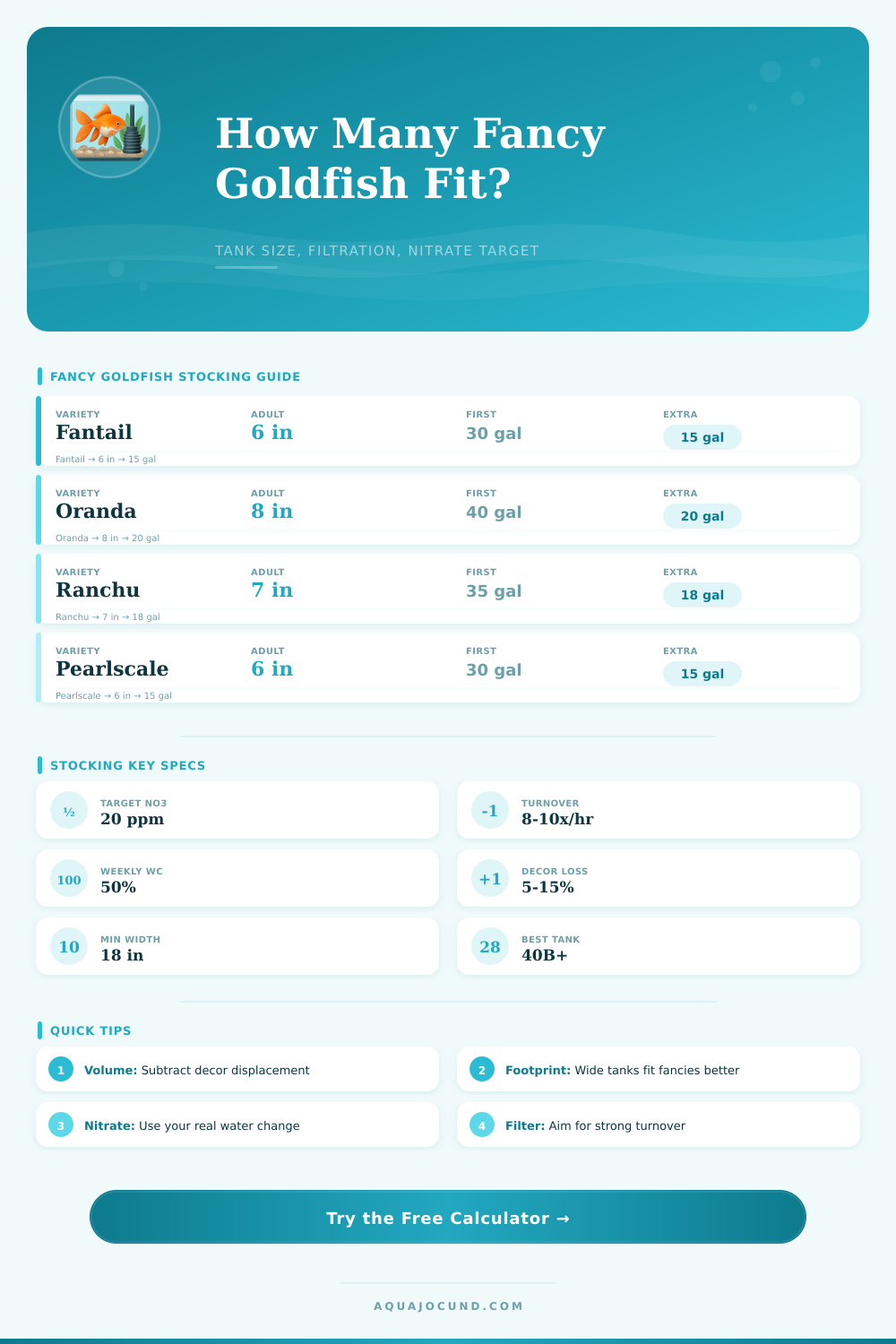
| Variety | Adult Size | First Fish | Each Extra | Footprint Per Fish | Bioload Factor |
|---|---|---|---|---|---|
| Fantail / common fancy | 6 in / 15 cm | 30 gal | 15 gal | 260 sq in | 1.00 |
| Oranda | 8 in / 20 cm | 40 gal | 20 gal | 340 sq in | 1.22 |
| Ranchu / lionhead | 7 in / 18 cm | 35 gal | 18 gal | 300 sq in | 1.12 |
| Ryukin | 8 in / 20 cm | 40 gal | 20 gal | 340 sq in | 1.25 |
| Black moor / telescope | 7 in / 18 cm | 35 gal | 18 gal | 310 sq in | 1.10 |
| Pearlscale | 6 in / 15 cm | 30 gal | 15 gal | 280 sq in | 1.05 |
| Butterfly telescope | 7 in / 18 cm | 35 gal | 18 gal | 320 sq in | 1.12 |
| Mixed fancy group | 7 in / 18 cm | 35 gal | 18 gal | 315 sq in | 1.15 |
| Tank | Dimensions | Volume | Footprint | Typical Fancy Count |
|---|---|---|---|---|
| 20 long | 30 x 12 x 12 in / 76 x 30 x 30 cm | 20 gal / 76 L | 360 sq in | 1 small fancy |
| 29 gallon | 30 x 12 x 18 in / 76 x 30 x 46 cm | 29 gal / 110 L | 360 sq in | 1 fancy |
| 40 breeder | 36 x 18 x 17 in / 91 x 46 x 43 cm | 40 gal / 151 L | 648 sq in | 2 fancies |
| 55 gallon | 48 x 13 x 21 in / 122 x 33 x 53 cm | 55 gal / 208 L | 624 sq in | 2-3 fancies |
| 75 gallon | 48 x 18 x 21 in / 122 x 46 x 53 cm | 75 gal / 284 L | 864 sq in | 3-4 fancies |
| 90 gallon | 48 x 18 x 24 in / 122 x 46 x 61 cm | 90 gal / 341 L | 864 sq in | 4 fancies |
| 125 gallon | 72 x 18 x 22 in / 183 x 46 x 56 cm | 125 gal / 473 L | 1296 sq in | 5-6 fancies |
| 180 gallon | 72 x 24 x 24 in / 183 x 61 x 61 cm | 180 gal / 681 L | 1728 sq in | 7-9 fancies |
| Factor | Conservative | Balanced | High Capacity | How It Affects Count |
|---|---|---|---|---|
| Nitrate target | 10 ppm | 20 ppm | 30-40 ppm | Lower target reduces count |
| Weekly water change | 30% | 50% | 70%+ | More replaced water supports nitrate control |
| Filter turnover | 5-6x/hr | 8-10x/hr | 10-12x/hr | Improves solids and oxygen reserve |
| Decor displacement | 15-20% | 8-12% | 3-7% | Less water means less dilution |
| Footprint width | 12-13 in | 18 in | 24 in+ | Wide tanks give more swimming area |
Fancy goldfish has bodies that are rounder and not as streamline as the bodies of common goldfish. Because fancy goldfish have bodies that are rounder and less streamlined than common goldfish, fancy goldfish require more horizontal swimming space than common goldfish. Furthermore, fancy goldfish also require more volume in there tanks to dilute the waste that they produce.
Many people purchases only one fancy goldfish for their tank, but their water does not stays as clear as it should remain, and their fancy goldfish develop swim bladder trouble. In order to establish the compatibility between fancy goldfish and a given tank, it is important to consider the number of fancy goldfish that the tank can support once the fancy goldfish reach their adult size. Although both oranda and ryukin fancy goldfish may reach eight inch in length, fantail fancy goldfish only reach six inches in length.
Choosing the right tank for fancy goldfish
Therefore, oranda and ryukin fancy goldfish will produce more waste than fantail fancy goldfish. The calculator builds a bioload factor into to account for these difference in the amount of waste produced by these fancy goldfish species. Consequently, the calculator provides a lower recommended number of fancy goldfish if one of the larger bodied fancy goldfish species are selected.
The calculator recommends lowering the count of fancy goldfish due to the increased amount of waste that the longer bodied fancy goldfish species will produce. Beyond the volume of the tank, the shape of the tank is another important factor. Both tall and narrow tanks and wide and shallow tanks of the same volume will hold fancy goldfish in the lower half of the tank.
In the lower half of the tank, the oxygen level will be lower and the waste will settle. Therefore, the calculator considers the bottom footprint of the tank in place of the gallon rating of the tank. Tanks with a wide footprint will allow the solid waste of the fancy goldfish to more easy reach the tank filter.
Solid waste that can easily reach the filter will be removed from the tank, preventing it from breaking down into nitrates. Filtration turnover is often an overlooked factor in tank creation for fancy goldfish. Fancy goldfish are known for the amount of mess that they create in their tanks.
The filter converts the flow rate to a turnover rate of the tank. If the turnover rate of the tank is not at least six times per hour, the calculator will indicate fewer fancy goldfish should be placed in the tank. Fewer fancy goldfish will be recommended for tanks with lower turnover rates because the solids in the water will remain suspended, preventing the biological filter from performing to its full potential.
The manufacturer often lists the rated flow of the filter, but you shouldnt assume it is adequate for fancy goldfish. Instead, the turnover rate should be considered. Another factor in the care of fancy goldfish is in the water change and the target nitrate levels in the tank.
You can enter the percentage of the water to be changed each week and the target nitrate levels into the calculator. Increasing the percentage of the tank water to be changed will allow for more fancy goldfish to live in the tank. More water changes will allow for more waste to be removed prior to the waste converting to nitrate.
However, a more strict target for nitrate levels will allow for fewer fancy goldfish to live in the tank. The calculator shows the relationship between water changes, nitrate targets, and the number of fancy goldfish for the tank. Yet, the ability to perform the water changes is another factor to consider.
Only if the maintenance schedule is able to be committed to will low counts of fancy goldfish be required for the tank. One additional factor that must be considered is the amount of decor that will be placed into the tank. Decorations of heavy rocks, large pots, or substrate will remove ten to twenty percent of the volume of the tank.
The calculation of the number of fancy goldfish that will be placed into the tank will consider decorations. This percentage of decor will be subtracted from the tank volume prior to calculating the other factor. The limiting factor in a tank will vary with the tank and its component.
The size of the bottom footprint of the tank may be the limiting factor, but the nitrate levels may be the limiting factor. The turnover of the tank may be the limiting factor for another tank setup. Finding the limiting factor can help to determine other necessary modification to the tank, such as adding filter media, increasing the width of the tank, or increasing the number of water changes.
Fancy goldfish must reach their adult sizes to ensure that they are living in a tank that can support their need. While young fancy goldfish do require less space, the adult size of the fancy goldfish is the factor that will impact the long term health of the tank. Therefore, you should of consider the adult size when purchasing fancy goldfish for a tank.
Ensuring that a tank can support the adult size will eliminate the need to move fancy goldfish later on in their life. Furthermore, reducing the stress of moving fancy goldfish will prevent potential disease outbreak in those fish. The fancy goldfish tank calculations cannot be replaced with regular testing of the tank.
The parameters of the tank may drift from the established levels, the growth rate of the fancy goldfish may vary, and the balance of the bacteria in the tank can only be established after the fancy goldfish are placed into the tank. Yet, using the fancy goldfish tank calculator prior to the purchase of fancy goldfish will ensure that the number of fancy goldfish for the tank are within the realistic parameter of that tank. Thus, if the calculator indicates two fancy goldfish rather than four, this is not the calculator being pessimistic in its recommendation.
Instead, it is performing calculations of the waste that will leave the tank, the amount of water in the tank, and the number of water changes that will occur each week. The tanks that remain stable are those where the owner has matched the size of the tank to the adult size of the fancy goldfish.