GH From Magnesium and Calcium Calculator
Convert calcium ppm and magnesium ppm into CaCO3 equivalents, dGH, Ca:Mg ratio, remineralizer contribution, and target-band fit.
Calculation Breakdown
| Measurement | Formula Used | Example | Result |
|---|---|---|---|
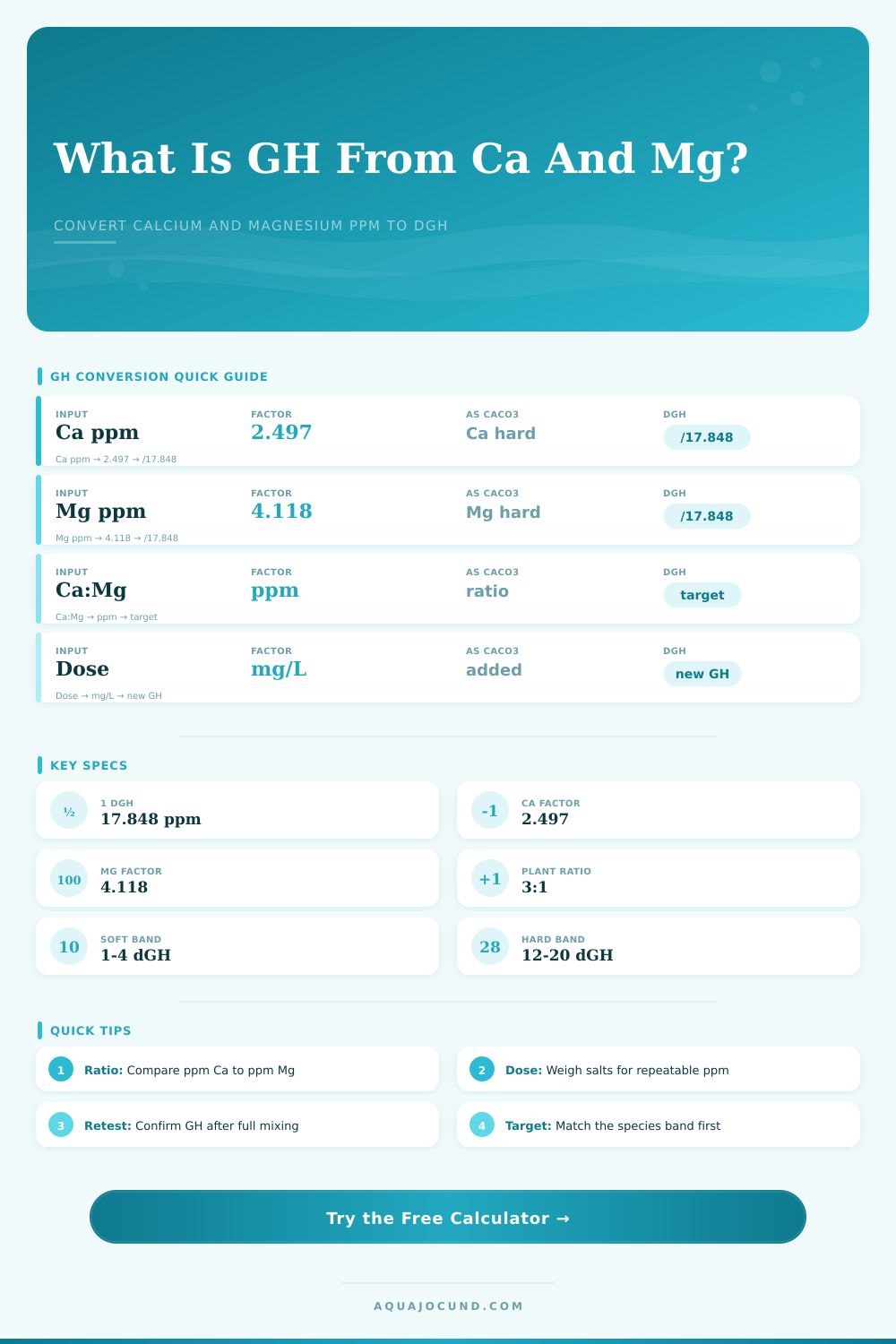
| Calcium hardness as CaCO3 | Ca ppm x 2.497 | 30 ppm Ca | 74.9 ppm as CaCO3 |
| Magnesium hardness as CaCO3 | Mg ppm x 4.118 | 10 ppm Mg | 41.2 ppm as CaCO3 |
| Total general hardness | (CaCO3 Ca + CaCO3 Mg) / 17.848 | 116.1 ppm CaCO3 | 6.5 dGH |
| Ca:Mg ratio | Ca ppm / Mg ppm | 30 ppm Ca and 10 ppm Mg | 3.0:1 by elemental ppm |
| Target Band | dGH Range | Approx ppm CaCO3 | Typical Ca:Mg Note |
|---|---|---|---|
| Soft blackwater | 1-4 dGH | 18-71 ppm | Low mineral total matters most |
| Caridina shrimp | 4-6 dGH | 71-107 ppm | Stable, magnesium present |
| Neocaridina shrimp | 6-8 dGH | 107-143 ppm | Balanced Ca and Mg |
| Planted community | 5-10 dGH | 89-178 ppm | Often near 3:1 Ca:Mg |
| General community | 6-12 dGH | 107-214 ppm | Moderate hardness window |
| Goldfish | 8-16 dGH | 143-286 ppm | Harder than softwater tanks |
| Livebearers | 10-18 dGH | 178-321 ppm | Calcium-rich water preferred |
| Rift cichlids | 12-20 dGH | 214-357 ppm | High mineral total |
| Source | Ca Content | Mg Content | GH Contribution Pattern |
|---|---|---|---|
| Balanced GH mix | 15% | 5% | Adds Ca and Mg near a 3:1 ppm ratio |
| Shrimp GH mix | 8% | 3% | Lower dose concentration for smaller batches |
| Hardwater mineral mix | 12% | 4% | Raises both ions for hardwater targets |
| Calcium sulfate dihydrate | 23.3% | 0% | Raises Ca hardness without magnesium |
| Calcium chloride dihydrate | 27.3% | 0% | Strong calcium-only hardness addition |
| Magnesium sulfate heptahydrate | 0% | 9.86% | Raises Mg hardness without calcium |
| Magnesium chloride hexahydrate | 0% | 11.96% | Concentrated magnesium-only addition |
| Batch Or Tank | Volume | 1 dGH As CaCO3 | 3:1 Ca:Mg Addition |
|---|---|---|---|
| 5 gal nano | 18.9 L | 338 mg CaCO3 eq | 102 mg Ca + 34 mg Mg |
| 10 gal small tank | 37.9 L | 676 mg CaCO3 eq | 204 mg Ca + 68 mg Mg |
| 20 gal long | 75.7 L | 1351 mg CaCO3 eq | 409 mg Ca + 136 mg Mg |
| 40 gal breeder | 151 L | 2702 mg CaCO3 eq | 817 mg Ca + 272 mg Mg |
| 75 gal display | 284 L | 5068 mg CaCO3 eq | 1533 mg Ca + 511 mg Mg |
| 125 gal display | 473 L | 8440 mg CaCO3 eq | 2553 mg Ca + 851 mg Mg |
Water hardness, This is one measurement where there are multiple definitions and the “simplistic” definition doesn’t always apply. Hardness refer to both magnesium and calcium, and although both minerals is essential to fish and plant well-being, they don’t always align with each other. For example, you might have plenty of calcium to promote sturdy stems. However, you might also have low magnesium, which causes your plants to turn pale and inhibits molting in your shrimp.
The problem is that most standard test kits only report a combined value (total hardness) rather than reporting the ratio of each mineral. This means you may be told how much total hardness are in your water, but you won’t know the balance of those minerals. This makes it impossible to create a water recipe that work for your specific livestock.
Why Calcium and Magnesium Are Different
What does all this mean? Basically, the calculator (above) takes care of the math for you and you don’t need to get bogged down in various conversion factors. Magnesium is about 4.1 times as effective than calcium, whereas calcium is closer to 2.5 times as effective.
The latter is important, one part per million of magnesium will contribute more to your overall “hardness” than one ppm of calcium. People often overlook this fact, thinking parts per million always exchange dollar-for-dollar. They don’t. Adding a little magnesium to reduce your calcium content may result in increasing your overall hardness by more then anticipated. That causes you to exit the range of soft water that you want to maintain.
First up: What are you trying to achieve? Identify your target species and then you’ll know what the ratio of those minerals should be. A 3 to 1 ratio of Calcium to Magnesium (Ca/Mg) is common in most aquarium setups for plants. This also reflects ratios seen in nature as ions enters rivers in balanced form. If you stray too far off this mark you run into the risk of nutrient lockout, i.e., elevated concentrations of one ion prevent uptake of others. Leaves turn yellow but they don’t get better because they’re actualy experiencing a problem with the background mineral balance, not a deficiency of iron or something else. Use the ratio calculator on the page to see immediately how close your current mix is to either end of that scale.
Even if you’re unaware of it, remineralizing reverse osmosis water is chemistry. By dissolving salts into ions, you’re rebuilding water from scratch. Magnesium sulfate introduce magnesium without altering alkalinity. Calcium sulfate does the same thing for hardness. By blending these salts together, you’ll be able to hit exacting targets instead of guessing at a generic mix.
While the tool provides a list of common conversion points (shown on the reference grid), its true use lies in tailoring the dose to match your desired change percentage/volume. A full batch mix requires a different dose than a 10% water change, getting this wrong can spike your parameters dangerously.
How stable does it need to be? Stability is more critical then the specific number you reach. Hardness changes quickly, but fish and plants responds slowly to those changes. They get stressed out, which causes them to decline rapidly or look diseased. Rather than having perfect hardness with wild swings from one water change to another, you’re better off having a slightly less than perfect but always the same hardness.
The calculator allows you to model such swings; you enter how much water you’re replacing in relation to total tank volume, and then it calculates what the final hardness will be before you even open the bottle of minerals. That way you know ahead of time whether you’ll need just a small dose (which may bridge the gap) or if you would of had to switch your base mix altogether.
It’s not about reaching a number but about establishing an ecosystem that allows for life to persist with minimal meddling. When you realize calcium and magnesium are different components of hardness, you don’t guess anymore; you design. You no longer view the water as something static that happens around you but as an active medium you can dial in.
This change in mindset alters your approach to maintaining the tank. It transforms regular tasks into a routine where you feel like you’re in control. You go back to basics: what do the animals require? You will have no more confusion due to conflicting test results.