💧 GH Booster Dosing Calculator
Estimate remineralizer dose, dGH rise, Ca/Mg/K contribution, and staged dosing for shrimp and fish tanks.
| Mineral Mix | Dose Basis | Ca ppm per dGH | Mg ppm per dGH | K ppm per dGH | Best Use |
|---|---|---|---|---|---|
| Shrimp Balanced GH+ | 2.0 g / 20 gal / dGH | 5.0 | 1.7 | 0.4 | Neocaridina, Caridina GH-only tanks |
| Plant Ca/Mg/K Booster | 2.4 g / 20 gal / dGH | 4.2 | 1.1 | 2.5 | Planted aquariums needing potassium |
| Equilibrium-Style Blend | 3.0 g / 20 gal / dGH | 3.2 | 1.1 | 3.8 | RO water planted tanks |
| Rift Lake Mineral Salt | 2.8 g / 20 gal / dGH | 5.8 | 1.8 | 1.2 | African cichlids and hard water fish |
| Calcium-Heavy Remineralizer | 1.8 g / 20 gal / dGH | 6.5 | 0.8 | 0.2 | Snails, livebearers, calcium correction |
| Magnesium-Heavy Remineralizer | 2.2 g / 20 gal / dGH | 3.0 | 2.8 | 0.3 | Low magnesium planted tanks |
| Livestock | Typical Target | Soft Limit | Hard Limit | Notes |
|---|---|---|---|---|
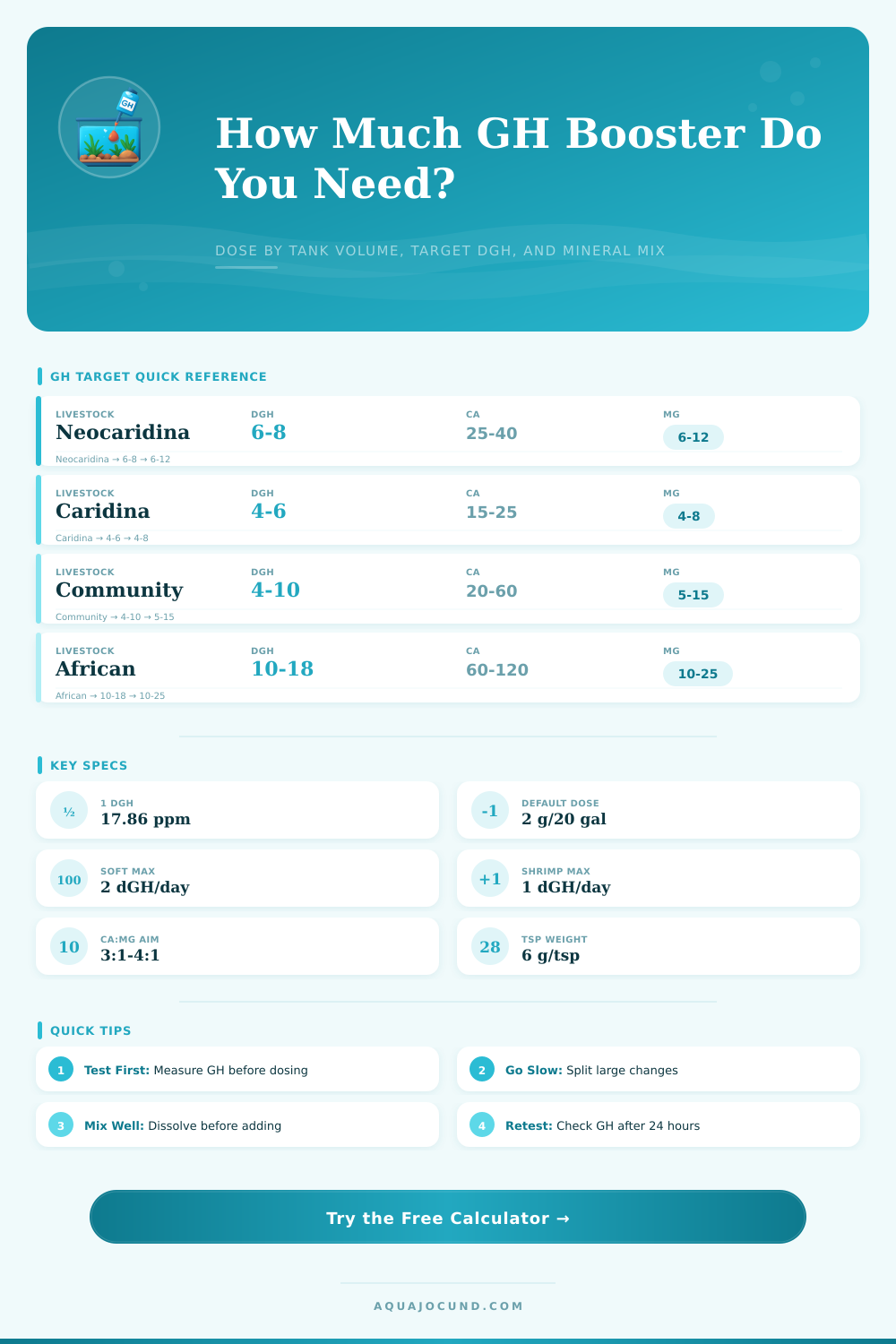
| Caridina Shrimp | 4-6 dGH | 3 dGH | 7 dGH | Use GH-only remineralizer with active substrate |
| Neocaridina Shrimp | 6-8 dGH | 5 dGH | 10 dGH | Stable GH matters more than chasing one number |
| Community Fish | 4-10 dGH | 3 dGH | 12 dGH | Tetras, rasboras, corydoras, gourami mixes |
| Soft Water Fish | 2-6 dGH | 1 dGH | 8 dGH | Discus, wild angels, many blackwater species |
| Livebearers | 8-15 dGH | 6 dGH | 20 dGH | Guppies, mollies, platies, swordtails |
| African Cichlids | 10-18 dGH | 8 dGH | 22 dGH | Lake Malawi and Tanganyika style tanks |
| Planted Tank | 4-8 dGH | 3 dGH | 12 dGH | Watch Ca, Mg, and K balance separately |
| Tank | Dimensions | Volume | For +1 dGH | For +4 dGH |
|---|---|---|---|---|
| 5 Gal Nano | 16 x 8 x 10 in / 41 x 20 x 25 cm | 5 gal / 19 L | 0.5 g | 2.0 g |
| 10 Gal | 20 x 10 x 12 in / 51 x 25 x 30 cm | 10 gal / 38 L | 1.0 g | 4.0 g |
| 20 Long | 30 x 12 x 12 in / 76 x 30 x 30 cm | 20 gal / 76 L | 2.0 g | 8.0 g |
| 29 Gal | 30 x 12 x 18 in / 76 x 30 x 46 cm | 29 gal / 110 L | 2.9 g | 11.6 g |
| 40 Breeder | 36 x 18 x 16 in / 91 x 46 x 41 cm | 40 gal / 151 L | 4.0 g | 16.0 g |
| 55 Gal | 48 x 13 x 21 in / 122 x 33 x 53 cm | 55 gal / 208 L | 5.5 g | 22.0 g |
| 75 Gal | 48 x 18 x 21 in / 122 x 46 x 53 cm | 75 gal / 284 L | 7.5 g | 30.0 g |
| 125 Gal | 72 x 18 x 22 in / 183 x 46 x 56 cm | 125 gal / 473 L | 12.5 g | 50.0 g |
| Tank Type | Recommended Max | When to Split | Retest Timing |
|---|---|---|---|
| Sensitive Caridina | 0.5 dGH per day | Any rise over 0.5 dGH | 24 hours after each dose |
| Neocaridina Shrimp | 1 dGH per day | Any rise over 1 dGH | Next day before lights on |
| Community Fish | 2 dGH per day | Any rise over 2 dGH | After full circulation |
| Hardy Livebearers | 2-3 dGH per day | Any rise over 3 dGH | After 12-24 hours |
| Rift Cichlids | 2-3 dGH per day | Large RO remineralizing jobs | Before adding livestock |
General hardness, or the GH of the water in the aquarium, is an important parameter to maintain in the tank for shrimp, plants, and fish to remain healthy. If the GH is not maintained within the appropriate level, shrimp may struggles to molt and may die from illness, plants may appear faded, and the fish may become stressed. The correct level of GH for the aquarium is not a static number.
The correct level of GH for a aquarium can and should be adjusted according to the needs of the livestock in the tank, the minerals that are naturaly contained within the water that is used to fill the tank, and the minerals that a mineral mix product adds. A dosing calculator is a tool that takes each of these variables of the aquarium and calculates the appropriate amount of mineral mix that should be dose into the tank to achieve the desired results. Each of the variables within the dosing calculator have an impact on the results of the calculation that the dosing calculator performs.
How to Use a GH Calculator for Your Aquarium
For instance, the dosing calculator will ask for the volume of the tank. However, the user must account for the shape of the tank; a bow-front and cylinder-shape tank will hold a different volume of water than a rectangular tank of the same size. Furthermore, the calculator will ask for the current GH of the tank and the desired GH of the tank.
The difference between these two values is the amount of rise in GH that is to be achieved. Additionally, the calculator will ask for the type of livestock that is contained in the tank. For instance, a Neocaridina shrimp can tolerate a wider range of GH then a Caridina shrimp, so the dosing calculator will alert the user if the desired GH lies outside of the range that is safe for the tanks inhabitants.
Furthermore, the type of mineral mix that will be used can also impact the calculations performed by the dosing calculator; for instance, a mineral mix that is created with a focus on plants will contain more potassium than a mineral mix that is created with a focus on shrimp. Thus, it is important to enter the type of mineral mix that will be used in the dosing calculator. Beyond these variables, there are a few other settings that can be adjusted within the dosing calculator.
For instance, the user can set the daily maximum rise in GH. This daily maximum rise in GH is not a speed limit for adjusting the GH of the tank, but rather is a variable that ensures that the animals within the tank are not exposed to too rapid of changes in the GH. Many shrimp species are sensitive to changes in the GH, but some, like cichlids, are more hardier.
Furthermore, the dosing calculator also asks for the buffer percentage for the mineral mix that is to be dosed into the tank. This buffer percentage ensures that the user does not dose the minerals into the tank to a level that is too high; if adding the calculated amount of minerals will result in the GH of the tank being too high, the buffer percentage will allow the user to make small adjustments to the amount of minerals that are to be dosed. Additionally, the dosing calculator will provide several results based off the variables and settings that were entered.
The total dose that should be used tells the user how many grams of the mineral mix should be dose into the tank. Additionally, the breakdown of the minerals within the mix will show if the minerals contains the correct amount of each type of mineral. Furthermore, the staged dosing suggestion will allow the user to dose the minerals over several days to achieve the desired GH.
Finally, the target range check will alert the user if the desired GH is safe for the type of livestock that is within the tank. These various results can allow the user to decide what adjustments to make to the tank, if any. It is important to understand that the GH of the water in the tank is not the same as the KH of the tank.
Increasing the GH of the water will not necessarily increase the KH of the tank. Furthermore, the KH of the water has an impact on the GH of the tank; tap water may contain minerals that contribute to the GH of the tank, but the KH of the water may not be balanced to that of the tanks requirements. Thus, by using the dosing calculator to only add the minerals that is needed to balance the KH of the tap water to the requirements of the tank, the dosing calculator allows for the user to avoid adding too much of one mineral but not enough of another.
Many people make several common mistakes when dosing mineral mixes into their tanks. For instance, many people treat every tank in the same way. Each tank, however, has different type of livestock, and different requirements for the GH of the water.
Furthermore, many people make a large change in the GH of the water all at once. Such a change can lead to the shrimp struggling with their molt, or the fish clamping their fin. These mistakes can be avoided by using the dosing calculator and making certain to dose the minerals according to the specifications of that particular tank.
The use of mineral mixes also has an impact upon the dosing calculator. For instance, if the user only wishes to perform a thirty percent water change in the tank, the amount of mineral mix that is needed will be less than if the user were to dosage the minerals into the entire tank. However, the tanks livestock will still be exposed to the full amount of minerals.
Thus, the water change percentage in the dosing calculator allows for the user to adjust according to these conditions. By running the numbers in the dosing calculator before beginning to dose the minerals into the aquarium, the user can review several different aspect of the tank. For instance, the mineral mix may contain various amounts of calcium to potassium.
The dosing calculator can reveal these variables. Additionally, the dosing calculator can reveal whether the minerals that are to be dose into the tank contain potassium. Furthermore, the dosing calculator allows the user to view how many day will be required to reach the desired GH.
Each of these details are essential to understand before beginning to dose the mineral into the tank. Each of these aspects will help to determine whether the dosage will help the user to solve the problem that is existing in the tank. After dosing the minerals according to the dosing calculator, it is important to perform a test of the tank after twenty-four hours.
The GH of the tank may not change instant throughout the tank, so a second test will allow the user to verify that the tank has reached the desired GH. This second test also allows the user to dose more minerals if necessary to reach the desired GH. Finally, a final test will ensure that the user follows the plan created by the dosing calculator according to the actual conditions within the aquarium.