GFO Reactor Sizing Calculator
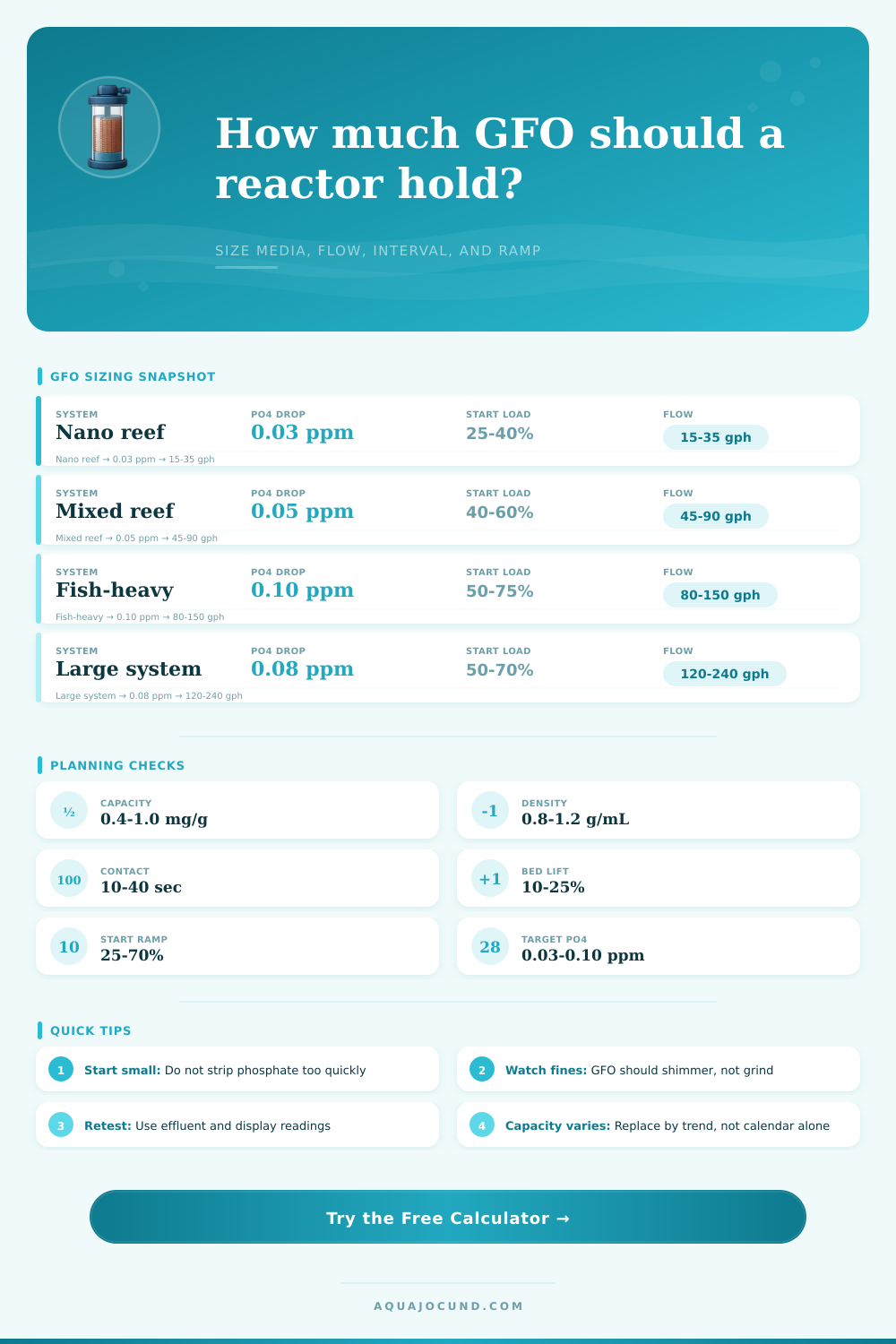
Size granular ferric oxide media from tank volume, phosphate reduction target, media capacity, reactor diameter, flow, exhaustion interval, and a safer startup ramp.
📌GFO Reactor Presets
🧪Tank, Phosphate, Media, and Reactor Inputs
GFO Reactor Sizing Result
⚖GFO and Phosphate Media Comparison Grid
📊Phosphate Reduction Guide
| Tank posture | Common PO4 range | First reduction target | Ramp guidance |
|---|---|---|---|
| Sensitive SPS or pale corals | 0.02 to 0.08 ppm | 0.01 to 0.03 ppm | Start 25% to 40% of calculated media |
| Mixed reef maintenance | 0.04 to 0.12 ppm | 0.03 to 0.06 ppm | Start 40% to 60% and retest |
| Algae recovery phase | 0.12 to 0.40 ppm | 0.05 to 0.10 ppm | Use several smaller media changes |
| Fish-heavy system | 0.10 ppm and up | 0.05 to 0.15 ppm | Plan shorter intervals or more export |
🧱Reactor Diameter and Bed Height Reference
| Inner diameter | Media per 1 inch bed | Media per 2.5 cm bed | Useful note |
|---|---|---|---|
| 2 in / 5.1 cm | 51 mL | 50 mL | Small reactors can become tall quickly |
| 2.5 in / 6.4 cm | 80 mL | 79 mL | Common for nano and mid-size systems |
| 3 in / 7.6 cm | 116 mL | 114 mL | Good balance for many reef systems |
| 4 in / 10.2 cm | 206 mL | 203 mL | Large diameter keeps bed height lower |
🌊Flow and Contact Time Guide
| Flow behavior | Contact time | Surface cue | Risk if wrong |
|---|---|---|---|
| Too slow | Over 60 seconds | Bed looks packed and still | Channeling and unused media zones |
| Good adsorption range | 10 to 40 seconds | Top grains gently shimmer | Usually the best starting point |
| Too aggressive | Under 8 seconds | Whole bed boils hard | Fines, dust, and reduced capacity |
| Startup rinse | Variable | Effluent runs clear | Discard initial rusty fines |
🔄Exhaustion and Testing Schedule
| Check point | What to test | Likely meaning | Adjustment |
|---|---|---|---|
| 24 to 48 hours | Display PO4 | Initial ramp strength | Pause if drop is faster than planned |
| Weekly | Display and reactor effluent | Media still binding | Keep running if effluent is lower |
| Near interval end | Effluent equals display | Media is exhausted | Replace or regenerate if suitable |
| After replacement | Clear effluent and livestock response | Startup safety check | Repeat the ramp, not the maximum dose |
Or maybe your reef tank appears okay, but has an underlying issue with phosphates. When they increases, corals contract or algae covers them. Granular ferric oxide can be effective for this, but what’s the proper amount and how fast does it need to flow? The answer is not in the label size; its about precise sizing.
When it comes to removing phosphate, many hobbyists view it as an on/off switch rather than a dial. They dumps in too much media and watch the numbers crash which stresses the corals. Knowing how much phosphate enters your tank every day (from substrate leaching and feed) are essential. If phosphate input is small, then a big reactor will suck out phosphate to fast.
How to Choose the Right Size and Flow
By using tank volume and daily phosphate rebound, the calculator find the correct size. To avoid shocking your livestock, it recommend a modest start. Less media at startup allow it time to adjust more slowly. No more sudden phosphate crashes within an hour that cause biological stress on sensitive corals because you allow the levels to decrease over a week or two instead. A smaller volume change is the difference between stability and disaster.
The simple interface instantly switches between imperial and metric units. Saves you from human math mistakes.
The quantity of media are only half the story. Equally critical is flow rate. If water is moving too quickly, it won’t have time to react with the iron oxide and bind the phosphate. Short contact time waste money. Tables you can reference gives contact times ranging from ten to forty seconds. A gentle shimmer across the top of the media bed is what you’re aiming for. Fines are created by boiling water which also lowers capacity. Channeling problems arises in stagnant water.
It’s not like all granular ferric oxide is equal. Your tank’s organic load will greatly reduce its capacity. Use real-world variables in the calculator to account for that. If your water has higher organics, use a lower capacity number so it last as long as expected.
But reactor shape matter as well. Narrow reactors result in taller beds which increase contact time. It is harder to control flow in that setup different than in a wide reactor, which has a flat, short bed that allows for more even flow across the surface.
How much media does yours hold? Before you purchase, see sizing guide to learn. To maintain low phosphate, you need to keep it there consistently but not excessively. Your goal is a stable phosphate level where the media slowly adsorbs what your livestock produce while rock beds release stored phosphates over time. Rock beds release stored phosphates gradually and you’ll need to check regularly. Single random tests isn’t as meaningful as trend lines.
Know how much water you have. Subtract space taken up by any equipment. Know how much of each media you’ll need. Math. Begin with a lower quantity of media than expected. Observe the surface glitter, and go from there. Peaceful clarity… not chaos.