⚗ GFO Quantity Calculator
Estimate granular ferric oxide grams, tablespoons, phosphate reduction, reactor flow, and media exhaustion timing for aquarium phosphate control.
| Media Type | Bulk Density | Working Capacity | Best Placement |
|---|---|---|---|
| Standard granular GFO | 0.72 g/mL | 0.55 mg PO4/g | Small reactor or media bag with forced flow. |
| High capacity granular GFO | 0.82 g/mL | 0.90 mg PO4/g | Reactor, half dose start for reef tanks. |
| Pelletized reactor GFO | 0.78 g/mL | 0.62 mg PO4/g | Canister basket or reactor with low dust. |
| Wet high capacity slurry | 0.95 g/mL | 0.95 mg PO4/g | Reactor at cautious starting amount. |
| Fine grain rapid GFO | 0.66 g/mL | 0.70 mg PO4/g | Bag or very gentle reactor after rinsing. |
| Ferric oxide hybrid media | 0.70 g/mL | 0.65 mg PO4/g | Mixed bed reactor or tray. |
| Coarse low dust GFO | 0.68 g/mL | 0.48 mg PO4/g | Higher flow tanks and repeated small changes. |
| Aluminum oxide phosphate media | 0.76 g/mL | 0.50 mg PO4/g | Short controlled runs, not tumbled hard. |
| Tank | Dimensions | Cautious Start | Normal Range |
|---|---|---|---|
| 10 gal nano | 20 x 10 x 12 in / 51 x 25 x 30 cm | 4-8 g / 0.4-0.8 tbsp | 8-15 g / 0.8-1.6 tbsp |
| 20 long | 30 x 12 x 12 in / 76 x 30 x 30 cm | 8-16 g / 0.8-1.6 tbsp | 16-30 g / 1.6-3 tbsp |
| 40 breeder | 36 x 18 x 16 in / 91 x 46 x 41 cm | 15-30 g / 1.5-3 tbsp | 30-60 g / 3-6 tbsp |
| 55 gal | 48 x 13 x 21 in / 122 x 33 x 53 cm | 20-40 g / 2-4 tbsp | 40-80 g / 4-8 tbsp |
| 75 gal | 48 x 18 x 21 in / 122 x 46 x 53 cm | 30-55 g / 3-6 tbsp | 55-110 g / 6-11 tbsp |
| 125 gal | 72 x 18 x 21 in / 183 x 46 x 53 cm | 50-90 g / 5-9 tbsp | 90-180 g / 9-18 tbsp |
| System Goal | Typical PO4 Range | Daily Drop Limit | GFO Approach |
|---|---|---|---|
| SPS reef | 0.03-0.08 ppm | 0.03-0.06 ppm | Small dose, test often, avoid sudden stripping. |
| Mixed reef | 0.05-0.12 ppm | 0.05-0.08 ppm | Half dose first, adjust by test trend. |
| Soft coral reef | 0.08-0.20 ppm | 0.06-0.10 ppm | Use only enough media to hold a stable range. |
| Fish-only marine | 0.10-0.50 ppm | 0.10-0.20 ppm | Larger reserve is acceptable when algae is the concern. |
| Flow Condition | Media Behavior | Calculation Effect | Adjustment |
|---|---|---|---|
| Under 1x media volume per minute | Low contact | Longer cleanup, less capacity used | Increase reactor flow or reduce packing. |
| 2-4x media volume per minute | Gentle surface shimmer | Best working range | Keep only the top layer moving. |
| 5-7x media volume per minute | Strong tumble | Faster contact, more fines risk | Back down flow if dust appears. |
| Over 8x media volume per minute | Grinding or bypass risk | Reduced effective interval | Split media or slow the reactor. |
One of the unseen variables of a reef tank is phosphate. If temperature and salinity is correct, corals may still appear sluggish. This could be due to phosphates, which affect its ability to build skeletons or process light. To control them, you need to understand how they move through the system.
Most aquarists make a mistake at this point, understanding what goes into the calculator. Enter in your target levels and your tank volume and the calculator will do the math for you.
How to Control Phosphate in Your Reef Tank
Adsorption means binding phosphate molecules on surface of media. Specifically, granular ferric oxide bind phosphate until it becomes saturated. Like a sponge with water in its pores, once they’re all filled, there’s no more action from the media. However, the media will look the same whether it is fresh or used up. Because you cannot see what has happened, proper dosing are key.
You don’t want to waste time under dosing, where results won’t be seen. You also don’t want to overdose by stripping nutrients out to fast, which can starve algae grazers and shock your corals.
You need to provide the daily phosphate input to the tool every day. Often it’s not easy for most people to actualy guess how much phosphate they’re putting in their tanks. It could be coming from contaminated water sources, livestock waste, or even what’s on packaging of their food. Most hobbyists under-estimate how much they put in when feeding.
To find out yours, turn off your media, wait a week, and take weekly readings with your test kit(s). The change in phosphate levels represent your phosphate input. If it go up 0.05 ppm/day, that’s your input. Plug that in as your “planning interval” field. That will give you a more true picture of the time to exhaustion based off your real world conditions different than some general rule of thumb.
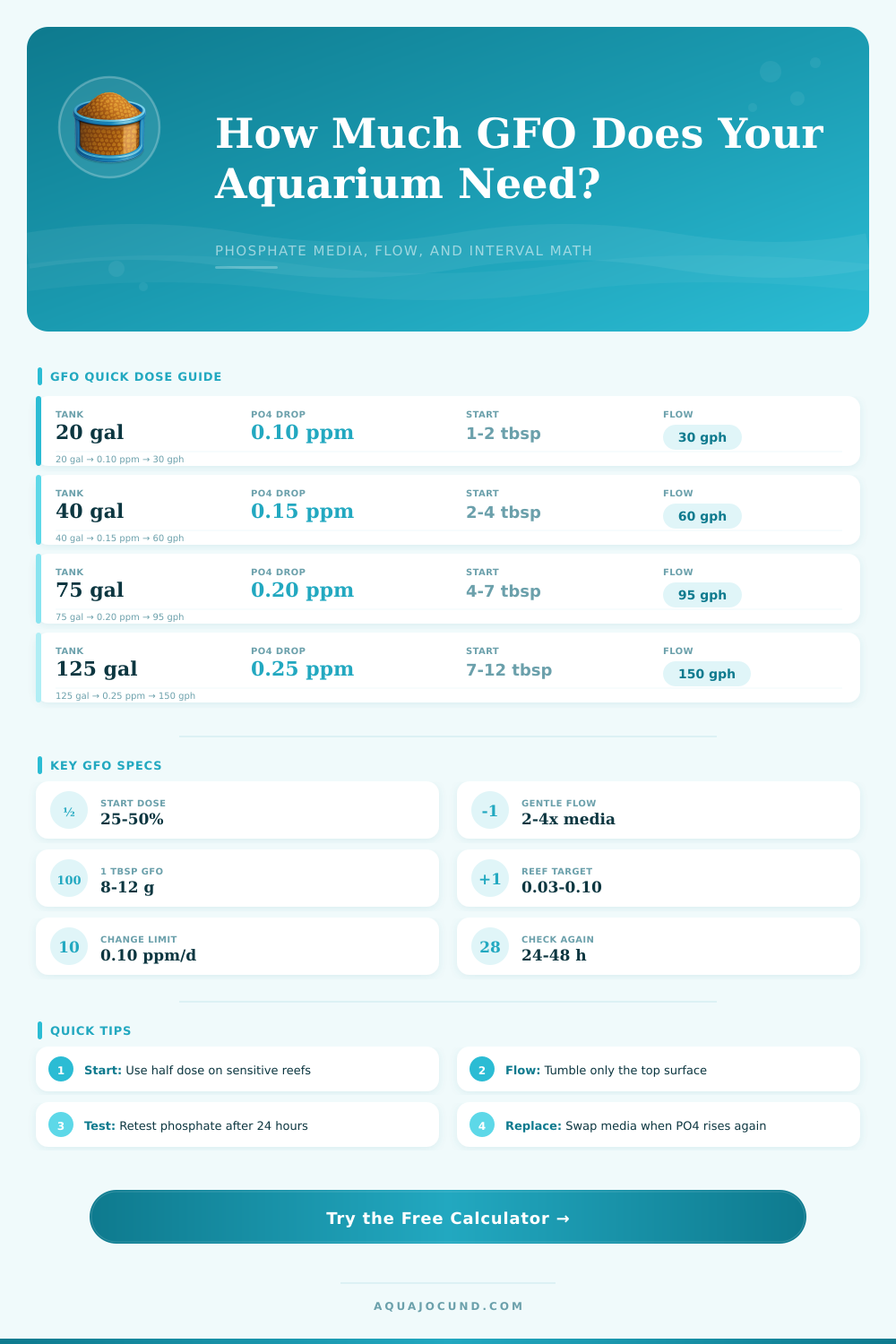
How does Reactor flow figure in? Binding efficiency vary with various styles of movement. Gentle surface tumbling works well because it exposes new surfaces without crushing grain into dust. Fast flow lead to channelling, where water goes around the media. Slow flow coats outer grains and blocks inner core. Because the calculator factors-in your contact style, the calculated grams aligns with hydraulic reality instead of theoretical rules. The following table show binding efficiency based on several types of movement.
Another thing to consider is media type. High-capacity pelletized GFO works well (less dust, better flow) but takes up far less volume than standard granular GFO does. The latter is tried-and-true, but it take more room in the reactor. Keep in mind that worn-down GFO will dissolve and leach iron; if this escapes the reactor bag, the dissolved iron can fuel nuisance algae growth. Coarser grades are kinder to sensitive systems but take up more physical space. Consider your desired level of phosphate reduction against size of your reactor and its ability to tolerate potential iron leaching.
The weight on the scale is simply a ballpark figure, and it’s a place to start from, not a rule written in stone. If your biological filtration is new or you have some sensitive SPS coral, begin with half of what was calculated. You should of used more. After forty-eight hours, retest to determine if the drop has been too drastic. Ideally you want the phosphate to decrease gradualy, never suddenly crashing. When stable, the level will stay in a narrow range and not swing up and down like crazy.
Change the media whenever it shows an increase on the test, even if the media bag is still full. Believe the chemistry; don’t rely on how the bag looks.
Once you nail this, controlling phosphates becomes a repeatable process. You’ll get a solid handle on keeping your tank stable instead of it going out-of-whack each time you check the levels.