Generator Wattage Aquarium Calculator
Size backup generator running watts and startup surge for aquarium heaters, return pumps, air pumps, optional lights, runtime priorities, and emergency load tiers.
| Equipment | Typical running watts | Startup multiplier | Tier priority | Calculator note |
|---|---|---|---|---|
| Resistance heater | 25-500 W each | 1.0x | Heat tier | Duty changes running watts, but connected watts can all switch on. |
| Return pump | 15-120 W each | 1.8-2.8x | Circulation tier | Largest motor surge is added to running load. |
| Powerhead or wavemaker | 4-60 W each | 1.2-2.0x | Circulation tier | Use lower surge for DC controllers, higher for AC motors. |
| Air pump | 2-20 W each | 1.3-2.0x | Oxygen tier | Small load, high survival value during outages. |
| LED light | 10-250 W total | 1.0-1.2x | Full basics tier | Optional in emergencies unless livestock needs light timing. |
| Controller or doser | 3-30 W total | 1.0-1.3x | All tiers | Keep critical controllers on the same backup circuit. |
| Tank | Volume | Life-support loads | Typical running load | Surge planning load |
|---|---|---|---|---|
| 10 gal nano | 10 gal / 38 L | 25 W heater, 5 W air, 8 W filter | 35-55 W | 55-90 W |
| 20 gal planted | 20 gal / 76 L | 75 W heater, 8 W air, 15 W pump | 70-110 W | 110-170 W |
| 29 gal community | 29 gal / 110 L | 100 W heater, 8 W air, 25 W pump | 95-150 W | 150-230 W |
| 55 gal display | 55 gal / 208 L | 2 heaters, air, return or canister | 220-340 W | 320-520 W |
| 75 gal reef | 75 gal / 284 L | 2 heaters, return, flow, air, controller | 300-520 W | 450-780 W |
| 125 gal system | 125 gal / 473 L | Multiple heaters, sump return, air, flow | 550-850 W | 800-1200 W |
| Priority | Heater duty | Pump duty | Light duty | Best use |
|---|---|---|---|---|
| Longest runtime, oxygen first | 25% | 40% | 0% | Short controlled runs when the tank is not cooling quickly. |
| Balanced life support | 60% | 100% | 20% | Default outage plan for most freshwater displays. |
| Heat stability first | 85% | 80% | 0% | Cold room, small tanks, open tops, or sensitive warmwater setups. |
| Reef circulation first | 55% | 100% | 10% | Reef systems where oxygen and flow are critical. |
| Normal operation snapshot | 100% | 100% | 100% | Used when testing total connected equipment behavior. |
| Tier | Included loads | Excluded loads | Primary output | Manual check |
|---|---|---|---|---|
| Tier 1 oxygen | Air pumps, controller, small misc | Main pumps, heaters, lights | Lowest running watts | Confirm strong surface agitation or air stones. |
| Tier 2 circulation | Tier 1 plus main pumps at selected duty | Heater and lights | Oxygen plus water movement | Start one motor at a time if breakers are tight. |
| Tier 3 heat protection | Tier 2 plus heater duty | Lights unless manually included later | Best life-support wattage | Watch temperature drift and adjust duty. |
| Tier 4 full basics | Tier 3 plus optional lights | Noncritical accessories | Closer normal-operation load | Use for testing, not the first emergency assumption. |
It’s a Tuesday evening in late November. You’re in bed and suddenly it hits you, the lights went out! And that includes aquarium. That’s more than glass and water; it’s a delicate ecosystem dependent upon electrical equipment to provide heat, oxygenation, filtration, and so forth. Right now your fish need warmth and flow regardless of your scheduled maintenance day(s), insurance policy, etc. This is where most aquarists come to realize that they’ve underestimated their backup requirements. The margin for error is thin. Fear is real.
It’s important to note that selecting a generator for an aquarium isn’t so much a question of how many total watts it puts out as it is determining how big a generator you need to start your tanks compared to run them. Knowing the difference will protect all your gear. When most folks purchase a generator, they base their decision on the “total” wattage found printed on the label of any device. This results in starting up the generator and then turning it off right away.
How to Choose a Generator for Your Aquarium
What happens with an air compressor motor or a return pump motor is they pull significantly more power for a split second when they first turn on than they do while running smoothly. The formula above does the math for you, distinguishing between the instantaneous peak and the ongoing continuous load. So it won’t let you undersize your machine, nor oversize it unnecesarily.
Heaters are the silent killers of generator capacity. Once turned on, they draw consistent power once active, but they can dominate your wattage budget quickly. Depending upon how much warmth you want to create and what kind of environment you’re trying to heat, your heaters can gobble up your wattage budget in no time flat.
Fortunately, the tool considers something called duty cycle which is the percentage of time the heater is actualy operating to maintain the desired temp. So in a warm room, your heater may only kick in 20% of the time. But then again if you live in a drafty basement it may run 80%. That makes a huge difference not only in how much heat output you need but also how much fuel it will consume. If you don’t account for the duty cycle, you might plan for the best-case scenario and leave your tank cold when you need it most, or the worst-case scenario and never use it at all.
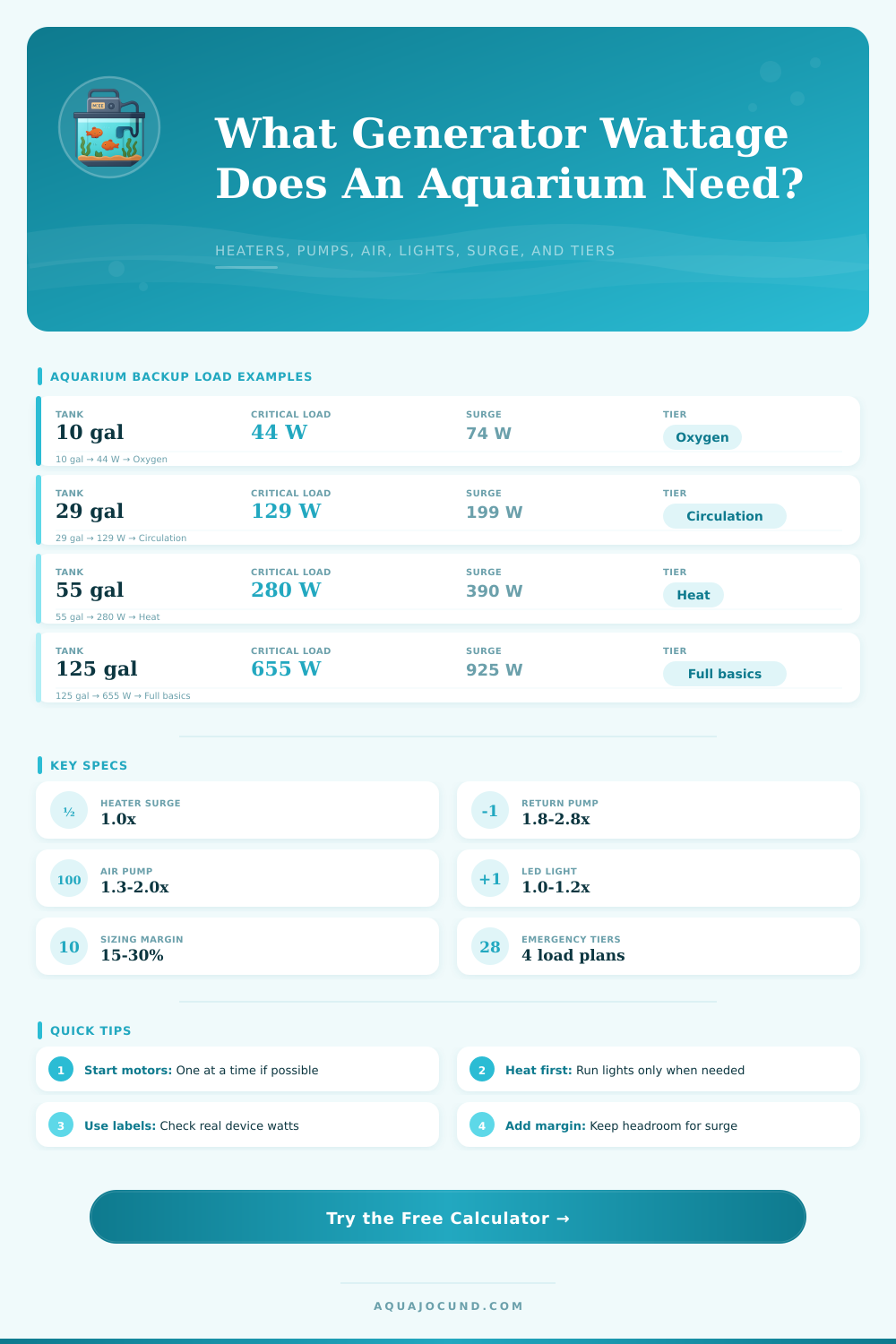
In an emergency, there’s no negotiation when it comes to circulation; dead water quickly runs out of oxygen. Without a powerhead or return pump, your filter media stop processing ammonia. Before tweaking the details, here is the baseline for how various tank sizes relates to these loads. Use this as your starting point and then adjust based off individual components. For example, a basic 55g display could require two-hundred watts solely for life support. Conversely, you’d not be surprised to find a large reef system easily exceeding six hundred watts. It all depends on the types and number of pump.
Moddern equipment will include DC pumps, which draw lower surge power versus AC motors, and this alone makes a huge difference in what generator you would choose. If you’re short on juice, then tiered emergency plans are a real-world solution that puts your priorities in order. During a power outage, do you really need all the lights? In fact, running LEDs drains fuel without saving any fish. That’ll burn gas but won’t protect any fish.
By prioritizing your essential loads, those that ensure oxygen, flow, and heat remain online, you can eliminate optional functions like automatic dosing pumps or lighting. Tiered thinking turns a black/white dilemma into an actionable list. Prioritize life support, and everything else is negotiable. This will dramatically extend the amount of time you can sustain a tank with a small portable generator… From hours to days.
If you have a small generator with low surge capacity, start it individually. Spiking all the power demand simultaneously may stall the motor and trip breakers. Stagger your start-up sequence to avoid this issue. After starting the return pump, wait 10 seconds before starting the air pump. This provides slow but effective protection for the system.
Plan for inefficiency and age by adding a safety margin of 15-30% when sizing. Aquarium gear degrades over time, so does your generator. Expecting that decline makes it reliable when you most need it. You can’t avoid power outages, but you don’t have to lose any fish.
You’re not trying to maintain a perfect looking tank while it’s dark. What you’re trying to do is maintain live livestock until the grid comes back up. Don’t worry about how it looks. Just focus on the temperature and the flow. Remember: your generator isn’t an aesthetic feature. It’s a life support system.
Once the lights go out, your plan goes into action. Ensure your plan has some headroom for the surge. Because the fish are going to be waiting.