🧪 Furan-2 Dosing Calculator
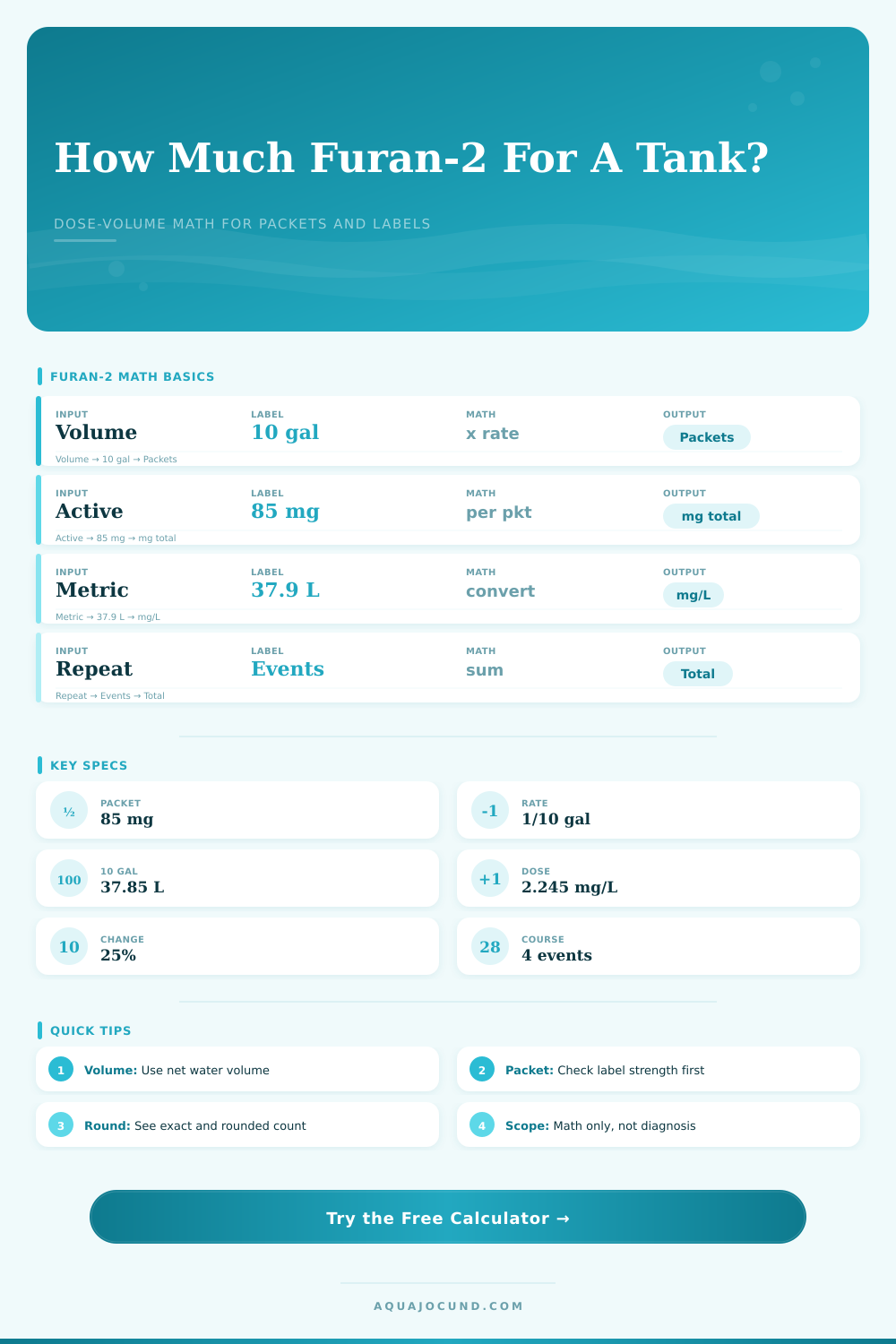
Convert aquarium water volume, Furan-2 label strength, packet counts, active nitrofurazone mg, water-change replacement, and schedule totals into neutral math.
✅ Calculated Dose Math
| Product Form | Strength Input | Calculator Output | Default Math | Rounding Use |
|---|---|---|---|---|
| Furan-2 Packet | 85 mg each | packet count | 1 packet per 10 gal | Exact or whole packet |
| Furan-2 Scoop | 170 mg per tsp | teaspoons and mL | 1 tsp per 20 gal | Kitchen spoon math only |
| Custom Packet | mg active each | packet or tablet count | active mg divided by label mg | Fraction or whole units |
| Percent Powder | % active by weight | grams powder | active mg adjusted by percent | Scale precision |
| Dry Blend | mg active per gram | grams blend | active mg divided by mg/g | Scale precision |
| Liquid | mg active per mL | mL liquid | active mg divided by mg/mL | Syringe precision |
| Teaspoon Custom | mg active per tsp | tsp and mL | active mg divided by mg/tsp | Volume spoon precision |
| Tank Size | Net 90% Volume | Exact Packets | Active Nitrofurazone | Metric Volume |
|---|---|---|---|---|
| 5 gallon | 4.5 gal | 0.45 packet | 38 mg | 17 L |
| 10 gallon | 9 gal | 0.90 packet | 77 mg | 34 L |
| 20 long | 18 gal | 1.80 packets | 153 mg | 68 L |
| 29 gallon | 26.1 gal | 2.61 packets | 222 mg | 99 L |
| 40 breeder | 36 gal | 3.60 packets | 306 mg | 136 L |
| 55 gallon | 49.5 gal | 4.95 packets | 421 mg | 187 L |
| 75 gallon | 67.5 gal | 6.75 packets | 574 mg | 256 L |
| 125 gallon | 112.5 gal | 11.25 packets | 956 mg | 426 L |
| Conversion | Exact Factor | At Label Rate | Use In Calculator |
|---|---|---|---|
| US gallon to liter | 1 gal = 3.785411784 L | 10 gal = 37.854 L | Volume conversion |
| Packet to active mg | 1 packet = 85 mg | 8.5 mg per gal | Packet output |
| Label rate to mg/L | 85 mg / 37.854 L | 2.245 mg/L | Target default |
| Teaspoon label | 170 mg per tsp | 2.245 mg/L | Bulk scoop math |
| Cubic inch to gallon | 1 in3 = 0.004329 gal | 231 in3 = 1 gal | Dimension volume |
| Cubic cm to liter | 1000 cm3 = 1 L | Direct metric | Metric volume |
| Water Changed | Remaining Water | Replacement Amount | Example First Dose |
|---|---|---|---|
| 10% | 90% | 10% of target active | 0.10 packet per label packet |
| 25% | 75% | 25% of target active | 0.25 packet per label packet |
| 33% | 67% | 33% of target active | 0.33 packet per label packet |
| 50% | 50% | 50% of target active | 0.50 packet per label packet |
| 75% | 25% | 75% of target active | 0.75 packet per label packet |
Fish medication doses is tricky. A tank isn’t just water. It’s also filled with live plant, decorative rocks, filter media, gravel, and other objects. These items displaces some of the water, but not all of it. That means you’re probably overdosing (or underdosing) amount of active ingredient by assuming your ten gallon tank has exactly ten gallons of water in it.
By entering your net volume into the calculator, it do the math for you. You won’t have to guess about displacement coefficients anymore. You will no longer treat the rocks instead of water.
How to Measure Your Tank’s True Water Volume
Nitrofurazone. Nitrofuran-2. It is an antibiotic that target a wide range of bacterial infections. It is specifically used against fin rot, ulcers, and external sores because it works well through the gills and on the skin of fish. It is not a blunt instrument. It typically require a single packet per 10 gallons (as noted on the package). Why? Because they assume an ideal cube of empty water.
In reality, you have substrate that can displaces up to 20% of that space. By ignoring that, you increase concentration beyond what was meant. You stress the beneficial bacteria in your filter in addition to stressing infected fish. That’s where people err. Don’t follow the bag without measuring the bowl.
Don’t measure the bowl. Next, calculate your true tank volume. For a regular rectangular box, just enter the interior dimensions and the tool will calculate the displacement. Gravel and light planting are generally estimated at ten percent. Heavy rock landscaping or large filter canisters may increases that to as much as thirty percent or even higher. The net volume determines target concentration.
Why? Because nitrofurazone degrades rapidly in solution. Within 24 hours, it become less effective. Without knowing your starting point, any dose consumed in water changes will not be replenished.
The tricky thing about medications is that there’s a sweet spot between the right amount and overkill. Yes, if you ignore the displacement from your rocks and gravel, you’ll likely end up overdosing the tank. But then what? Just walk away for the next week and come back later. Nope. That would of not work. The medication breaks down. And besides that, your body uses up the medicine through daily maintenance.
So how do you treat? With this tool you can play with scenarios such as dosing everyday versus topping off after doing partial water changes. The math around scheduling is important here. For example, if you do a 25% water change, then you’ll have to add approximately a quarter of the total dose to maintain concentration. It calculate the final amount of product needed for the entire treatment. This allows you to purchase sufficient amounts upfront so you don’t fall short mid-treatment (i.e., Day 3 of a 5-Day Treatment).
It’s not just about the amount of the product either. Some come as packets, others as scoops of dry powder, and still others in custom blends. Each of these affect how much is in each unit, which then affects the strength. You can toggle this in the calculator. Whether you’re dosing from a pre-measured packet or a spoonful of powder it will adjust the concentrations in the aquarium accordingly. It removes the packaging and focuses on the chemistry alone.
It’s not a fish doctor, it doesn’t tell you what’s wrong with your fish. It’s a math helper. It won’t advise you to do anything, it will simply calculate, down to milligram precision, exactly how much nitrofurazone you should use to get the desired strength/quantity in the tank’s water. It also won’t inform you that your fish might have another problem, such as a fungus. That problem may need a different treatment.
Please read the label of any medication you’re thinking of using and make sure it is safe for your species (and any sensitive/inverts you keep). Snails and shrimps don’t like nitrofurazone.
The dose is only half the equation. Whether the dose is survivable by your pets is the other half. If you’ve got the numbers, stick to the schedule. Consistency beats intensity. Maintaining a moderate but steady concentration for multiple days is better then a high spike followed by a rapid crash. Mapping out that consistency is what the calculator does. It transforms chaotic sickness in a tank into a manageable sequence of small, precise steps.
Treat the space that really exists. Adjust for the rocks. Measure the water. And do it all again. That’s how you keep the chemistry in check.