🐟 Fry Survival Rate Calculator
Estimate how many eggs or fry may make it through the first grow-out window.
📊 Survival Estimate
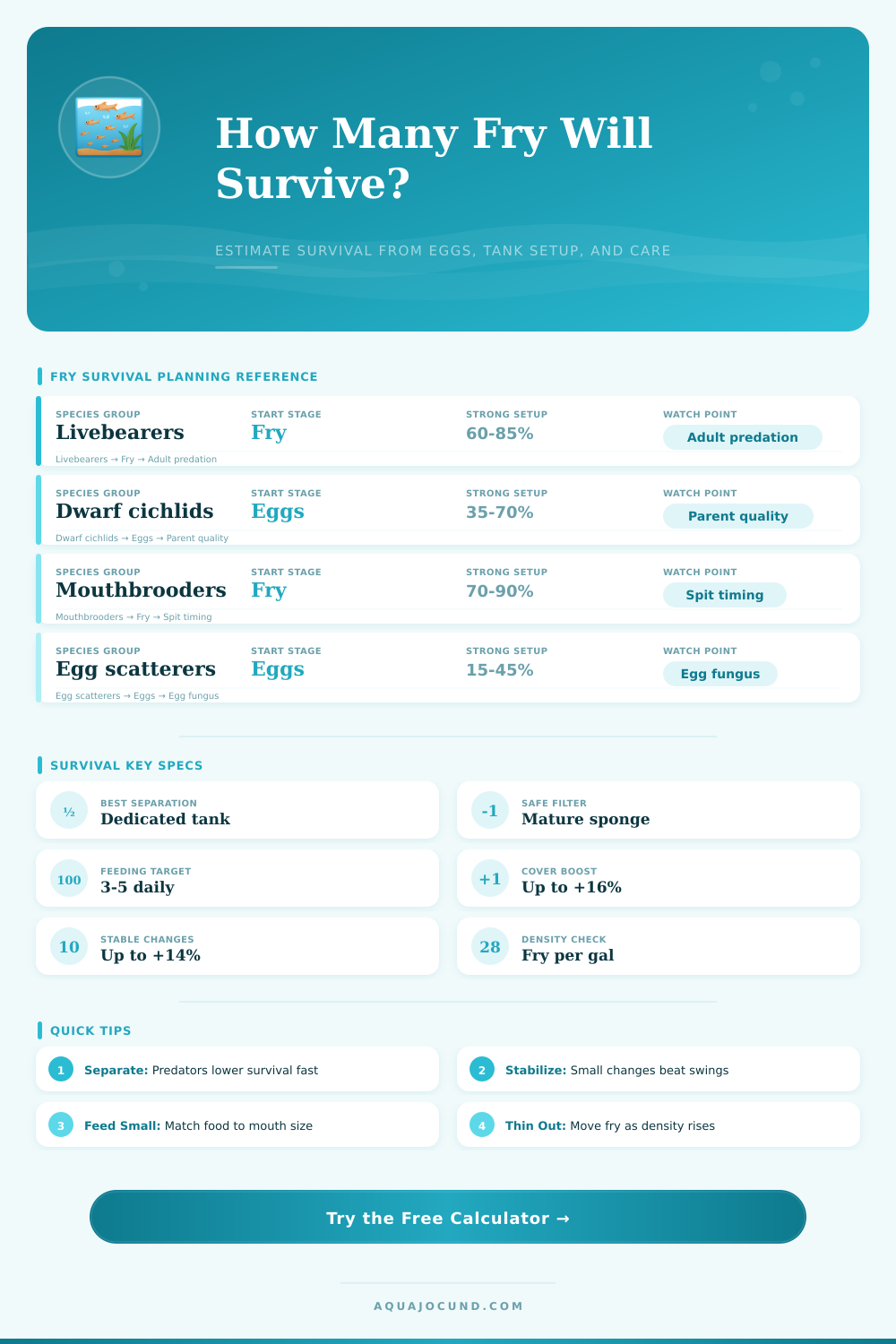
| Species group | Typical starting count | Egg-stage baseline | Free-fry baseline | Density target |
|---|---|---|---|---|
| Livebearers | 15-80 fry | Not common | 80% | 5 fry/gal |
| Dwarf cichlids | 30-120 eggs | 58% | 72% | 4 fry/gal |
| African mouthbrooders | 10-60 fry | 60% | 78% | 4 fry/gal |
| Tetras / danios | 50-300 eggs | 48% | 62% | 6 fry/gal |
| Angelfish / discus | 100-500 eggs | 52% | 68% | 3 fry/gal |
| Labyrinth fish | 80-500 eggs | 45% | 64% | 5 fry/gal |
| Corydoras / small catfish | 20-120 eggs | 62% | 70% | 4 fry/gal |
| Goldfish / pond fry | 100-1000 fry | 38% | 55% | 2 fry/gal |
| Tank | Dimensions | Volume | Light fry load | Heavy grow-out note |
|---|---|---|---|---|
| 2.5 gal nursery | 12 x 6 x 8 in / 30 x 15 x 20 cm | 2.5 gal / 9.5 L | 8-15 fry | Short-term only |
| 5.5 gal tank | 16 x 8 x 10 in / 41 x 20 x 25 cm | 5.5 gal / 20.8 L | 20-30 fry | Thin livebearers early |
| 10 gal tank | 20 x 10 x 12 in / 51 x 25 x 30 cm | 10 gal / 37.9 L | 35-60 fry | Good first grow-out |
| 20 gal long | 30 x 12 x 12 in / 76 x 30 x 30 cm | 20 gal / 75.7 L | 70-120 fry | Better surface area |
| 29 gal tank | 30 x 12 x 18 in / 76 x 30 x 46 cm | 29 gal / 110 L | 90-150 fry | Useful for taller cichlids |
| 40 breeder | 36 x 18 x 16 in / 91 x 46 x 41 cm | 40 gal / 151 L | 140-240 fry | Strong grow-out footprint |
| Factor | Low setting | Middle setting | High setting | Why it matters |
|---|---|---|---|---|
| Predation separation | Community tank | Breeder box | Dedicated tank | Adult fish remove fry quickly |
| Filtration | No powered filter | New sponge | Mature sponge | Fry need oxygen without intake losses |
| Feeding frequency | 1 daily | 3 daily | 5+ tiny meals | Small stomachs need repeated food |
| Cover density | Bare tank | Plants / hides | Dense moss or nursery mesh | Cover protects weak and small fry |
| Water change stability | Irregular swings | Weekly matched | Daily drip or micro changes | Stable temperature and TDS reduce shock |
Raising fish from eggs or fry require that you manage the environment conditions for the fish because the survival of the fish critically depend on these conditions. Many people has experienced a loss of fish from there eggs that have successfully hatched but then failed to survive beyond the period required for the fry to become free swimming from their eggs. The survival of the fish is not always determined by the number of egg that the parent fish have produced.
The survival of the fish is determined by whether or not you provide a proper conditions to the fry. You must understand the different stages of fish development because each stage of development for the fry is associate with a level of risk of the death of the fry. The stage of the fry will determine the amount of loss that you will experience in your tank.
How to Help Baby Fish Survive
For example, if the fry has just hatched from their eggs, you will have a high risk of loss of the fry as they need to absorb the yolk sacs that contains the nutrients that will allow the fry to become free swimming. Once the fry are free swimming, they are more stable than when they are in their egg stage. Additionally, since the free swimming fry have passed the initial bottleneck in their life for survival, they will have a higher chance of survive to the next stage of development.
The calculator incorporate the stage of the fry to determine the survival rate for each stage of fry. Once you have determine the stage of fry in your tank, you can better judge the other variables in the calculator because you understand at which stage of fry the majority of survival will occur. Different species of fish will possess different natural strength and weakness in the survival of their fry.
For example, livebearing fish will produce free swimming fry that can survive longer than egg scattering fish that tend to lay more egg that are susceptible to fungus and other predator fish. Additionally, mouthbrooding and dwarf cichlid fish is more susceptible to water conditions that will kill the fry because they must be very careful with the behavior of their fry when they release them from their mouths. The species of the fish will be used as the foundation for the survival rate estimate for the fry.
Additionally, changing the species of the fish will have a more greater effect on the survival rate estimate than any other variable in the calculator. Tank volume is important for determining the survival of the fry. The volume of your tank will determine the amount of waste that is present in the water and the amount of competition for food among the fry.
Although it is possible to use a small tank for a short time to raise fry, a small tank will become overcrowded as the fry grow. The tank volume and number of fry will be used to calculate if the density of the fry in the tank can cause a decrease in the survival rate of the fry. Filtration and the cover of the tank are two important factor in the survival of the fry.
The filtration will determine the quality of the water, and using a spongy filter will ensure that the tank does not suck the fry into the filter. Additionally, dense moss and mesh will provide areas for the fry to hide from other, stronger fry. These two factors will be accounted for in the calculator to make sure that the fry will not die from poor water quality or being eaten by other fry in the tank.
Additionally, separating the fry from the adult fish will ensure that the parent will not eat the fry while they are still in their fry stage. Feeding frequency is important for fry because their stomach are small. Therefore, they will need to be fed frequently to ensure that they do not drop from starvation.
Feeding the fry only once each day will result in measurable loss of the fry. Additionally, water change will need to be stable so that sudden changes in temperature or chemistry of the water do not shock the fry. The parameters for feeding and water changes will be used in the calculator as factors that ensure the survival of the fry.
The reference table contain the information for the survival rates of the different species of fish in tanks of different sizes. These tables are not the substitute for the survival rate calculator. The reference tables will provide information regarding the survival of the fry from the eggs, but if your calculated survival rate is lower than the rate in the reference tables, there will be a breakdown of which factor is causing the lower survival rate for your tank.
This will allow you to decide what change you may need to make to your fry tank. The survival rate calculator will provide you with a clear picture of the survival of your fry. However, there will always be a variable outside of the calculator that may impact the survival of the fry.
For instance, the parent fish may eat their own fry, or there may be a glitch with the heater that results in the death of the fry due to exposure to too cold water. The calculator will show you the different area in which you can provide extra attention to ensure the survival of the fry. Additionally, by watching the numbers shift as you change a certain variable in the calculator, you will have a better understanding of the survival of the fry.
Most successful breeder understand that the key to raising fry is to keep the environmental conditions steady so that the fry can survive to the point where they no longer pose a threat to the adult fish.