🐟 Fry Feeding Amount Calculator
Estimate tiny fry meals from live count, age, length, food type, and water fouling risk.
Feeding Estimate
| Food type | Solids used | Fouling index | Best stage | Calculator note |
|---|---|---|---|---|
| Fine powdered fry food | 92% | 1.00 | Early to juvenile | Dense nutrition, easy to overfeed |
| Micronized starter powder | 92% | 1.12 | First free-swim | Very fine particles stay suspended |
| Rinsed baby brine shrimp | 18% | 0.72 | Early grow-out | Live movement improves capture rate |
| Decapsulated brine shrimp eggs | 95% | 1.18 | Early to mid grow-out | Nutritious but uneaten eggs foul quickly |
| Rinsed microworms | 12% | 0.92 | Small bottom-feeding fry | Useful when fry graze low in the tank |
| Infusoria / greenwater | 1.5% | 0.55 | Tiny first foods | Large liquid volume for little dry nutrition |
| Egg yolk slurry | 8% | 1.55 | Emergency first food | Use sparingly because it clouds water fast |
| Crushed high-protein crumble | 90% | 1.08 | Juveniles | Only after fry can take larger particles |
| Stage | Typical age | Daily dry target | Meal count | Visual check |
|---|---|---|---|---|
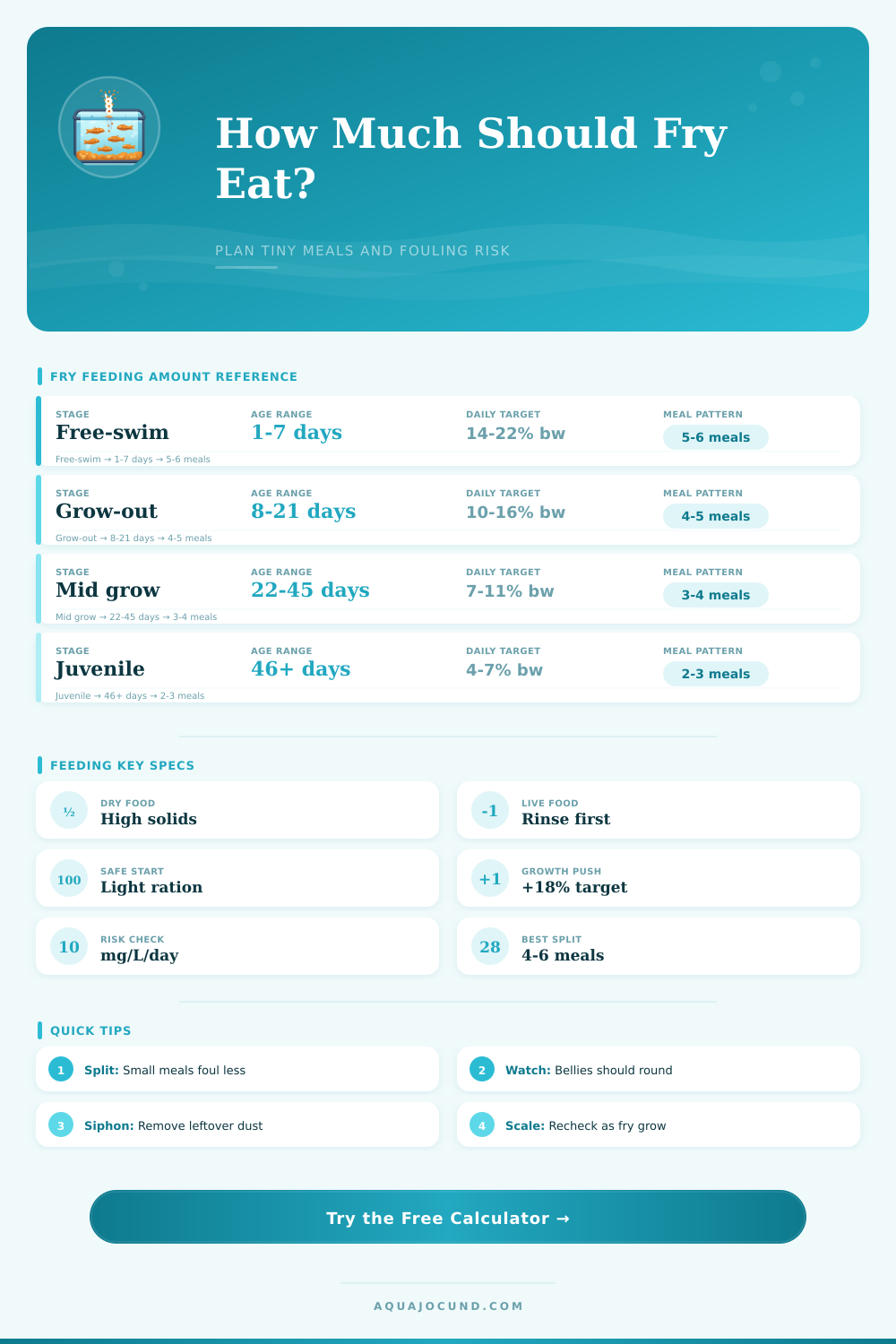
| First free-swimming | 1-7 days | 14-22% body weight | 5-6 | Slightly rounded bellies |
| Early grow-out | 8-21 days | 10-16% body weight | 4-5 | Food gone within minutes |
| Mid grow-out | 22-45 days | 7-11% body weight | 3-4 | Steady growth without haze |
| Juvenile | 46+ days | 4-7% body weight | 2-3 | Transition to larger foods |
| Tank | Volume | Low-risk offered load | Caution zone | High-risk signal |
|---|---|---|---|---|
| 2.5 gal nursery | 9.5 L | Under 8 mg/day | 8-18 mg/day | Clouding after meals |
| 5.5 gal tank | 20.8 L | Under 18 mg/day | 18-38 mg/day | Film or bottom dust |
| 10 gal tank | 37.9 L | Under 34 mg/day | 34-75 mg/day | Ammonia after feeding |
| 20 gal long | 75.7 L | Under 70 mg/day | 70-150 mg/day | Uneaten food pockets |
| 40 breeder | 151 L | Under 140 mg/day | 140-300 mg/day | Persistent haze |
| Profile | Typical first-food size | Example length | Estimated weight | Feeding note |
|---|---|---|---|---|
| Tiny egg-layer fry | Infusoria to micro powder | 4-6 mm | 0.5-2 mg | Very small meals, high frequency |
| Livebearer fry | Powder or baby brine shrimp | 6-10 mm | 2-12 mg | Strong eaters after birth |
| Cichlid fry | Baby brine shrimp | 5-12 mm | 2-20 mg | Growth push needs clean water |
| Cory / catfish fry | Microworm, powder, BBS | 5-12 mm | 3-24 mg | Bottom leftovers must be removed |
| Goldfish / pond fry | Greenwater to crumble | 8-18 mm | 8-90 mg | Volume demand rises quickly |
Feeding newly hatched fry can be a delicate operation as it is up to you to ensure that they don’t starve themselves to death. Once the fry has absorbed all of their yolk sacs, they’ve burned through there reserves and haven’t yet learned how to capture prey. It’s therefore important to feed just enough to sustain growth (and prevent the fry from poisoning the water before your filtration kicks in). Get this right and they’ll live; get this wrong, and they’ll foul up the tank. After entering your tank size and number of fry, the calculator figure out the rest. You don’t have to guess or play with numbers anymore… you can focus on their health instead.
Fry food isn’t all created equal. Most of us lump everything together and assume that it will perform identicaly in the aquarium. That’s simply not true. Food density is as important as, or even more important than, quantity. A few pinches of dry food contain a large percentage of solid nutrition. This means fewer flakes or pellets is necessary to feed the same number of fish without instant cloudiness. Conversely, live foods such as baby brine shrimp has minimal dry mass by weight. They’re primarily water, meaning more volume are required to achieve the same level of nutrition. Knowing this helps you accuratey estimate food consumption during every meal.
How to Feed Your Baby Fish Correctly
The first couple of weeks follow a rigid rule when it comes to age and appetite. Babies may need almost 20% of their body weight in food per day to meet their fast pace of growth. As they mature into juveniles, that number gradually declines until it reach around five percent once they are fully grown. The calculator helps break it down according to life stage, although you’ll want to watch your fish themselves to ensure the percentages seem reasonable. Are their bellies rounded immediately following a feeding? Is the water clear an hour later? If so, you’re probably getting it about right. Do you notice a haze in the tank or any substrate-dwelling dust collecting? Then you fed too much, even if the math say otherwise.
The second factor is filtration. How well can your set up handle waste without spiking ammonia? Biological stability + mechanical filtration (mature sponge filters) = slightly more wiggle room for feeding vs. Bio-only setups use an air stone and a bare bucket. The calculator takes your filtration type into account as it guesses fouling danger… I.e., lets you know when water quality will decline. Why is this important? Most hobbyists obsess over growth rate while neglecting the fact that ammonia toxicity kills fry at a quicker pace then starvation. If the water chemistry goes belly-up, there’s no rushing it.
Most fish graze throughout the day rather than eat a single big meal, so breaking up the day’s feed into multiple smaller ones is frequentely more appropriate. This also eases the load on your filter media. It also allows you to make adjustments during the day, such as if the fry don’t seem interested in eating or are acting sluggish. For example, some species are aggressive eaters, such as many cichlids; which will eat everything in sight. Other species, such as certain catfish fry, require live food that sinks slow enough for them to catch. Use the tool to choose a species profile that accounts for how they hunt, so the portion size reflects their hunting style.
Biological filters also need time to mature. This is especially true of new tanks. If you have a new tank, it’s best to start with less than what the calculator recommends. You should of done this until your water parameters are steady and you see that your fry are consistently full, rather than swimming around with bloated bellies. Then once the system settles down again, gradually increase food rations to promote quicker growth. Watching and waiting is the name of the game here.
Of course you want your fish growing, but you really want them livig too. So adjusting food rations to match the load the tank can support is how you create an environment for success (not just survival). And yes, it’s all about the bellies…and the water…watching both as closely as possible.