Frag Tank Volume Calculator
Estimate operating tray volume after freeboard, rack displacement, frag plugs, sump connection, turnover target, and coral zone depth.
Calculation Breakdown
| Item | Calculator value | Typical use | Volume effect |
|---|---|---|---|
| Standard eggcrate | 0.18 in solid equivalent | Light frag shelf | Low to moderate |
| Heavy eggcrate | 0.28 in solid equivalent | Large racks, dense plugs | Moderate |
| Acrylic frag rack | 0.22 in solid equivalent | Clean show trays | Moderate |
| Ceramic tile grid | 0.45 in solid equivalent | Heavy grow-out bases | High |
| Standard plug | 0.020 gal each | 1 in stem plug | Count sensitive |
| 2 in tile | 0.050 gal each | LPS and encrusters | High per frag |
| Tray size | Dimensions | At 8 in depth | At 10 in depth |
|---|---|---|---|
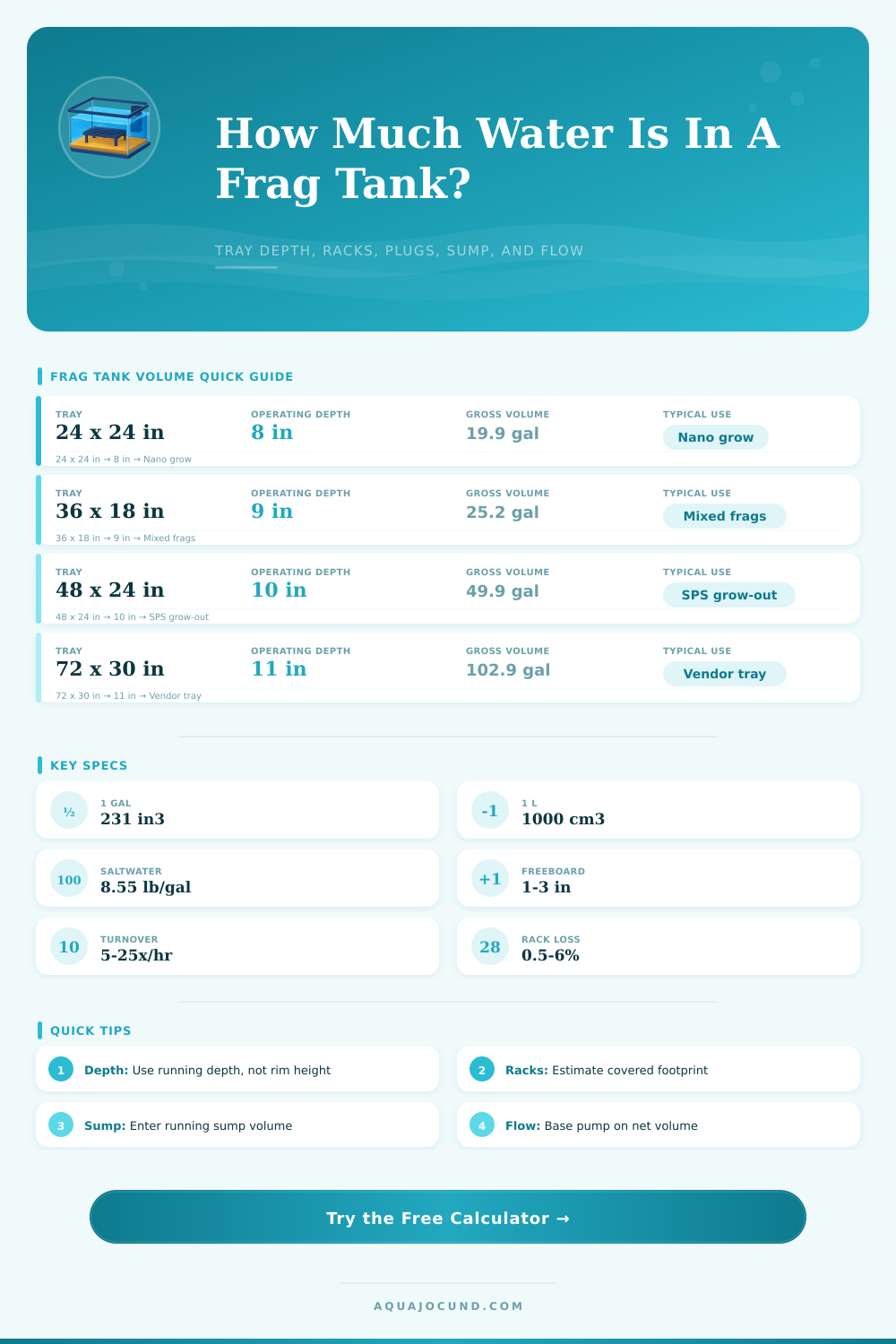
| Cube frag tray | 24 x 24 in / 61 x 61 cm | 19.9 gal / 75 L | 24.9 gal / 94 L |
| 40 breeder style | 36 x 18 in / 91 x 46 cm | 22.4 gal / 85 L | 28.1 gal / 106 L |
| Low boy 50 | 48 x 24 in / 122 x 61 cm | 39.9 gal / 151 L | 49.9 gal / 189 L |
| Wide lagoon | 60 x 24 in / 152 x 61 cm | 49.9 gal / 189 L | 62.3 gal / 236 L |
| Vendor tray | 72 x 30 in / 183 x 76 cm | 74.8 gal / 283 L | 93.5 gal / 354 L |
| System style | Typical depth | Freeboard | Turnover target |
|---|---|---|---|
| Soft coral / mushroom tray | 7-9 in / 18-23 cm | 1.5-2.5 in | 5-8x/hr |
| Zoa garden tray | 8-10 in / 20-25 cm | 1.5-2.5 in | 8-12x/hr |
| LPS lagoon tray | 9-12 in / 23-30 cm | 2-3 in | 6-10x/hr |
| Mixed coral grow-out | 9-11 in / 23-28 cm | 2-3 in | 10-15x/hr |
| SPS high-flow tray | 8-11 in / 20-28 cm | 2-3 in | 15-25x/hr |
| Frag quarantine tray | 7-10 in / 18-25 cm | 2-3 in | 5-10x/hr |
| Conversion | Value | Use in this calculator | Note |
|---|---|---|---|
| Cubic inches to gallons | 231 in³ = 1 gal | Imperial tray volume | Exact US liquid gallon |
| Liters to gallons | 3.785 L = 1 gal | Metric output | US liquid gallon |
| Cubic centimeters to liters | 1000 cm³ = 1 L | Metric tray volume | Direct volume conversion |
| Saltwater weight | 8.55 lb/gal | Water load estimate | Approximate reef salinity |
So you read the spec sheet and buy a tray. Fifty gallons it says. Fill ‘er up, right? But your pump isnt really moving any water off the surface.
So you stack three racks, load eighty plugs, and connect a sump that holds twenty more gallons of stagnant water. Now you’ve got three racks with eighty plugs total and a sump holding an additional twenty gallons of still water. Your stand’s weight just increased alot, but you has much less actual space for your corals. Most frag systems fail before they ever get started due to this disparity between what the nominal tank size is and what the true operating volume are.
Stop Guessing Your Tank Size
It’s a matter of displacement. Saltwater weighs about 8 1/2 lbs/gallon, which is heavier than regular water. And that’s if you’re not accounting for hard mass of ceramic tiles or eggcrate. Not only are you undervaluing weight, you’re overvaluing the volume of the tank to begin with.
Depending on how much equipment you have, you can lose several percentage points in usable water due to gear alone. All of this is happening in a shallow tray. On paper this sounds like a minor deduction. In reality it translates into poorer mixing and lower flow rates.
Rack height isnt everything. Some builders use the glass interior rim as their measuring point (i.e., from glass bottom to rim). Then they fill ‘er up until lip overflows. That is a bad idea because you will spill and wont get good light penetration. So what’s the operating depth? That is what you want to know.
The water column is over your coral. Your safety margin is the freeboard. If you’re not sure about the depth of the coral zone, will you give your zoanthids a shadow bath or hit your SPS with the correct intensity? The math on that is handled above after you establish vertical limits. No need to guess at how much space racks consume.
Not all turnover rates are created equal. For example, soft coral do best in low water flow where there’s just enough current to remove detritus from their surface but not so much as to blow them away. Conversely, aggressive flow is required by SPS polyp heads to remove detritus and move food particles towards their mouths.
So what about a mix? You have to make a compromise that’ll be too fast for your hardy corals and too chaotic for your delicate ones. That’s why you see the table on the page has two reference columns. High flow trays can tolerate upwards of twenty-five times their volume per hour, whereas soft systems may only need five times their volume per hour.
If you use a pump based off the gross volume alone, it’s guaranteed that you’ll have either wet coral (or one with dead polyps) or splashing water everywhere. Another level of complication is added by sumps. Although sumps are required to heat and filter, sumps also serve to dilute your turnover rate. For example, if your display tank is twenty gallons and your sump is thirty, then one turnover of the entire system would require moving fifty gallons. This means you need more powerful pumps and larger pipes than you would expect by just looking at display tank.
Material displacement matters too. An open gridded standard eggcrate is lightweight and takes up very little space in the tank. Solid block materials like heavy ceramic tiles or thick acrylic shelves take much greater displacement. Hundreds of small displacements add up fast when you’re keeping a vendor style tray loaded with dense plugs. Every plug pushes water out a bit. Times that by eight or a hundred and youve lost half a gallon or more without even putting one drop of salt in your tank.
This brings up the topic of weight. Which we tend to forget. That big, heavy, frag rack sits atop a stand that might not handle 50 lbs of dynamic loading. That is what happens when water moves (as it does during maintenance and even pump failure). Knowing how much weight you have will help you get the thing fastened down correctly. It will also help you decide how much heating capacity you need because heating a big thermal mass require more power than heating a little column.
Most folks begin their journey with the best of intentions and end up overcomplicating things when it comes to plumbing. We become enamored with fancy flow rates and numbers that sound impressive without taking into account the biological fact that they’re in shallow water columns. Your frag tank isnt a display piece. It’s a growth factory. Match your actual water volume to your hardware instead of what the manufacturer says you should of had based on the size.
First, identify what you’d like to grow in the tank. Identify their growth requirements (e.g., depth). Determine how big the tray is going to be (including racks), sitting on the bench. How much space does this take up? Subtract amount used for plugs and other gear. If you are using a sump, add its volume. Now size your pump.
It sounds cumbersome but it keeps you from making so many mistakes. When you calculate volume correctly, the project goes from being one of guesswork to something you can manage, where corals not only survive but actualy thrive. You end up having better water movement, less splashing, and a system that works as designed from the very first day.