Frag Plug Count Per Rack Calculator
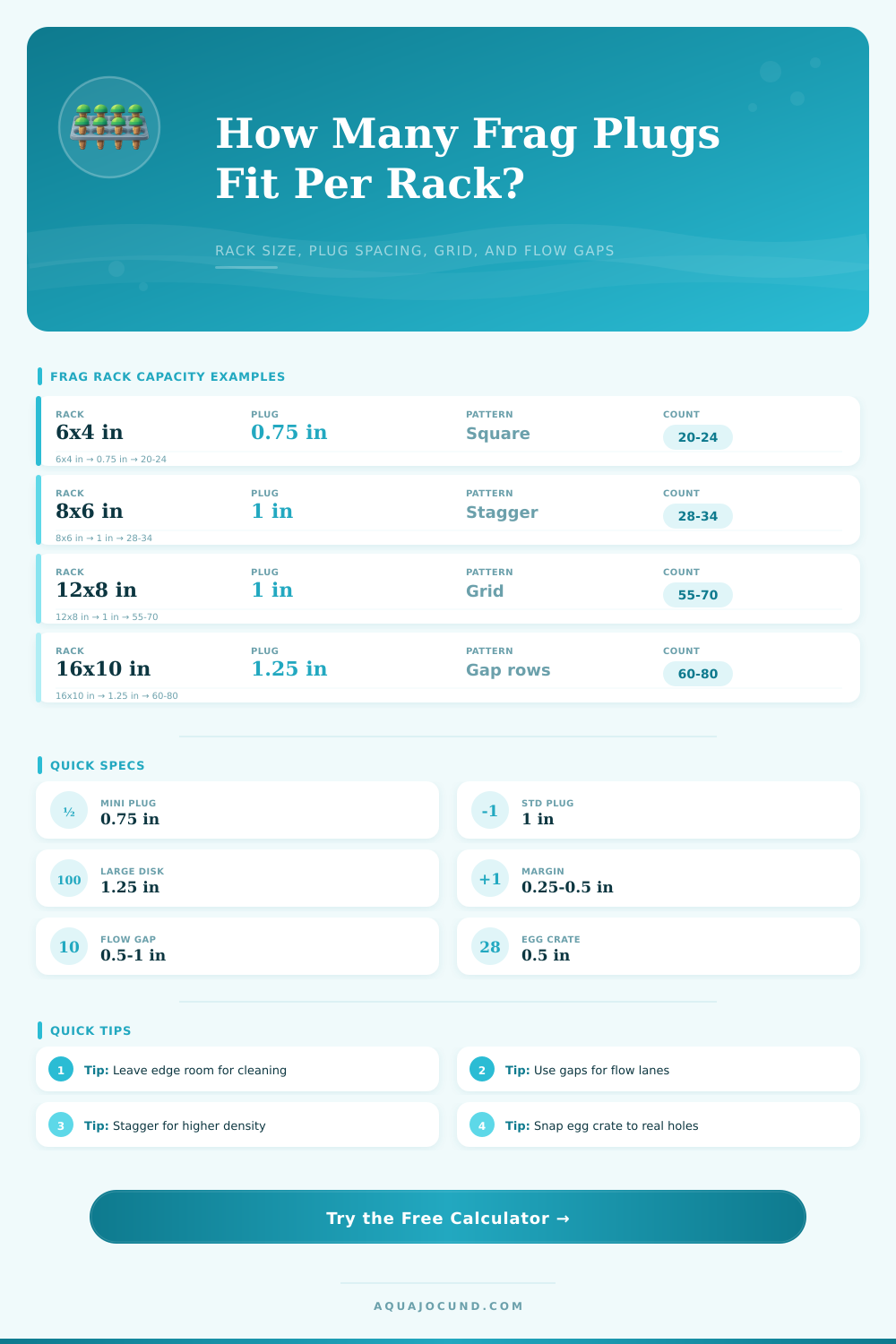
Estimate how many coral frag plugs fit on a rack after plug diameter, spacing, edge margin, flow lanes, egg-crate hole pitch, stagger pattern, unusable zones, and tiers.
Calculation Breakdown
| Row Group | Rows | Typical Columns | Slots Before Loss | Flow Gap Note |
|---|
| Plug Type | Typical Top Diameter | Starting Spacing | Rack Note |
|---|---|---|---|
| Mini ceramic plug | 0.75 in / 1.9 cm | 0.25-0.35 in / 0.6-0.9 cm | Good for dense SPS growout and small magnetic racks. |
| Standard frag plug | 1.00 in / 2.5 cm | 0.30-0.50 in / 0.8-1.3 cm | Most common default for mixed coral racks. |
| Wide frag disk | 1.25 in / 3.2 cm | 0.40-0.65 in / 1.0-1.7 cm | Better for encrusting frags and moderate growout room. |
| Large LPS disk | 1.50 in / 3.8 cm | 0.75-1.25 in / 1.9-3.2 cm | Use lower density so fleshy corals do not touch. |
| Square tile | 1.00 in / 2.5 cm side | 0.25-0.50 in / 0.6-1.3 cm | Square rows usually waste less space than staggered rows. |
| Rack Name | Footprint | Typical Pattern | Usable Capacity Range |
|---|---|---|---|
| Nano magnetic rack | 6 x 4 in / 15 x 10 cm | Square or egg-crate | 10-20 standard plugs with margin. |
| Desktop growout rack | 8 x 6 in / 20 x 15 cm | Odd-row stagger | 25-35 standard plugs depending on gaps. |
| 20 long egg-crate shelf | 11 x 8 in / 28 x 20 cm | Snapped grid | 45-65 mini or standard plugs. |
| 40 breeder shelf | 14 x 9 in / 36 x 23 cm | Stagger with lanes | 55-85 standard plugs. |
| Vendor tray insert | 18 x 12 in / 46 x 30 cm | Square rows | 80-140 plugs by spacing target. |
| Layout Goal | Open Spacing | Flow Gap Plan | Best Use |
|---|---|---|---|
| Maximum holding density | 0.20-0.35 in / 0.5-0.9 cm | No gap or every 5 rows | Short-term holding, uniform small SPS frags. |
| Mixed growout | 0.35-0.60 in / 0.9-1.5 cm | 0.5-0.75 in gap every 3-4 rows | Balanced access, flow, and capacity. |
| LPS or soft coral room | 0.75-1.25 in / 1.9-3.2 cm | 0.75-1.25 in gap every 2-3 rows | Allows expansion and reduces contact risk. |
| High-flow egg-crate shelf | Grid skip sets spacing | Leave a full open row group | Works well under gyre or cross-flow pumps. |
| Grid Pitch | Hole Skip | Center Spacing | Capacity Impact |
|---|---|---|---|
| 0.50 in / 1.27 cm | Every hole | 0.50 in / 1.27 cm | Only works for stems or very small tops. |
| 0.50 in / 1.27 cm | Every 2 holes | 1.00 in / 2.54 cm | Dense standard plug stem layout. |
| 0.50 in / 1.27 cm | Every 3 holes | 1.50 in / 3.81 cm | Good for normal plug heads with clearance. |
| 0.63 in / 1.60 cm | Every 2 holes | 1.26 in / 3.20 cm | Useful on heavier diffuser or printed grids. |
The tool eliminates mental math when planning tanks or shopping for new equipment online because you simply plug in your specs and dimensions, and the tool will calculate what fits in your rack. But don’t stop with the number. Most people gets caught up thinking about density (the number of items per inch) without considering flow and light penetration through corals. Corals requires water movement to remove waste and other elements and to allow light to reach them.
The beauty is the tool does this for you, so you only have to worry about the geometry of space. However, you still need to consider whether what you plan for your tank will meet there biological requirements, rather than just maximizing the number of items on a shelf.
Why Space and Flow Are Important for Corals
While most of us do this to conserve space, leaving an edge margin is worth it and should of been part of your design plan. A half inch creates a big difference in your day-to-day maintenance. Not only does it make feeding and trim jobs easier, but it also provides enough clearance for reaching under a plug with tweezers without scratching tank glass or the shelf itself. It also ensures no algae has anywhere to grow in hidden dead zones cast by farthest frags on the rack.
This is a rockin’ rack because plugs in a solid block can acts like a dam that blocks current flow, which is important for flow gaps. Although your display may photograph nicely, a solid block of plugs act like a dam, forcing water to trickle over the top like a waterfall instead of sweeping through the rack. With this tool, you control both gap width (i.e., more or less debris clearance) and frequency, providing a nice balance between water flow and density. While narrower gaps conserve some space, they limit debris clearance considerably; lower frags tends to have poor hygiene and tissue recession.
The layout works this way: to get the most out of your available space, staggering rows provides a workaround; the same number of centers in less vertical space but no decrease in horizontal space. This becomes most important if you’re using normal one-inch plugs and any quarter inch less clearance means constant stress rather than healthy polyp extension. The calculator models these shifts, which lets you visually compare how many extra slots you get by moving away from a strictly square grid.
The problems with egg crate diffusers come from the fact that you’re constrained to plugging only in locations where there is an existing hole… And sliding a plug into any location you wish isnt possible. Because your options are limited to matching up with existing holes in the plastic grid, skipping every other or third hole (which drastically lowers the number of frags) can actualy increase the health of each individual frag by improving water flow and less mutual shading. This skip interval is taken into account by the tool, such that you’re not second-guessing if a plug will fit through the mesh or perch dangerously atop it.
While many of us love to pack as much as we can into a rack, this isn’t necessarily best practice when it comes to keeping corals growing long term. Just because you stuffed 6 frags into an area doesn’t mean it will work well after a month. You could have just enough flow so that they all look good for a while, except one coral suffer and loses most of its tissue, leaving nothing at the bottom tier. Allowing them space to move will allow each frag to recieve what it needs to grow.
Plan your tank carefully now. This will help you buy the right amount of stock and ensure you don’t end up with extra frags that die soon because of how your system runs. This saves you money.