🐟 Food Cost Per Feeding Calculator
Estimate aquarium feeding spend from livestock biomass, ration percentage, feedings per day, package size, edible yield, moisture, and uneaten waste.
| Food type | Typical yield | Moisture correction | Best fit |
|---|---|---|---|
| Micro pellet | 92-98% usable, low dust | 1.00 dry fed-as | Betta, nano fish, tetras, rasboras |
| Tropical flake | 82-92% usable after fines | 1.00 dry fed-as | Community fish that feed at the surface |
| Sinking wafer | 88-96% usable if target fed | 1.00 dry fed-as | Shrimp, corydoras, plecos, snails |
| Gel food | 75-90% after mixing and trimming | 1.30 soft hydrated portion | Goldfish, grazers, medicated feeding |
| Cichlid pellet | 90-97% usable, size dependent | 1.00 dry fed-as | Mbuna, peacocks, Oscars, large community fish |
| Frozen cube | 60-80% after thaw water is discarded | 2.50 drained wet portion | Reef fish, picky fish, conditioning diets |
| Marine pellet | 90-96% usable if quickly eaten | 1.00 dry fed-as | Clownfish, wrasses, damsels, marine community |
| Koi pellet | 88-96% usable with skimmer loss | 1.00 dry fed-as | Pond fish, koi, large goldfish |
| Livestock group | Daily ration | Feedings | Cost note |
|---|---|---|---|
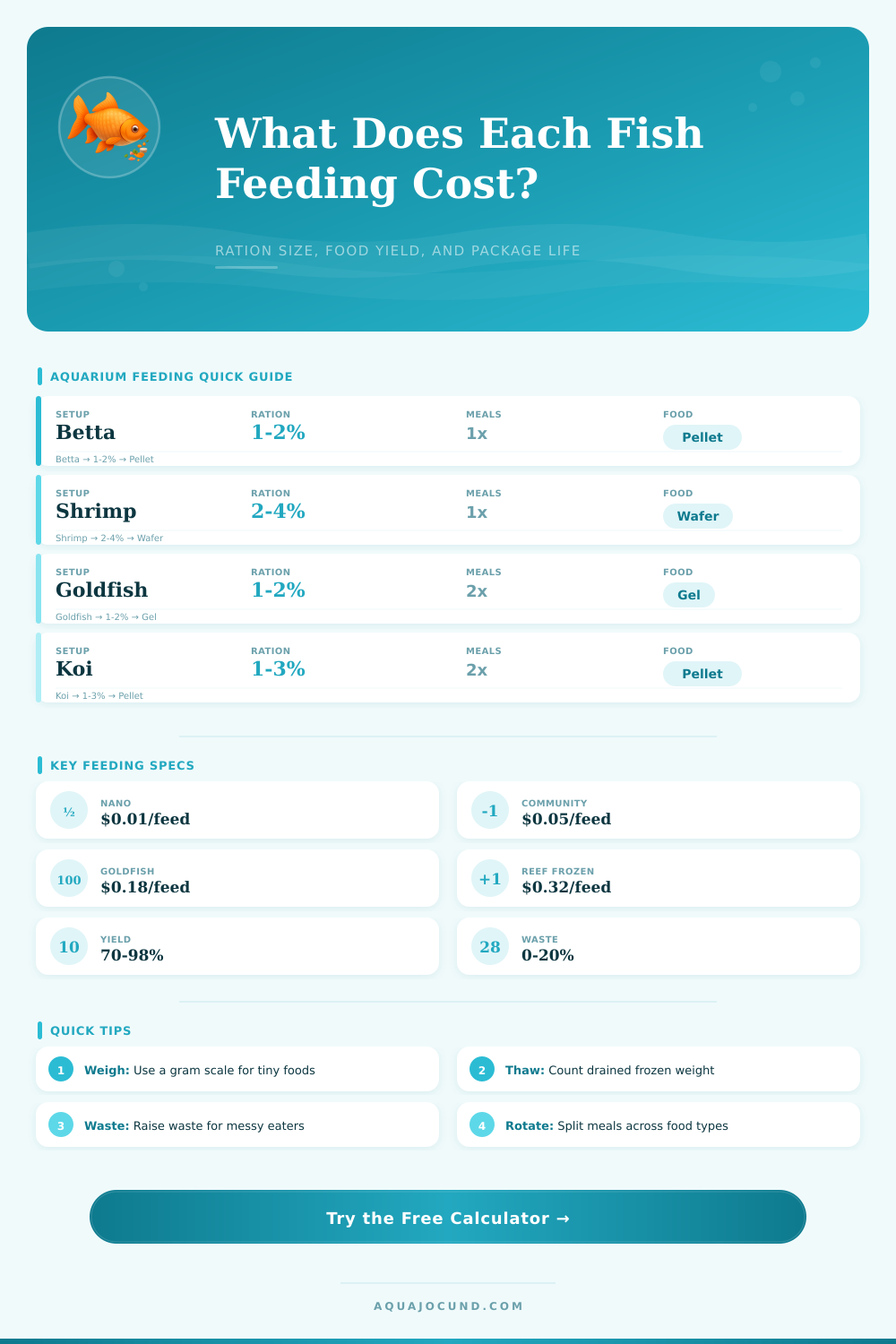
| Betta or gourami | 1.0-2.0% body weight | 1-2 small meals | Tiny meals make package freshness more important than package size. |
| Nano shrimp colony | 2.0-4.0% of estimated biomass | 1 target meal or alternate days | Remove leftovers; slow grazing can hide overfeeding. |
| Small community fish | 1.5-2.5% body weight | 1-2 meals | Flake dust increases cost per eaten gram. |
| Goldfish | 1.0-2.0% adult, more for juveniles | 2 meals | Gel and pellet waste should be counted if food breaks apart. |
| Cichlids | 1.0-3.0% depending on size | 1-3 meals | Large pellets can be efficient when the size matches the fish. |
| Reef community | 1.0-3.0% plus coral/frozen rotation | 1-3 meals | Frozen foods often have the highest loss from thaw water. |
| Koi and pond fish | 1.0-3.0% in warm water | 1-4 meals | Seasonal temperature changes can halve or double daily food. |
| Setup | Example biomass | Meal size | Typical food plan |
|---|---|---|---|
| 5 gallon betta | 1 fish at 2-4 g | 0.02-0.06 g dry food | Micro pellets, occasional frozen or gel treat |
| 10 gallon shrimp tank | 40-80 shrimp, estimated 6-12 g | 0.10-0.35 g wafer | Wafer fragments, biofilm support, blanched foods |
| 20 gallon community | 20-35 g small fish | 0.20-0.60 g flake or micro pellet | Two small meals, one fasting day weekly |
| 40 breeder goldfish | 120-220 g fancy goldfish | 1.0-2.5 g gel or pellet | Split meals to reduce waste and buoyancy problems |
| 75 gallon cichlid tank | 250-600 g active fish | 2.5-9.0 g pellet | Vegetable-forward or protein-forward by species |
| Mixed reef fish | 60-180 g marine fish | 0.8-4.0 g frozen wet food | Frozen plus pellet rotation, rinse if nutrients climb |
| Comparison point | Low-cost pattern | Higher-cost pattern | What the calculator adjusts |
|---|---|---|---|
| Package yield | Efficient pellets eaten whole | Waste risk dusty flakes or thaw water | Edible yield, spoilage, and uneaten food percentages |
| Meal frequency | One precise target feeding | Several broadcast feedings | Feedings per day and fasting days per week |
| Fish biomass | Small adults at maintenance ration | Juveniles, breeding fish, warm pond fish | Body weight, ration percent, and growth adjustment |
| Diet rotation | Main staple covers most meals | Specialty frozen or live food every day | Share of this food in the weekly diet |
| Water load | Clean eaters, all food consumed | Messy fish, rich frozen food, pond skimmer loss | Water-quality load multiplier and leftover warning |
Did I mention that your high quality pellets or frozen mysis seem to last for just a few weeks? You only feed your fish twice a day, yet there’s barely half a bag left. It’s one of those mysteries in the hobby. “Well, obviously frozen mysis costs more money because it’s more convenient! I get 1/4 cup per scoop, so that’s 16 servings, right? At two times a day, it cost $1 per day. That math doesn’t account for the invisible factors that suck your wallet dry.
Just plug your biomass and ration percentages into the calculator above to do the math. No need to guess if your expensive flake really saves money compared to the plain old flake sitting nearby.
Stop Guessing: Calculate Your Real Fish Food Cost
First, let me say that not all grams is alike. A gram of dried micro pellet will basically fall on floor or go in fish’s mouth, while a gram of frozen food goes into your tank as both nutrients and water (which also weighs something). That water only contributes to the physical volume of the package; it doesn’t contribute anything towards the nutritional value. So if you don’t take the water content of your food into account, you’re going to wildly understate how rapidly the valuable portion goes missing. This may seem like a minor point of physics, but it makes a huge difference in your wallet.
You can choose to correct for the water content and amount of edible material, which means you know exactly what’s costing you money when it enters the tank. Then there’s the waste factor, where most of your budget leaks. You pour in food and watch your fish go to town. Nothing goes to waste. Or so you think.
Before your fish eats it, some of those tiny flake dissolve. Some sinking wafers crumble when the target audience doesn’t quickly show up. Even if you’re a careful feeder, all that food creates dust that settles on your substrate. Estimate what fraction of your food never becomes fish meat. For active cichlids and/or messy eaters such as goldfish, that number rise a lot. The calculator prompts you for your observed leftover rate. Be honest (not hopeful) about what you see down there. Being honest means knowing what your actual daily spend is.
Another way to think about this is package life. Sometimes, a big package of something look cheaper by the ounce, but you’ll have leftovers sitting around in your pantry for months at a time, where it degrades in quality and sticks together, wasting more of it. Often, small packages will yield more of the actual good stuff than huge bags that go bad before you can use them up. The calculator estimates how many days your remaining package will last using your adjusted feedings. This lets you choose between saving money now with bigger purchases or having ingredients as fresh as possible. Turns out, sometimes, a little less convenience pays off when you don’t end up wasting as much.
The math also hinges on biomass calculations. Rather than data, it’s tempting to gauge how much to feed by habit. How often have you guessed? But if you know roughly how many fish you keep and their combined weight, everything that follow becomes more precise. A nano shrimp colony weighs almost nothing; therefore, their meal size are measured in fractions of a gram. In contrast, during warm weather, an entire pond of koi can consume pounds of food. Knowing your total estimated livestock weight allows you to scale the ration percentage accordingly, ensuring you aren’t feeding your fish based off bowl size, but rather appetite size. This principle scales from smallest betta tank to biggest outdoor feature.
The next wrinkle is diet rotation. Most fish don’t eat only one thing all year round. They supplement their diets with veggies and other frozen goodies. They buy a bag of pellets to use as a base, then vary it up with treats. To account for this, you can specify what percent of every week’s diet consists of each food. That way, if you have an expensive food that spikes the average but also have a cheap staple that makes the average appear lower, it won’t skew the result. Instead, you’ll get a blend of your true spending, not an idealized picture of what you’d like to spend. It represents how you actualy feed your tanks, not how you wish you would feed them.
If you’re keeping fish, this is the only way to eliminate the guesswork out of maintaining an aquarium. No longer do you have to ask yourself why am I spending so much on my food? Instead you’ll know exactly where it’s going. If you want healthy juveniles or you keep lean adults in a reef set up, knowing how much a single feeding actually costs gives you control over your water quality and your wallet. Knowing what you’re really measuring is most of the trick.
Then once you can see those numbers it makes feeding less of a chore and more of a precise exercise. Often you’ll save money by feeding smarter and not necessarily buying the cheapest brand. This shift in thought process makes each feed a calculated decision versus an automatic dump.