Fluidized Reactor Flow Rate Calculator
Estimate the pump flow needed to lift aquarium reactor media from media mass, grain size, tube diameter, bed depth, desired expansion, pump head, and valve loss.
⚙Unit system and reactor presets
📏Reactor and media inputs
🌊Media fluidization comparison grid
🧪Fluidized reactor media reference
| Media type | Typical size | Bulk density | Expansion style | Calculator note |
|---|---|---|---|---|
| Granular ferric oxide | 0.3-1.0 mm | 50 lb/ft³ | 10-25% | Use gentle boil to protect grains. |
| Activated carbon | 1-3 mm | 28 lb/ft³ | 5-20% | Fluidize lightly after fines are rinsed. |
| Biopellets | 2-4 mm | 40 lb/ft³ | 35-60% | Needs rolling tumble, not a packed column. |
| K1 moving bed | 8-10 mm | 9 lb/ft³ | 40-80% | Wide reactors reduce channeling. |
| K3 moving bed | 10-12 mm | 8 lb/ft³ | 45-85% | Large media prefers higher freeboard. |
| Hel-X bio media | 12-13 mm | 7 lb/ft³ | 40-75% | Use a coarse top screen. |
| Zeolite chips | 2-5 mm | 44 lb/ft³ | 20-40% | Moderate lift avoids chip abrasion. |
| Fine reactor sand | 0.4-0.8 mm | 90 lb/ft³ | 20-45% | Check outlet screen before increasing flow. |
💨Flow range by reactor diameter
| Inside diameter | Cross-section | Gentle media | Tumble media | High-lift media |
|---|---|---|---|---|
| 2 in / 5.1 cm | 3.14 in² | 8-16 gph | 18-28 gph | 30-45 gph |
| 2.5 in / 6.4 cm | 4.91 in² | 12-25 gph | 28-44 gph | 47-70 gph |
| 3 in / 7.6 cm | 7.07 in² | 18-35 gph | 40-64 gph | 67-100 gph |
| 4 in / 10.2 cm | 12.57 in² | 31-63 gph | 70-113 gph | 119-178 gph |
| 6 in / 15.2 cm | 28.27 in² | 71-141 gph | 158-254 gph | 268-400 gph |
🐟Common aquarium reactor presets reference
| System use | Typical reactor | Media charge | Expansion target | Starting flow |
|---|---|---|---|---|
| Nano phosphate polish | 2 in tube | 0.25 lb GFO | 15% | 8-14 gph |
| 10 gal carbon chamber | 2 in tube | 0.20 lb carbon | 10% | 10-18 gph |
| 20 long pellet reactor | 2.5 in tube | 0.65 lb pellets | 45% | 35-50 gph |
| 40 breeder zeolite reactor | 3 in tube | 1.2 lb zeolite | 30% | 42-65 gph |
| 75 reef GFO reactor | 3 in tube | 0.9 lb GFO | 20% | 25-42 gph |
| 125 display bio reactor | 6 in tube | 2.5 lb Hel-X | 60% | 210-300 gph |
🔧Adjustment factors for clean tuning
| Condition | Flow adjustment | Reason | When to recheck |
|---|---|---|---|
| New sponge or screen | Add 5-10% | Break-in raises restriction | After 24 hours |
| Fine media dust | Subtract 10-20% | Prevents carryover | After rinsing clear |
| Manifold feed | Add 10-25% | Shared line loses pressure | When other valves move |
| Long flexible hose | Add 5-15% | Small hose friction rises fast | After cleaning hose |
| Heavy biofilm media | Add 10-20% | Clumps need more lift | Weekly until stable |
After spending money on a brand new fluidized bed reactor, you set it up and load it with fancy-schmancy media. You fire up the pump but do you know what’s going on? Does it function propery? There is some movement of the media (the water certainly isn’t standing still)… so is it floating or just lying there motionless? How much flow should you have? You can’t pick a random pump!
You have to find out how quickly the water should move to float the grains up off the bottom. You must avoid breaking them down into sawdust, which make half of your population lie dormant in your tube. After inputting the weight of your media and the size of your reactor, the calculator do the rest.
How to Find the Right Water Flow
You don’t have to guess how many gallons per hour is necessary for your small system… Is it ten? Is it twenty? It also turns physical properties into a realistic target flow rate which consider the actual world of friction losses. Hobbyists tend to overlook head loss until they’ve got their pump running at full throttle with very little flow through their media. Before the water even enters the reactor chamber, valve restrictions, tubing length, and plumbing bends will rob pressure from the system.
Water pushing up: To expand your bed, water must push up with enough force to overcome gravity and drag so the media stay suspended. Particles is suspended. The gentle shimmer comes from using just enough flow with granular ferric oxide so they barely suspend, but not enough that they collide with each other too violent. A dead zone happens when there is not enough flow, so phosphate does not bind as well. The powder forms when there is too much flow, turning delicate polymer beads into dust that clogs filters and clouds tank water.
The tool finds the sweet spot based off the desired expansion percentage and the static bed depth. It provides a surface velocity that indicates how quickly the water move across the cross section of the tube.
The other thing to remember about media is its behavior when it becomes dirty. For instance, biopellets are great because they roll up fresh with moderate flow but after a few weeks of use, they gather biofilm. Because of this, they gets heavy and start to clump. That additional weight means half your media may settle at whatever settings you started with. I included a safety margin input in the calculator for this very purpose. So you can add some extra capacity to the pumps you choose to account for the aging media. Head room is better than running a pump maxed out from day one.
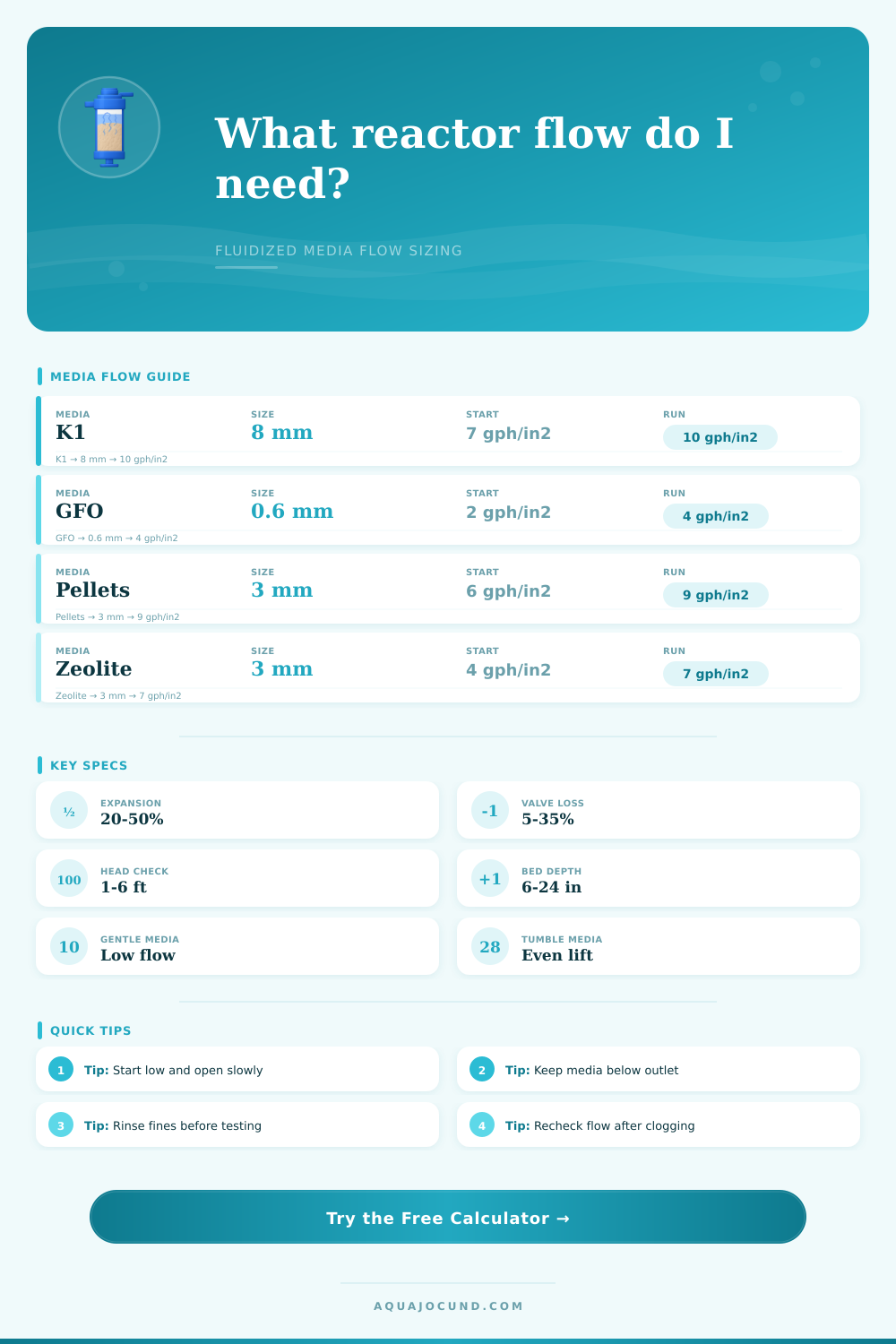
This also means that your system tuning will depend on whether you’re going for aggressive biological filtration or gentle polishing. Particles in fine sand or GFO are delicate; they may require only two gallons per hour per square inch of cross-sectional area. On the other hand, larger Hel X pieces or K media is quite sturdy and will withstand a lot more velocity before falling apart. These large bits need some turbulence to break off old biofilm so their fresh surface area is exposed to moving water. Don’t use light treatment with large K media as if it were delicate GFO, you’ll be starving the good bacteria living within each plastic bead while wasting your pumps potential.
As you can see from the table below, size and density change the necessary flow rates dramaticly. For example, zeolite chips will need just the right amount of lift to be fluidized but not too much than to abrade one another. Likewise, activated carbon is finicky at first. When new, it produces fines that need to flush through your system. You want to treat this with kid gloves and give it time for those dust particle to wash out.
Knowing these things allows you to understand that one flow rate does not fit all reactors. Open your valve slowly and start low. You’ll know when it’s right because water rises evenly throughout the width of the column, not one big jet up the center. If it channels, then you’ve got poor media distribution or incorrect flow. There is no calculator that can perfectly predict what will happen when your unevenly packed media interacts in your particular set-up. When all the grains are floating free but still won’t hit the top screen, congratulations; you’re on your way.
It’s all an art form after that as you adjust based off both biological necessity and mechanical limitations. What does all this mean? Simply, provide those suspended bits with just enough movement to perform their function well. Too much and they’ll fall apart. Not enough and they’ll go stale. Achieving the balance changes a static column of sand or plastic into a living filtration system.
So you would of wondered whether your media was performing. Now you know, it’s suspended.