🧪 Flubendazole Dose Calculator
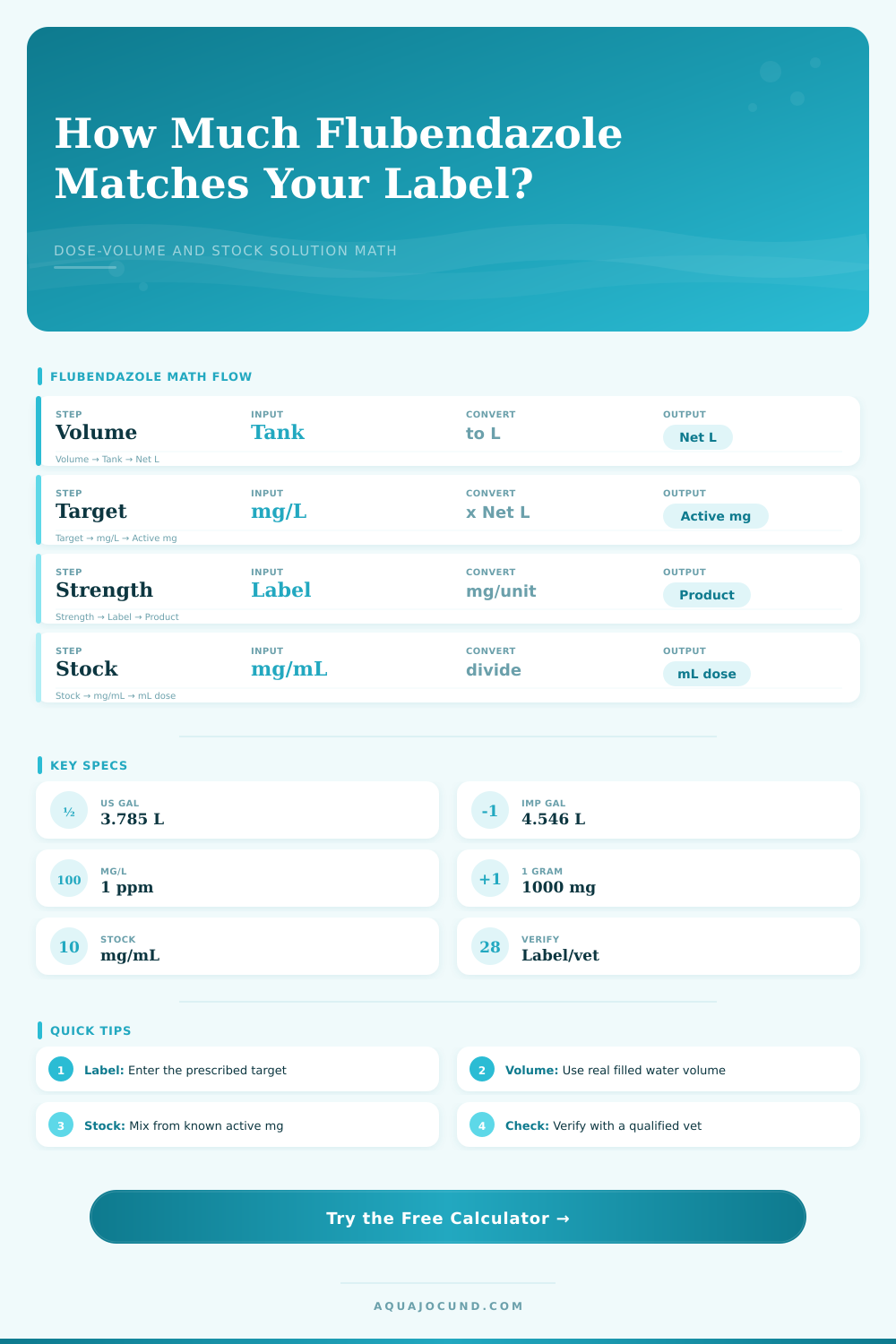
Convert aquarium water volume, label or veterinarian target, product strength, stock solution, displacement, and schedule entries into neutral dose math.
| Strength entry type | What the number means | Product amount formula | Verification point |
|---|---|---|---|
| Percent active by weight | Active percent printed on dry powder or premix | Product g = active mg / (percent / 100) / 1000 | Confirm percent is active flubendazole, not total medication blend. |
| mg/g dry blend | Milligrams active ingredient in each gram of product | Product g = active mg / mg per g | Use label active ingredient per gram, not scoop size alone. |
| Unit tablets or packets | Milligrams active ingredient in one tablet, capsule, or packet | Units = active mg / mg per unit | Verify whether the label permits splitting measured units. |
| Stock mg/mL | Milligrams active ingredient in each mL of prepared stock | Stock mL = active mg / stock mg per mL | Use final solution volume and account for dead volume. |
| Tank size | Typical inside dimensions | Nominal volume | Active mg at 1 mg/L after 10% displacement |
|---|---|---|---|
| 5 gal desktop | 16 in x 8 in x 10 in / 41 x 20 x 25 cm | 18.9 L / 5.0 gal | 17.0 mg active |
| 10 gal standard | 20 in x 10 in x 12 in / 51 x 25 x 30 cm | 37.9 L / 10.0 gal | 34.1 mg active |
| 20 long | 30 in x 12 in x 12 in / 76 x 30 x 30 cm | 75.7 L / 20.0 gal | 68.1 mg active |
| 40 breeder | 36 in x 18 in x 16 in / 91 x 46 x 41 cm | 151 L / 40 gal | 136 mg active |
| 75 gal display | 48 in x 18 in x 21 in / 122 x 46 x 53 cm | 284 L / 75 gal | 256 mg active |
| 125 gal display | 72 in x 18 in x 21 in / 183 x 46 x 53 cm | 473 L / 125 gal | 426 mg active |
| Conversion | Exact math used | Where it appears | Why it matters |
|---|---|---|---|
| US gallons to liters | 1 gal = 3.785411784 L | Direct volume and result cards | Target concentration is entered as mg/L, so volume is calculated in liters. |
| Cubic inches to gallons | 1 cu in = 0.004329 gal | Rectangle, cube, cylinder, and bow front shapes | Inside dimensions convert to water capacity before displacement. |
| Cubic centimeters to liters | 1000 cu cm = 1 L | Metric dimension mode | Metric tank dimensions already resolve directly to liters. |
| mg/L to ppm | 1 mg/L = 1 ppm in water | Target concentration input | Many labels and lab notes use ppm and mg/L interchangeably for water math. |
| Gram to milligram | 1 g = 1000 mg | Dry product strength conversions | Active ingredient targets are calculated in mg before converting to grams. |
So there’s this awesome weapon for our aquarium battles with tenacious parasites: flubendazole. However, don’t use it casually. You’ll come up short on the math for administering it proper; there isn’t much room for error. Underdose? Your parasite get stronger. Overdose? Crash your biofilter and harm your livestock. It’s a fine balancing act where precise calculations is necessary, not estimates.
After you plug in variables, the calculator does the math for you. You will no longer have to guess at concentrations or convert between unit.
How to Use the Flubendazole Calculator
I think one of the biggest errors that hobbyists make are using the nominal volume listed on tank. This value represent what they hope is inside their tank, which isn’t true if it’s a living system. There is sand, rocks, filters, and yes, even fish that take up water. So if you dose your tank for 50 gallons but only have 40 gallons because it has lots of hardscape, now you’ve just bumped up your concentration by 25%. That’s a hefty bump that can potentially be stressful to sensitive species. The displacement percentage lets you account for this non-water space, making sure that the active ingredient goes into only water that your fish are actualy in.
You should also know what form your product comes in. For home aquarium, flubendazole isn’t usually available as a pure active ingredient. More commonly, it is encapsulated in a tablet or premixed in combination with inert carriers. So how do you read the label? Are they selling five percent active? That means you need 20x the weight of the tablet compared to pure powder. How many times have we heard of someone using a whole tablet, even though the tablet’s total weight is the same as amount of pure active ingredient? Big mistake. Look at specific number of milligrams per gram or per unit of whatever you are buying (active ingredient). The reference table provided with this tool explains all these different strengths. This will help you distinguish between the weight of the medicine vs. It is the weight of the package itself. It seems like a small distinction, but boy does it make a difference.
Another source of confusion that leads to error is volume conversion. Most dosing instructions are provided in a metric system using milligrams/liter. In water, this is numerically equal to parts per million. That’s because it’s a handy shorthand for expressing concentration. But most tanks is purchased in gallons. A US gallon is roughly 3.785 liters. So if you don’t remember to convert the tank volume prior to using desired dose rate… then your dose will be nearly four times too large! The calculator automatically makes this conversion. It just works whether you use metric or imperial measurements, you won’t need to keep multiple conversion factors in your noggin’ as you fill up your syringes.
For large tanks, using stock solutions can simplifies dosing. A stock solution is a liquid concentrate made by dissolving a measured amount of the active ingredient in a known volume of solvent. It’s much easier to dose accurately from a stock solution rather than weighing out a few milligrams of powder each time you want to treat. But you have to consider the dead volume. When you mix up a stock solution some of it will always be left behind in the mixing jar or on the syringe. If you don’t compensate for that lost solution, then you’re not giving as much as intended. The calculator has a field where you can enter how much gets lost to ensure the final dose matches what you intended.
Volume is only part of the story; timing is also critical. Flukes and other parasites follow life cycles which include more than one treatment to break their cycle. For example, a treatment may kill adult flukes without harming the eggs. This means you must do another dose after a water change to target the new larval forms which will have hatched by then. Using the schedule module lets you set up this timeline. It takes into account how much water you change and how it reduces the concentration. It determines if you should dose again with the entire amount or just add enough back to make up for what was lost.
The bottom line: This is a risk management tool. I am not saying you shouldn’t use flubendazole. That is a decision for the label or a vet. What I am saying is that if you go ahead with it, then we want to make sure the math checks out. Having accurate values for active strength and dose volume is what separates a successful treatment from an aquatic accident. If you enter the right information into the numbers, they will tell the truth. You should of used this tool earlier.